Benjamin Netanyahu just went to war with a diplomatic body chaired by Donald Trump. Think about that for a second.
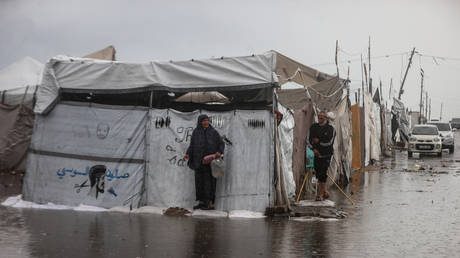
In November 2026, Trump’s U.S.-led Board of Peace publicly called out Israel for dragging its feet on emergency humanitarian deliveries while severe winter flooding swamped displacement camps across Gaza. Netanyahu didn't quietly absorb the blow or issue a polite diplomatic dodge. His office fired right back, denying responsibility for the crisis and pinning the entire mess on Hamas.
Most headlines frame this clash as a simple spat over aid trucks and winter tarps. That's completely missing the point. What you're actually watching is a high-stakes collision over who controls Gaza's post-war transition, how Hamas gets disarmed, and whether a weakened caretaker prime minister can stall the White House until a new Israeli government takes over.
The Public Blowup Over Winter Flooding in Gaza
The trigger was brutal weather meeting broken infrastructure. Heavy November rains turned tent cities and damaged neighborhoods in the Gaza Strip into flooded sewage traps. Tens of thousands of displaced Palestinians were left wading through contaminated water because years of war had obliterated local drainage and sewage lines.
Trump’s Board of Peace—the international oversight body established under his 20-point Gaza plan and backed by UN Security Council Resolution 2803—lost patience. The board blamed Israel for failing to facilitate urgent humanitarian deliveries and heavy equipment needed to prevent a full-blown winter disaster.
Netanyahu’s office hit back hard on November 10, 2026. In an unusually pointed public statement, the Prime Minister’s Office rejected the board's criticism and insisted Israel was working closely with Washington to execute a massive winterization effort through COGAT, Israel’s military-civilian coordination agency.
To back up his pushback, Netanyahu rattled off a specific set of numbers:
- More than 91,000 tents delivered into the enclave
- Over 8,200 trucks carrying tarpaulins, blankets, and winter clothing
- 12 vacuum trucks brought in specifically to pump and remove raw sewage
- Ongoing repairs to water networks alongside fuel shipments for pumping stations
Then came the real punchline. Netanyahu accused Hamas of exploiting humanitarian supplies and dual-use construction materials to rebuild its terror tunnels and military capabilities. In his framing, Gaza isn't drowning because of Israeli border restrictions. It's stuck in ruin because Hamas refuses to hand over its guns.
Why This Fight Isn't Really About Tents or Tarps
If you take Netanyahu’s press release at face value, this looks like a logistics argument. It isn't. The dispute over winter aid is just the surface tremor of a much deeper structural freeze in Trump's Gaza roadmap.
Back in July 2026, Hamas signed onto a 15-point disarmament roadmap brokered through the Board of Peace. Under that framework, Hamas agreed to gradually decommission its weapons in stages linked to a phased withdrawal of Israeli troops.
Netanyahu flatly rejected that sequence. His position hasn't budged an inch: zero Israeli military withdrawals until Hamas surrenders every single weapon—heavy rockets, small arms, tunnels, everything—up front.
Because Netanyahu refuses to accept phased reciprocity, he has effectively frozen the operational rollout of the Board of Peace. You can't separate humanitarian aid from governance when the same border gates control both. By blocking the board’s governing and security mechanisms from deploying on the ground, Israel has kept Gaza in a state of suspended animation.
A November 2026 assessment by the Middle East Institute laid bare just how badly the broader 20-point Gaza plan has stalled. Out of 20 core benchmarks, only two have been fully delivered and five partially met. Five are completely stalled, six haven't even started, and territorial control has actually moved backward—with Israeli forces holding roughly 60 to 70 percent of the Strip, up from 53 percent earlier in the ceasefire.
The Six Demands Sitting on Netanyahu’s Desk
Behind closed doors, the friction between Jerusalem and Washington goes way beyond press releases. White House frustration boiled over into direct diplomacy when presidential envoy Jared Kushner phoned Netanyahu in late November to press him on six specific, immediate steps the Board of Peace wants greenlit right now:
- Deploy the International Stabilization Force (ISF): Allow the U.S.-backed multinational peacekeeping force to actually enter Gaza and begin operating.
- Approve base construction: Let heavy construction materials into the Strip so the ISF can build operational bases.
- Train a new Palestinian police force: Permit 4,000 Israeli-vetted Palestinian recruits to exit Gaza for training in Egypt and return to replace Hamas policing.
- Bring in temporary housing: Clear large-scale modular and temporary homes to replace flooded tents before winter peaks.
- Activate the technocratic committee: Allow the Palestinian technocratic administration—the National Committee for the Administration of Gaza—to set up shop in Rafah, starting in an area slated for a new UAE-backed neighborhood.
- Unblock water and health infrastructure gear: Approve restricted materials needed for permanent water sanitation and hospital repairs.
Look at that list. Every single item touches Israel's core security paranoia about dual-use materials. Cement, steel pipes, heavy machinery, and communications gear are essential for temporary housing, sewage plants, and peacekeeping bases. They are also the exact materials Hamas spent two decades diverting into underground fortifications.
From Netanyahu’s perspective, letting those materials flood into Gaza before Hamas is totally disarmed repeats the exact mistake Israel made before October 7. From the Board of Peace’s perspective, refusing to let those materials in guarantees humanitarian collapse and leaves Hamas as the only functioning authority in half the Strip. Both arguments have internal logic. That's what makes the deadlock so nasty.
Caretaker Politics and the Eisenkot Factor
There is a massive domestic twist that most casual observers completely miss. Netanyahu isn't even governing with a fresh parliamentary mandate anymore.
In Israel’s October 27, 2026 elections, Netanyahu failed to secure a governing majority. He is currently serving as a caretaker prime minister while opposition leader and former IDF chief Gadi Eisenkot holds the mandate to assemble a new ruling coalition. Eisenkot has already pledged to implement Trump’s Gaza framework once in office.
During a phone call with Trump earlier in November, Netanyahu tried to use his caretaker status as an excuse, arguing he couldn't sign off on major strategic concessions in Gaza while coalition talks were underway. Officials familiar with the call didn't buy it for a second, pointing out that Netanyahu had no problem authorizing major military operations against Iran while wearing the exact same caretaker hat.
What is really happening is political survival. Netanyahu is walking a tightrope between two incompatible forces:
- His right-wing base and outgoing coalition partners: Figures like Finance Minister Bezalel Smotrich and Defense Minister Israel Katz have fiercely opposed ceding territory or empowering any Palestinian governing body in Gaza, with Katz even threatening fresh military offensives to displace residents if Hamas doesn't disarm.
- The Trump White House: Trump views the Board of Peace and his 20-point plan as a signature foreign policy legacy. Publicly defying Trump carries steep diplomatic costs, especially after a U.S. envoy bluntly warned Israel that stalling risked turning the country into a global pariah.
By firing back at the Board of Peace rather than attacking Trump personally, Netanyahu found a clever pressure valve. He gets to praise Trump as a "great friend" while painting the international board around him as naive bureaucrats who don't understand Hamas's tunnel network. And if he ends up leading the opposition in a few weeks, he preserves his credentials as the guy who never blinked.
The Uncomfortable Paradox Nobody Wants to Admit
Here is the truth that neither side's talking points will tell you. Both Netanyahu and the Board of Peace are trapped in a sequencing paradox with no clean exit.
If you follow the Board of Peace’s approach—opening the taps on reconstruction gear, modular housing, and international funding while Hamas still holds weapons—you run a very real risk that Hamas taxes the aid, infiltrates local distribution, and uses the breathing room to rearm. International peacekeepers from partner nations aren't going to fight street-by-street battles against Hamas militants to confiscate hidden rifles.
On the flip side, if you follow Netanyahu’s approach—blocking reconstruction and delaying the technocratic administration until Hamas voluntarily hands over every last Kalashnikov—you ensure that Hamas never disarms at all. Why would an armed group surrender its only leverage while the territory remains under indefinite Israeli military occupation with zero political horizon? Meanwhile, two million civilians sit in flooded tents, breeding the exact desperation that fuels future recruitment.
How to Track What Actually Matters Next
If you want to cut through the spin coming out of Jerusalem and Washington over the next few weeks, ignore the dueling press releases about tent counts and diplomatic warmth. Watch three concrete indicators instead:
- The 4,000 police recruits: Watch whether Israel actually lets the first batch of vetted Palestinian police trainees cross into Egypt. Words are cheap, and Netanyahu has signaled "willingness" to Kushner before without moving an inch. Movement at the border crossing is the real tell.
- Gadi Eisenkot’s coalition deadline: Keep an eye on whether Eisenkot successfully locks in his 67-seat coalition. The moment a new Israeli government is sworn in, the White House will demand immediate execution of the Rafah technocratic pilot and ISF base construction.
- Dual-use customs clearances: Track whether COGAT clears heavy engineering equipment and prefabricated housing units, not just food trucks and tarpaulins. Food keeps people alive, but heavy equipment is what actually ends the emergency phase.
Until those three bottlenecks move, every clash between Netanyahu and Trump’s Board of Peace is just noise covering up a basic stalemate over who blinks first on Gaza's future.


