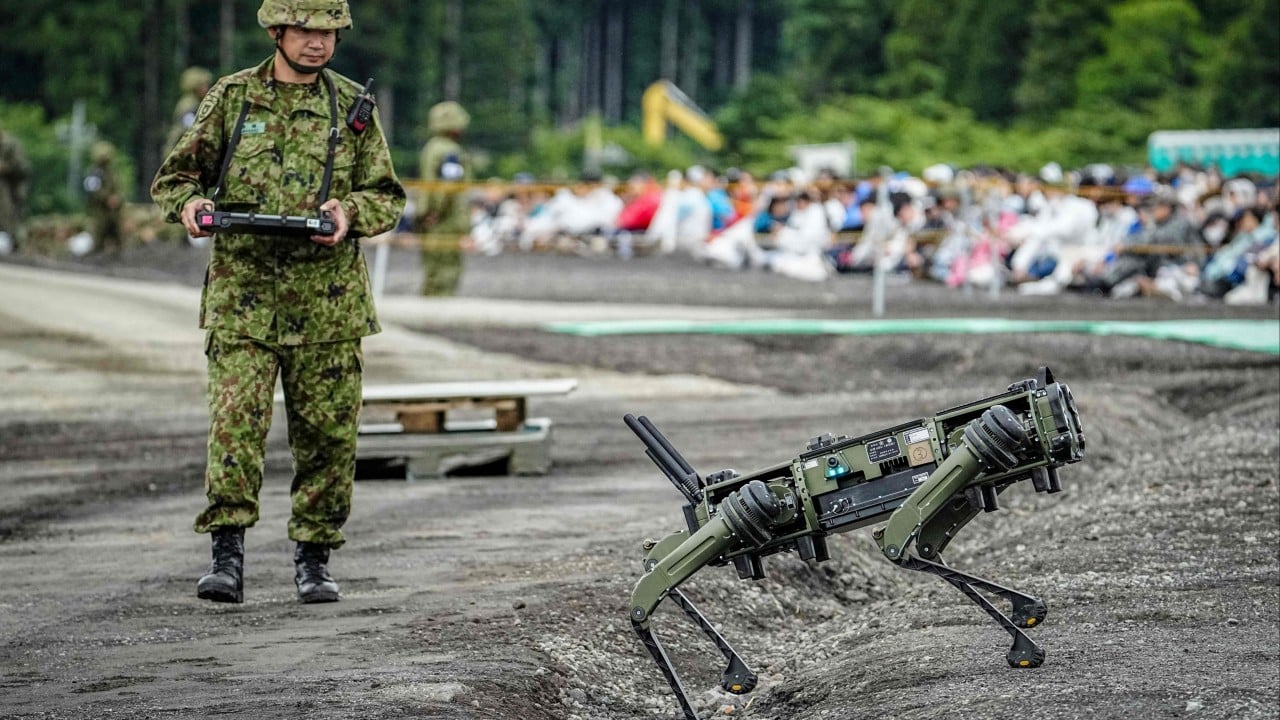
If you still think Japan's military exists purely to wait around and absorb an attack, you are living in the past.
Beijing’s military mouthpieces are sounding the alarm. The PLA Daily, the official newspaper of the Chinese People’s Liberation Army, recently took aim at Japan’s latest large-scale live-fire exercises, explicitly claiming that Tokyo's forces are transitioning to a posture that is more offensive, dangerous, and oriented toward actual combat. North Korea joined the chorus, calling the drills a rehearsal for reinvasion.
But screaming about a return to 1930s Japanese militarism misses the point entirely. The real story isn't that Japan is suddenly itching for an invasion. It is that the line between offense and defense in modern warfare has completely evaporated, and Tokyo is adapting to a brutal security environment faster than anyone expected.
The Illusion of Purely Defensive War
For decades, Japan operated under an exclusively defense-oriented policy. The Self-Defense Forces (SDF) were structured like a shield. If an enemy attacked, the US military was supposed to act as the spear.
That framework is dead. Look at the hardware featured in the Ground Self-Defense Force’s recent drills, like the Type 25 high-speed glide projectile. While Tokyo keeps the exact specs under wraps, regional analysts estimate its range could reach up to 1,000 kilometers. Combine that with the temporary deployment of the American Typhon ground-launched missile system to Kagoshima Prefecture for the Valiant Shield exercises. The Typhon fires Tomahawk cruise missiles capable of striking targets 1,600 kilometers away.
When you are practicing with weapons that can hit targets deep inside mainland China or North Korea from a Japanese launchpad, the word "defense" starts to sound like semantic gymnastics.
The PLA Daily points to this as proof of Japanese aggression. In reality, it is a response to a massive geographical vulnerability. Recent strategic analyses show that land-based air defenses on both sides can only cover limited offshore distances. This creates a massive 300-nautical-mile airspace corridor over the Sea of Japan where Chinese bombers can operate with fewer threats, allowing them to launch standoff missile attacks against Japanese bases.
If Japan cannot threaten those launch platforms before they fire, it cannot defend itself. What critics call a preemptive strike capability is, in the minds of Tokyo’s planners, the only way to make deterrence credible.
What is Actually Happening on the Remote Islands
The centerpiece of these controversial exercises is always the same scenario: defending and retaking remote islands. Beijing frames this as a pretext for regional power projection. But if you look at how the SDF is actually deploying its newest assets, it looks less like an invasion force and more like a high-tech fortress.
Instead of building massive amphibious fleets to conquer new territory, Japan is focusing on anti-access/area denial (A2/AD). They are buying unmanned systems and mobile missile launchers. For instance, the US Marines just completed a more permanent deployment of the Navy-Marine Expeditionary Ship Interdiction System (NMESIS)—an unmanned surface-to-ship missile launcher—and the Marine Air Defense Integrated System (MADIS) to Okinawa.
The goal isn't to sail to China. The goal is to make the waters surrounding Japan completely lethal to any entering fleet.
This creates a paradox that driving-seat critics love to exploit. To keep a hostile navy away from your islands, you need long-range anti-ship missiles. To stop a missile battery on the mainland from obliterating your airfields, you need counterstrike capabilities that can take out those batteries. Every single weapon required to hold a defensive line in 2026 looks identical to a weapon used to start a fight.
The Real Escalation is the Integration
The aspect of these drills that truly rattles Beijing isn't just the Japanese hardware. It is how tightly that hardware is being stitched into the US military machine.
During the latest war games, Japan didn't just fire missiles on its own turf. It launched an anti-ship missile from its own forces roughly 46 miles off the coast of the Philippines, successfully striking a decommissioned ship facing the South China Sea. The drill involved more than 17,000 troops from the US, Australia, the Philippines, and Japan.
This level of allied integration makes it impossible for an adversary to isolate Japan in a crisis. The PLA Daily frames this as Japan becoming a powder keg for the Asia-Pacific. A more accurate reading is that Japan is intentionally blurring the lines of its alliance. If a conflict breaks out in the Taiwan Strait or the South China Sea, the infrastructure, missile systems, and command structures tested in these drills are already functionally unified.
Your Next Steps for Following This Security Shift
To truly understand where this regional tension is heading, stop watching the political speeches and start tracking the budget lines and deployment zones. Here is how to keep tabs on the actual shift:
- Watch the Ammunition Depots: Japan is currently building dozens of insulated ammunition depots across its southwestern islands to store these new long-range missiles. Where those depots go tells you exactly where Tokyo expects a flashpoint.
- Track the Constitutional Debate: Prime Minister Sanae Takaichi and the current Cabinet are pushing harder than ever for constitutional revisions regarding the SDF. Watch whether they formally drop the "exclusively defense-oriented" language or simply redefine it out of existence.
- Monitor Joint Logistics: The real test of military capability isn't firing a missile; it is rearming a launcher under fire. Keep an eye on upcoming joint US-Japan exercises that focus on logistics and supply line resilience in the First Island Chain.
The era of Japan as a passive military actor is over, but not because Tokyo wants a war. In a region where the speed of a missile dictates the terms of survival, waiting to be hit is no longer a viable defense strategy.
For a deeper dive into how these regional dynamics are playing out on the water, you can watch this breakdown of the latest joint maneuvers: Japan, US Lead Live Fire Drills in Major Indo Pacific Exercise. This report details the specific anti-ship missile tests conducted near the Philippines and provides context on how regional neighbors are reacting to the sheer scale of the allied exercises.