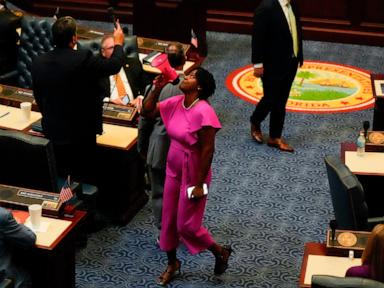
Political upsets always shock the establishment because they refuse to watch what is actually happening on the ground. When Florida state representative Angie Nixon secured the Democratic nomination for the U.S. Senate, national pundits acted like it came out of nowhere. It didn't.
If you spent any time listening to working-class families across Duval County and other urban centers, the writing was already on the wall. Nixon, a progressive who recently aligned with the Democratic Socialists of America, managed to crush her heavily funded opponent, former Army lieutenant colonel Alex Vindman. She pulled off a double-digit victory despite being outspent by staggering margins.
People want to know if she can pull off the impossible in November against Republican incumbent Ashley Moody. To understand that, you have to look past standard party math and examine how this primary actually shifted the rules of engagement.
The Money Trap And Grassroots Reality
Vindman had millions. He brought massive national name recognition from his prominent role as a witness during Donald Trump's first impeachment, along with deep-pocketed institutional backing from Washington insiders. He raised over sixteen million dollars. Nixon barely cleared the one-million-dollar mark.
In traditional political logic, Vindman should have walked away with the seat. But cash doesn't knock on doors. Volunteers do.
Nixon built an active coalition relying on labor networks, community organizers, and energized younger voters who are exhausted by the status quo. While her opponent operated like a national candidate trying to appeal to everyone from a distance, Nixon leaned into her local roots. She reminded voters of her hyper-visible legislative fights, including her high-profile protests against gerrymandered congressional maps in Tallahassee.
Voters bought into her message because it addressed material needs. She talked about affordable housing, fully funded public education, and healthcare access—topics that hit home immediately for struggling families.
Can A Progressive Win A Statewide General Election In Florida?
Let's be completely honest. The road ahead for Nixon is brutally steep. Florida has drifted rightward over recent election cycles, and Republicans hold a firm grip on statewide infrastructure. Moody enters the general election with enormous advantages.
Yet dismissing Nixon outright ignores how she won the primary. She didn't just win in deep-blue pockets; she performed exceptionally well in diverse urban neighborhoods and captured massive support among younger demographics who usually sit out primaries.
Traditional strategists always claim that progressive candidates are radioactive in the Sunshine State, pointing to the sizable immigrant populations who fled left-wing authoritarian regimes abroad. But Nixon sidestepped standard ideological traps by focusing intensely on economic populism. Her campaign proved that everyday people respond when someone speaks directly to the cost of living rather than playing standard Beltway politics.
If she wants to make history as the first Black lawmaker elected to represent Florida in the U.S. Senate, her team has to scale up that exact grassroots energy statewide. It means keeping volunteers motivated, turning out low-propensity voters, and forcing a debate on economic issues that Republicans prefer to dodge.
Stop looking at old playbook rules. The political ground underneath Florida is shifting, and November will show just how far that earthquake reaches.