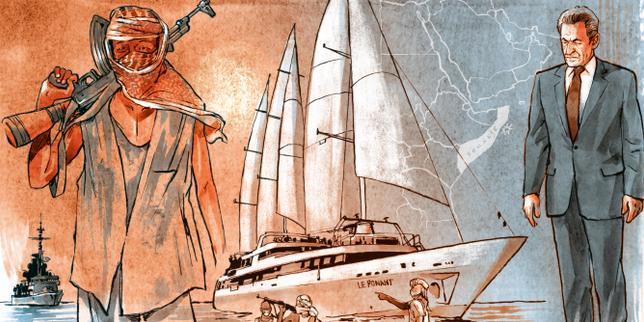
When Somali pirates boarded the luxury three-masted cruise yacht Le Ponant on April 4, 2008, they didn't just kick off a high-stakes hostage rescue. They inadvertently triggered a massive geopolitical showdown between the French government and one of the world's largest shipping conglomerates.
If you remember the headlines from back then, the story seemed simple. Pirates seized a ship, a French billionaire company paid a massive ransom, and French special forces swept in like movie heroes to bust the bad guys in the desert. It looked like a win for everyone except the pirates.
That narrative is completely wrong.
Beneath the heroic press conferences orchestrated by French President Nicolas Sarkozy, a fierce, quiet war was being waged over who actually holds power during a sovereign crisis: the state or a private corporation. CMA CGM, the shipping giant that owned Le Ponant, essentially hijacked the state's diplomatic authority by cutting its own deal with criminals. It set a dangerous precedent that altered maritime security forever.
The Illusion of State Control in the Gulf of Aden
When the pirates took the ship's 30 crew members hostage in the Gulf of Aden, the French military response was swift and heavy. Operation Thalathine was launched. The French navy deployed a missile frigate, a helicopter carrier, and dispatched elite commandos from the GIGN and the naval special forces unit Commando Hubert.
On paper, the state was running the show. In reality, they were completely blindfolded by the shipowner's checkbook.
France has a strict, unyielding public policy: the state does not pay ransoms to terrorists or pirates. Doing so funds future attacks and puts a target on every French citizen traveling abroad. Sarkozy wanted to project absolute state power. He authorized a military blockade to track Le Ponant as it anchored off the coast of Somalia. The commandos were parachuted into the ocean, ready to launch a bloody, high-risk assault to retake the vessel by force.
But CMA CGM had a completely different priority. They didn't care about French geopolitical prestige or international law. They cared about the lives of their crew and the preservation of their multimillion-dollar luxury asset.
How a Private Armateur Contested Sovereign Power
While French military officials were drawing up tactical assault plans on the deck of the frigate Jean Bart, executives at CMA CGM were quietly setting up an independent satellite communication link directly with the pirate leaders.
The private shipowner bypassed the state's command structure entirely. They hired private security consultants and rapidly negotiated a 2.1 million dollar cash ransom.
This move directly undermined the authority of the French government. By negotiating independently, CMA CGM effectively told the state that its laws, its military strategies, and its sovereign prerogatives were secondary to private corporate interests. The armateur treated the hostage situation not as a international crime or a violation of national sovereignty, but as a standard, insurable business loss.
When the French government realized a ransom drop was imminent, they were furious. If they launched an assault while a private deal was being made, they risked a bloodbath that would be blamed entirely on the military. The state was forced to back down and let a private entity dictate the terms of engagement with foreign criminals.
The cash was dropped into the ocean in waterproof bags from a private aircraft. The pirates counted the money, released the 30 hostages, and fled into the Somali desert.
The Desert Raid to Save Face
What happened next was pure political damage control. Once the hostages were safely aboard French naval vessels, the state finally reclaimed its monopoly on violence.
Sarkozy could not let the story end with a private company buying off pirates. French military helicopters tracked the fleeing pirate convoy into the desert village of Jariban. Elite snipers shot out the engine block of the pirates' 4x4 getaway vehicle from a moving helicopter. Commandos swarmed the ground, capturing six of the pirates and recovering a portion of the corporate ransom money.
French Hostage Crisis Timeline (April 2008)
-------------------------------------------
April 4: Pirates hijack Le Ponant in the Gulf of Aden.
April 5-10: CMA CGM bypasses state channels to negotiate a $2.1M ransom.
April 11: Ransom paid; 30 hostages freed; French military launches desert raid to capture six pirates.
The subsequent trial of those six pirates in Paris became a media circus. The French judicial system treated them as common thieves, trying to project an image of absolute law and order. But the damage to state prestige was already done. The trial couldn't obscure the fact that the French military had essentially acted as the clean-up crew for a private corporate transaction.
The Lasting Legacy of Private Maritime Security
The Le Ponant incident changed the rules of global shipping. It proved to maritime corporations that they could no longer rely solely on the slow, politically complicated apparatus of state navies to protect their trade routes.
Following the 2008 crisis, the shipping industry underwent a massive structural shift. Instead of pleading for naval escorts, major armateurs began bypassing state protections altogether by directly hiring Private Maritime Security Companies (PMSCs). Armed mercenaries, often consisting of former British, American, and French special forces operators, became standard fixtures on commercial vessels transiting the Indian Ocean.
This privatization of maritime security created a strange, grey-market economy where private corporations wielded lethal force on the high seas, completely independent of any national flag or international oversight. The state's traditional monopoly on maritime defense was fragmented, all because a single shipowner decided that writing a check was faster than waiting for a government to act.
If you are tracking modern supply chain risks or maritime law, you need to understand that the erosion of state authority didn't start with modern drone strikes or cyber warfare. It started in 2008, in the waters off Somalia, when a private company decided that sovereign policy was just another negotiable line item on a corporate balance sheet. To protect your own operations today, look closely at your insurance policies' Kidnap and Ransom (K&R) clauses—because when a crisis hits the high seas, history shows the corporate legal team often moves a lot faster than the navy.
For a deeper look into the tactical reality of this standoff, you can watch this breakdown of Opération Thalatine which details exactly how the special forces units had to coordinate around the corporate ransom timeline.