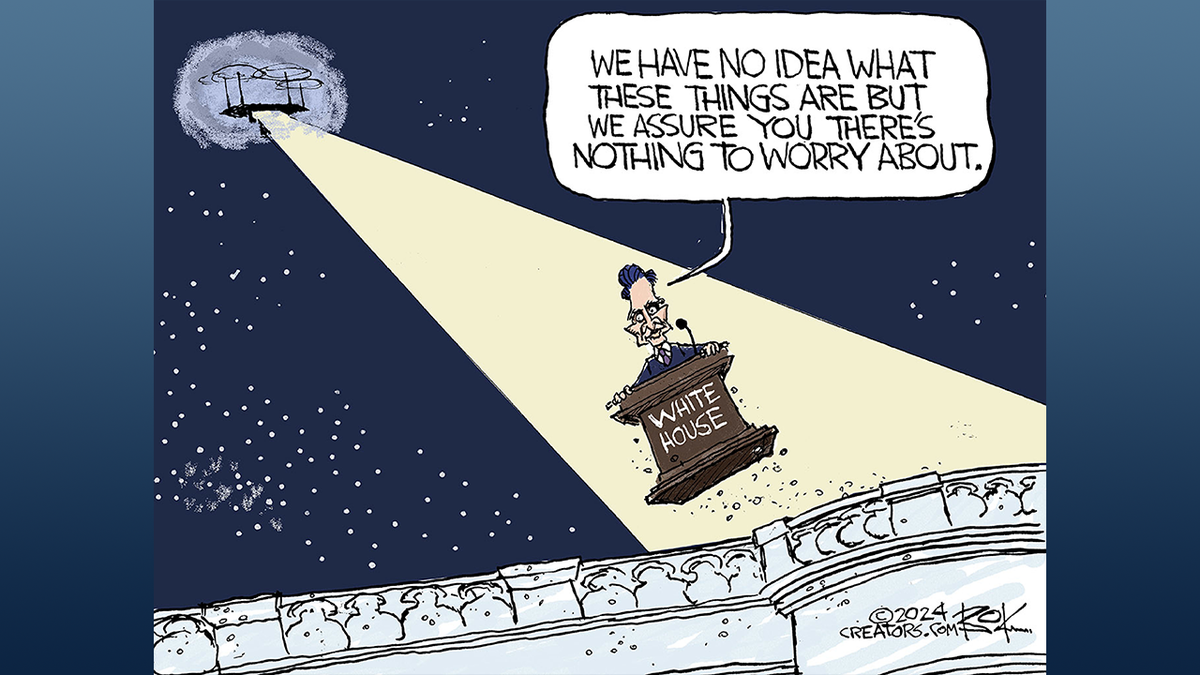
The national security establishment is panicking over toys. Reports of unidentified drones buzzing Joint Base Langley-Eustis—the very doorstep of the Secretary of Defense—have sent the beltway into a tailspin of "unidentified aerial phenomena" hysteria and "security breach" hand-wringing. The legacy media frames this as a terrifying mystery of foreign subversion or a massive technological gap. They are wrong.
This isn’t a failure of radar. It isn’t a failure of high-tech interceptors. It is a failure of the legal and bureaucratic imagination. We are watching the world’s most expensive military get checkmated by $1,500 worth of carbon fiber and lithium-polymer batteries because they are too afraid of their own lawyers to pull the trigger.
The Myth of the Ghost Drone
The "mystery" of these drones is a convenient fiction. When a swarm of small Unmanned Aircraft Systems (sUAS) hovers over a sensitive site for weeks, the military knows exactly what they are: off-the-shelf or slightly modified commercial tech being used to test response times, signal signatures, and—most importantly—political willpower.
The Hindustan Times and other outlets treat these incursions as a "breach" of the base. In reality, the breach happened years ago in the halls of Congress and the FAA. The U.S. military is currently operating with one hand tied behind its back by Title 10 and Title 50 restrictions that make kinetic engagement over domestic soil a legal nightmare. While the Pentagon waits for a signed memo from three different departments, the drone has already finished its surveillance loop and landed in the back of a moving SUV five miles away.
Why Your "Advanced" Radar is Blind
Conventional wisdom suggests we need "better sensors." That’s a lie sold by defense contractors looking for a fresh billion-dollar infusion. We have the sensors. The problem is physics and signal processing.
Most military-grade radar is designed to ignore "clutter"—birds, weather, and small objects moving at low speeds. It is tuned to find a Su-57 at 40,000 feet, not a DJI Mavic 3 at 400 feet. If you turn up the sensitivity to catch the drone, the screen becomes a blizzard of noise.
- Size-to-Signature Ratio: A small drone has a Radar Cross Section (RCS) similar to a large bird.
- Frequency Hopping: Modern commercial drones use sophisticated spread-spectrum tech that blends into the background noise of a populated area like Hampton Roads.
- The "Wait and See" Protocol: Rules of Engagement (ROE) currently favor de-escalation. By the time an officer confirms a drone is a threat and not a hobbyist who took a wrong turn, the window for electronic warfare (EW) jamming has closed.
The Lawyers Are the Real Air Defense
I have sat in rooms where commanders were more afraid of the FAA’s reaction to a jammed GPS signal than they were of a foreign adversary’s camera. This is the "lazy consensus" of modern defense: the idea that we must maintain perfect civilian regulatory harmony even when a base is being actively probed.
Under current U.S. law, shooting a drone out of the sky—even over a military base—can be interpreted as a violation of the Aircraft Sabotage Act. Jamming the signal can interfere with local cell towers or medical equipment. The adversary knows this. They are using our own commitment to due process and civilian safety as a kinetic shield.
Imagine a scenario where a $500 drone causes a $100 million F-22 Raptor to stay grounded because the risk of a mid-air collision or a sensor malfunction is too high. The adversary didn't need to fire a missile. They just needed a credit card and a Wi-Fi connection. That isn't a "security lapse." That is an asymmetric victory.
The "Symmetric Response" Fallacy
The Pentagon’s instinct is to build a "Counter-UAS" (C-UAS) system that is as expensive and complex as the planes they are protecting. This is a mistake. You don't fight a swarm of mosquitoes with a sniper rifle.
The industry is currently obsessed with directed-energy weapons and high-powered lasers. While these look great in a PowerPoint presentation, they are hampered by atmospheric conditions (fog, rain, smoke) and require massive power draws. More importantly, they are overkill.
The solution isn't more tech; it’s more aggressive policy.
- No-Fly Means No-Fly: Any unauthorized transmission within a five-mile radius of a Tier 1 installation should be met with immediate, automated broad-spectrum jamming. No questions. No memos.
- Kinetic Freedom: If it’s in the wire, it dies. Whether it's a bird-shot-loaded automated turret or a physical interceptor drone, the cost of the "kill" must be lower than the cost of the "threat."
- Liability Immunity: Congress must grant immediate civil and criminal immunity to base commanders who take down drones that stray into restricted airspace.
The Intelligence Value of Being "Annoyed"
The media views these drones as a threat to the Secretary of War’s safety. That’s amateur hour. A drone isn't there to drop a grenade on a VIP; there are much easier ways to do that. These drones are there for Signals Intelligence (SIGINT).
Every time a base goes into "Drone Response Alpha," the adversary records the radio frequencies used, the movement patterns of the security teams, the activation time of the local sensors, and the specific signatures of the response craft. We are giving them a free masterclass in our defensive playbook.
By failing to act decisively, we aren't "observing" the threat. We are being mapped. We are being decoded.
The Cost of Inaction
We have spent decades obsessing over "stealth" in our own aircraft while completely ignoring the "transparency" of our domestic installations. The drone incursions at Langley-Eustis are a loud, buzzing alarm clock.
If a peer competitor can hover a plastic quadcopter over the most sensitive airspace in the country with zero consequence, the concept of "air superiority" is dead. It doesn't matter if you own the sky at 30,000 feet if you’ve lost it at 300.
The military doesn't need a new "drone detection" budget. It needs the guts to ignore the FAA and treat the sky above its bases like the war zone it already is.
Stop asking what these drones are. Start asking why they are still flying.