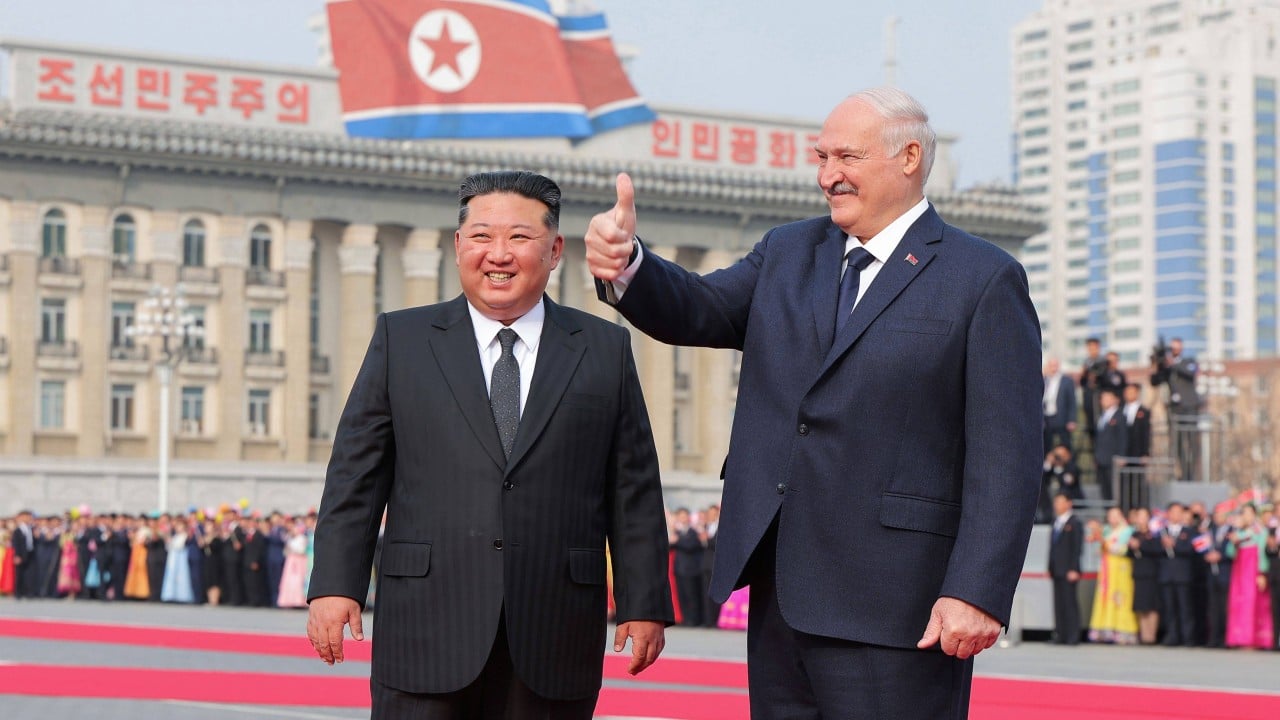
The arrival of Aleksandr Lukashenko in Pyongyang marks more than a diplomatic curiosity between two of the world's most isolated leaders. It is a functional expansion of a burgeoning logistical network designed to bypass Western sanctions. While the official cameras captured the choreographed warmth of Kim Jong-un’s greeting, the real substance of this visit lies in the creation of a three-way military and economic pipeline involving Minsk, Moscow, and Pyongyang. This is not a symbolic gesture. It is a procurement meeting.
For decades, Belarus and North Korea existed in separate spheres of the post-Soviet and Maoist fallout. Today, they are bound by a shared necessity for survival against a global financial system that has locked them out. Lukashenko’s first-ever visit to North Korea serves as the final link in a chain that allows for the seamless movement of labor, military technology, and sanctioned commodities across the Eurasian landmass.
The Artillery Pipeline and the Belarusian Middleman
Russia’s ongoing war in Ukraine has fundamentally altered the value of North Korean sovereignty. Kim Jong-un possesses the one thing Vladimir Putin needs most—massive stockpiles of Soviet-caliber munitions. However, moving those goods and masking the financial trails associated with them requires creative accounting and physical hubs. Belarus, already functioning as a de facto extension of the Russian military apparatus, is the perfect intermediary.
The logic is simple. North Korea provides the raw hardware. Belarus provides the technical modernization and the "civilian" cover for dual-use technologies. By involving Minsk, the Kremlin can diversify its supply routes and use Belarusian firms as front entities for purchasing Western components that North Korea cannot access directly. It is a shell game played with rail cars and shipping containers.
Observers often overlook the sophistication of Belarusian engineering in the heavy machinery sector. Lukashenko isn’t just looking for shells; he is looking for a way to integrate North Korean manufacturing capacity with Belarusian tractor and truck expertise. If they can build a missile TEL (transporter erector launcher) using a Volat chassis and a North Korean engine, they have created a weapon system that is harder to track and easier to mass-produce outside the reach of conventional monitoring.
Exporting Desperation for Hard Currency
Kim Jong-un faces a perennial shortage of foreign exchange. Lukashenko faces a labor shortage caused by political purges and a massive exodus of the Belarusian youth. This visit likely finalized agreements for the "export" of North Korean laborers to Belarusian construction sites and factories.
This arrangement serves both dictators. Pyongyang receives a cut of every dollar earned by its citizens abroad, providing a steady stream of hard currency that bypasses the SWIFT banking system. Minsk receives a disciplined, low-cost workforce that will not protest or join independent trade unions. It is a grim trade in human capital, conducted under the guise of socialist solidarity.
The legal framework for this was laid months ago. By framing these workers as "students" or "technical trainees," both nations hope to skirt United Nations Security Council resolutions that explicitly ban the use of North Korean overseas labor. It is a transparent ruse, but in a world where the UN's enforcement mechanisms are effectively paralyzed by Russian and Chinese vetoes, transparency is no longer a deterrent.
The Nuclear Shadow and Tech Transfer
Perhaps the most alarming aspect of this meeting is the potential for nuclear and missile technology sharing. Belarus recently became a host for Russian tactical nuclear weapons. While Lukashenko does not have "finger on the button" control, his military is now integrated into a nuclear-capable command structure.
North Korea, meanwhile, has mastered the art of miniaturization and solid-fuel delivery systems. There is a terrifying symmetry here. Belarus offers North Korea a back door into European proximity and Russian-adjacent military research. In exchange, North Korea offers the kind of "no-limits" military cooperation that even China remains hesitant to provide.
We are seeing the birth of a specialized industrial complex. This is not about ideology. It is about the commodification of defiance.
A Challenge to the Sanctions Regime
The West has long relied on the "maximum pressure" model to isolate regimes like those in Minsk and Pyongyang. This visit proves that isolation is a relative term. If these three nations—Russia, North Korea, and Belarus—can create a closed-loop economy, the primary tool of Western diplomacy becomes obsolete.
Sanctions only work when the target has no alternatives. By building a parallel trade network that deals in gold, bartered resources, and encrypted digital transfers, Lukashenko and Kim are demonstrating that they can endure indefinitely. They are betting that the West will lose interest or exhaust its stockpiles before they do.
The "why" behind this visit is clear. Lukashenko is securing his position as a vital cog in the new global opposition. He is making himself indispensable to Putin by securing the North Korean flank. Kim, in turn, gains a second European voice (after Russia) to champion his interests on the international stage.
The End of the Post Cold War Order
The imagery of the Pyongyang summit is a deliberate middle finger to the rules-based international order. It signals that the era of "rogue states" is over; they are no longer rogue if they are organized. They are a bloc.
This alliance is built on the cold reality of the battlefield and the spreadsheet. As long as the war in Ukraine continues to burn through resources, the road between Minsk and Pyongyang will remain busy. The trucks moving along those roads carry more than just goods. They carry the blueprint for a world where international law is a suggestion and the only currency that matters is the ability to stay in power.
Check the shipping manifests at the Port of Rason and the rail schedules at the Brest gateway. That is where the real story of this summit will be written, far away from the red carpets and the forced smiles of the state media broadcasts.
Keep a close eye on the sudden appearance of North Korean "agricultural specialists" in the Belarusian countryside. They won't be there to plant potatoes. They will be there to ensure the machinery of this new axis remains well-oiled and hidden from view.