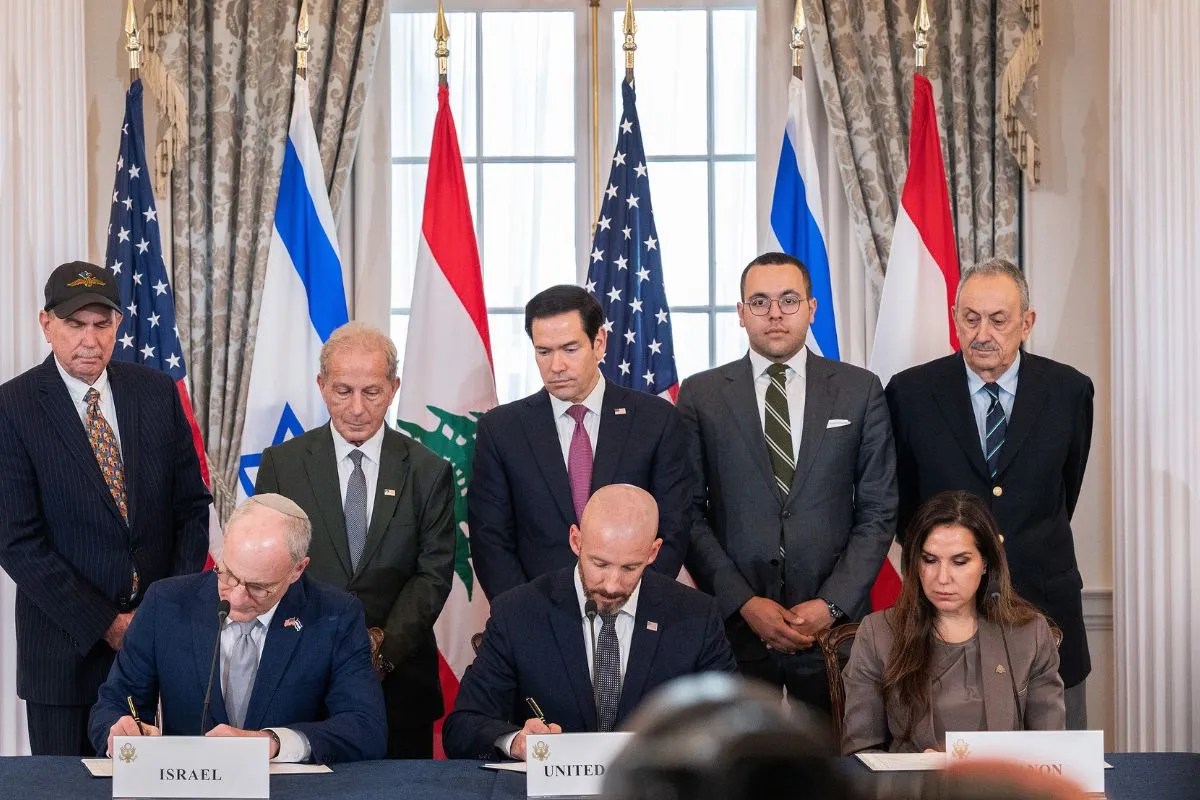
A diplomatic document cannot stop a war when the parties involved are fighting for their survival. The latest US-Israeli 14-point draft proposal aimed at ending hostilities along the Blue Line has collapsed before the ink could dry. Hezbollah officially rejected the terms, warning that enforcing them would trigger a devastating civil war inside Lebanon. The failure of this initiative highlights a stark reality. The Western diplomatic framework treats Hezbollah as a standard state actor that can be pressured into signing away its core geopolitical leverage. It cannot.
By demanding that the group withdraw its forces north of the Litani River and allow international oversight over its domestic weaponry, the draft asked Hezbollah to accept political suicide. For a militia embedded in the Lebanese state fabric, disarmament is not a negotiation point. It is an existential redline. Building on this topic, you can also read: Inside the Pakistan Human Rights Crisis the West Prefers to Ignore.
The Blind Spots of Western Diplomacy
The proposal, heavily backed by Washington, aimed to enforce a strict interpretation of UN Resolution 1701. It sought a zero-tolerance buffer zone between the Israeli border and the Litani River. Security would fall exclusively to the Lebanese Armed Forces (LAF) and the United Nations Interim Force in Lebanon (UNIFIL).
The strategy ignores the internal dynamics of Beirut. The LAF lacks the military teeth and the political will to forcefully disarm a faction that commands a massive, battle-hardened loyalist population. Forcing the national army to act as an enforcement mechanism against Hezbollah would splinter the military along sectarian lines. This is the exact scenario that triggered the 1975 Lebanese Civil War. Experts at The Washington Post have also weighed in on this situation.
Hezbollah’s leadership understands this leverage. When the draft suggested an international mechanism to monitor and audit Lebanese entry points—including airports, seaports, and land borders with Syria—the group viewed it as an attempt to install a foreign security mandate.
The Sovereignty Trap
To understand why this 14-point framework failed, one must examine the specific mechanics of the proposed monitoring committees. The US envisioned a multi-national oversight body led by Western powers to log, track, and verify the movement of goods into Lebanon. The explicit goal was to choke off the supply of Iranian missile components and precision-guided munitions.
From a tactical perspective, the plan makes sense for Israel. It cuts the logistical pipeline. Politically, however, it is dead on arrival in Beirut. No Lebanese prime minister, regardless of how desperate they are for economic aid, can hand over control of national borders to a foreign committee without triggering an immediate mutiny in the cabinet. Hezbollah holds a veto block in the political system. They can paralyze the government by simply walking out of parliament.
The draft also contained a clause allowing Israel freedom of movement in Lebanese airspace for defensive verification. This was a fatal inclusion. No sovereign state can formally sign a treaty that legitimizes the daily violation of its own airspace by a hostile neighbor. It turned a difficult negotiation into an impossible one.
The Reality of the Litani River Buffer
The Litani River is often discussed in diplomatic cables as a clean, geographic line on a map. On the ground, it is an arbitrary boundary cutting through towns, villages, and extended families.
[Litani River Buffer Zone]
========================================= Litani River Line
          |
          |  Proposed LAF / UNIFIL Exclusive Control Area
          |  (Hezbollah demanded to evacuate)
          |
========================================= UN Blue Line (Border)
Moving thousands of anti-tank missile operators and tactical units north of this line requires more than a tactical retreat. It means dismantling a decades-old civilian-military infrastructure. Hezbollah’s fighters in the south do not live in distinct military bases that can be evacuated. They are local residents, farmers, and shopkeepers who store equipment in underground networks beneath their own properties.
A forced evacuation under international supervision would mean uprooting entire Shia communities. This explains why the group's rhetoric shifted rapidly from border defense to a warning about internal sectarian warfare. They are signaling to the Christian, Sunni, and Druze factions in Beirut that any attempt to enforce Western terms will result in the immediate destabilization of the capital.
The Regional Pipeline Remains Untouched
A localized agreement between Israel and Lebanon cannot stand while the broader regional conflict continues to burn. Hezbollah operates as the crown jewel of Iran’s Axis of Resistance. Its actions are explicitly tied to regional calculations, specifically the ongoing war in Gaza and Tehran's wider chess match with Washington.
The US diplomatic approach attempted to decouple the Lebanon front from the Gaza front. This was a major strategic miscalculation. Hezbollah has stated repeatedly that its operations are a secondary front meant to stretch Israeli military resources. Signing a permanent 14-point settlement while Gaza remains unresolved would destroy the group's credibility within the regional alliance. It would signal that the proxy network can be broken apart piece by piece through localized economic and military pressure.
Israel, conversely, faces its own domestic pressures. Tens of thousands of citizens evacuated from northern communities refuse to return home under the constant threat of cross-border rocket fire. The Israeli government cannot accept a cosmetic ceasefire that simply resets the status quo to October 6. They require verifiable structural changes along their northern border.
The Mechanics of a Deadlock
With diplomacy stalled, the options on the table narrow dangerously. The collapse of the draft leaves three distinct tracks, none of which offer a peaceful resolution.
- Sustained War of Attrition: A continuation of targeted strikes, rocket barrages, and localized incursions that systematically destroys the infrastructure of southern Lebanon while keeping northern Israel unlivable.
- Total Conventional Incursion: A full-scale Israeli ground operation designed to physically push hostile forces past the Litani River, bypassing diplomacy entirely through raw military force.
- Domestic Lebanese Implosion: A scenario where economic desperation drives opposition factions in Beirut to actively challenge Hezbollah’s dominance, leading to localized armed clashes inside the country.
The international community continues to treat the Lebanese state as an independent entity capable of bargaining on behalf of its territory. The reality is that the state is an empty shell. The central government cannot collect garbage or keep the electricity running for more than four hours a day, let alone dictate terms to the most powerful non-state military actor in the world.
The 14-point draft failed because it was designed for a world that does not exist. It assumed that a bankrupt state could police a military force stronger than its own national army, and that a regional proxy would prioritize a Western-defined peace over its own structural survival. Until diplomatic efforts acknowledge that the border crisis is an extension of a regional ideological war rather than a simple boundary dispute, every proposed framework will suffer the same fate. They will remain irrelevant pieces of paper drafted in Washington, signed by no one, and completely ignored by the men holding the weapons on the ground.