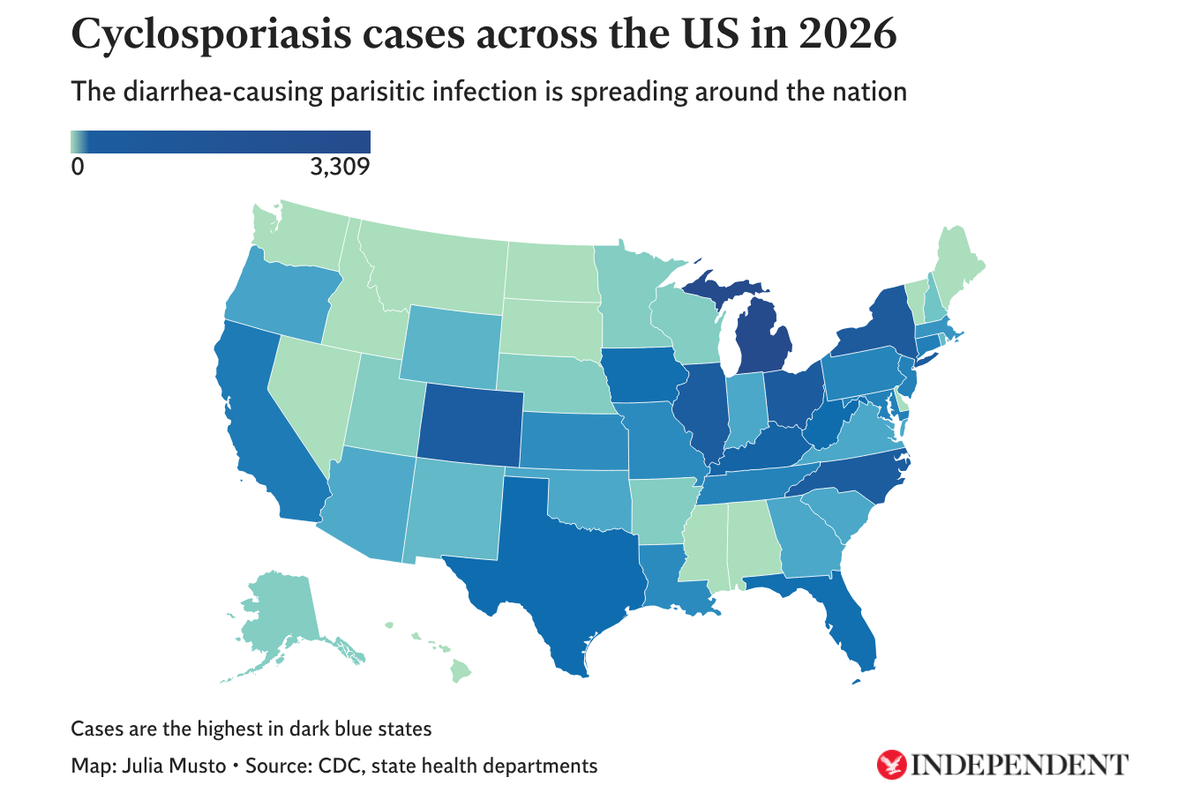
The media is currently having a collective meltdown over a supposed surge of Cyclospora cayetanensis cases across Michigan, New York, and dozens of other states. Headlines warn of a terrifying, stealthy parasite causing weeks of explosive diarrhea. They offer the same tired, useless advice: wash your hands, scrub your lettuce, and avoid questionable salad bars.
It is a classic public health panic. It is also entirely wrong.
We are not experiencing a sudden, terrifying biological invasion. We are experiencing a predictable diagnostic feedback loop. The "soaring" numbers do not reflect a sudden failure of agricultural sanitation; they reflect a massive shift in how clinical laboratories process human stool.
If you actually understand the clinical diagnostic pipeline, the unique biology of this parasite, and the economics of our global food supply chain, you quickly realize that the public health warnings are a performance. They exist to cover up regulatory failures and shift the burden of safety onto consumers who are powerless to prevent infection.
The Multiplex PCR Illusion
To understand why the headlines are lying to you, you have to look at how medical diagnostics have changed over the last decade.
Historically, if you went to an urgent care or emergency room with severe diarrhea, a doctor might have ordered an "Ova and Parasite" (O&P) exam. This test required a human lab technician to look at your stool sample under a microscope. But Cyclospora oocysts are notorious mimics. Under standard light microscopy, they look almost identical to yeast cells or other benign organic debris.
To actually find Cyclospora, a lab had to perform a highly specific, time-consuming modified acid-fast stain or use ultraviolet fluorescence microscopy. Because these tests were expensive, tedious, and required specialized training, doctors rarely ordered them unless you had a highly specific travel history to an endemic country. Consequently, thousands of Cyclospora infections went completely undiagnosed every single year, dismissed as a generic "stomach flu."
Then came syndromic multiplex PCR testing.
Today, clinical laboratories use automated molecular panels—such as the BioFire FilmArray Gastrointestinal Panel. Instead of a lab tech hunting under a microscope, a machine amplifies the DNA of 22 different pathogens simultaneously from a single stool swab. Cyclospora cayetanensis is on that panel.
Look at how the diagnostic pipeline shifted:
| Era | Diagnostic Method | Probability of Detection | Reported Cases |
|---|---|---|---|
| Pre-2015 | Manual O&P microscopy / Acid-fast staining | Extremely Low (Only tested on demand) | Artificially Low |
| Post-2015 (Current) | Multiplex PCR Gastrointestinal Panels | Extremely High (Tested automatically) | "Soaring" |
We are not seeing a massive increase in people getting sick. We are seeing a massive increase in doctors running PCR panels on people who were already getting sick anyway. The parasite was always there, circulating silently in our globalized food supply. We just finally bought the flashlights needed to see it, and now we are screaming about the dark.
The Biological Fact Public Health Ignores
Every summer, health departments issue infographics telling people to wash their hands to prevent the spread of Cyclospora. This advice is biologically illiterate.
Cyclospora cayetanensis is an obligate coccidian parasite. But unlike bacteria or viruses, it is not infectious when it first leaves the human body.
When an infected farmworker or consumer excretes Cyclospora oocysts, those oocysts are unsporulated. In this state, they cannot infect anyone. They require days, sometimes weeks, in the external environment under specific temperature and humidity conditions to undergo sporulation. Only sporulated oocysts can cause disease.
This simple biological fact has two massive implications that public health officials refuse to emphasize:
- Direct person-to-person transmission is functionally impossible. You cannot catch Cyclospora because your coworker did not wash their hands after using the bathroom. You cannot catch it from changing a diaper.
- It is strictly an environmental and agricultural issue. The contamination happens at the farm level, weeks before the food ever reaches your grocery store shelf.
By telling consumers to wash their hands to stop "outbreaks," health departments are shifting the blame from systemic agricultural failures to individual hygiene. It is a brilliant PR move for regulators, but it is scientifically bankrupt.
The Salad Washing Ritual is a Lie
If you think running your pre-bagged romaine lettuce or imported cilantro under tap water will save you from Cyclospora, you are living in a fantasy world.
Cyclospora oocysts are highly resilient, sticky, and hydrophobic. They secrete a proteinaceous outer wall that allows them to cling tightly to the microscopic crevices of plant tissues. When contaminated water is sprayed onto crops, the oocysts do not just sit on the surface like loose dust; they embed themselves in the plant's natural biofilms.
Furthermore, Cyclospora is famously resistant to chemical disinfection.
Chlorine washes used in commercial processing facilities do absolutely nothing to kill or dislodge the oocysts. Standard household produce washes are equally useless. If a shipment of fresh cilantro has been irrigated with water contaminated with human feces, those oocysts are there to stay.
No amount of rinsing in your kitchen sink is going to scrub them off. You are merely performing a hygiene ritual that provides a false sense of security while wasting water.
The Real Culprit: The Fragile Global Cold Chain
If you want to point fingers at the real cause of these seasonal spikes, look at the economics of the globalized agricultural supply chain.
Consumers in North America expect fresh, cheap raspberries, blackberries, basil, and cilantro 365 days a year. To meet this demand, major supermarket chains rely on a highly centralized network of farms in countries where agricultural water quality standards and sanitation infrastructure are vastly different from our own.
The parasite thrives in tropical and subtropical regions. When we import millions of tons of fresh herbs and berries from these regions, we are systematically importing the parasite.
Our regulatory system is structurally incapable of stopping this. Consider the timeline of a typical Cyclospora outbreak:
- Day 1: Contaminated cilantro is harvested in a foreign country and shipped to the US.
- Day 3: The cilantro is distributed to grocery stores and restaurants.
- Day 5: A consumer eats the cilantro.
- Day 12: After a one-week incubation period, the consumer develops watery diarrhea.
- Day 15: The consumer finally goes to a clinic. A PCR test is run.
- Day 18: The lab confirms Cyclospora and reports it to the local health department.
- Day 25: The CDC aggregates the data and notices a cluster of cases.
- Day 40: The FDA attempts a traceback investigation.
By the time the FDA realizes there is an outbreak, the contaminated batch of cilantro has already been eaten, excreted, and cleared from grocery shelves weeks ago. The traceback investigation is a post-mortem exercise. It is a forensic autopsy of a crime that was committed a month prior.
The system does not prevent outbreaks; it merely catalogs them after the damage is done.
Dismantling the "People Also Ask" Nonsense
Let us address the common questions people search for, stripped of the usual public health sanitization.
Can you prevent Cyclospora by eating organic?
Absolutely not. In fact, organic produce may carry a higher risk of parasitic contamination because it often relies on composted animal manure and avoids synthetic chemical treatments that might otherwise disrupt the agricultural ecosystem. Furthermore, "organic" does not mean the farmworkers have better access to sanitary facilities or that the irrigation water is free of human pathogens.
Does cooking kill Cyclospora?
Yes. Heat is one of the few things that reliably destroys the oocysts. If you cook your vegetables, the parasite is rendered harmless. But nobody is cooking their salad greens, cilantro garnishes, or fresh raspberries.
Why is it always New York and Michigan?
These states do not have dirtier food than the rest of the country. They have highly aggressive public health surveillance systems, dense populations that consume high volumes of imported, fresh-cut artisanal produce, and clinical laboratory networks that rapidly transitioned to multiplex PCR testing. They are finding more cases because they are looking harder, not because they are uniquely contaminated.
The Cold Truth
Stop panicking over the "exploding" case numbers. The rise of multiplex PCR testing has simply unmasked the baseline level of contamination that has existed in our food supply for decades.
If you want to completely avoid Cyclospora, the solution is not to wash your lettuce three times or buy organic. The only real solution is to stop eating raw imported berries, herbs, and leafy greens during the peak summer months of May through August.
If you are unwilling to give up your summer blackberry bowls or fresh cilantro-lime dressings, then accept the risk. But stop pretending that your kitchen sink rituals are going to save you from a deeply broken, globalized agricultural system that prioritizes cheap, year-round abundance over systemic water sanitation.
Choose your risk, or choose a different diet. But stop falling for the diagnostic illusion.