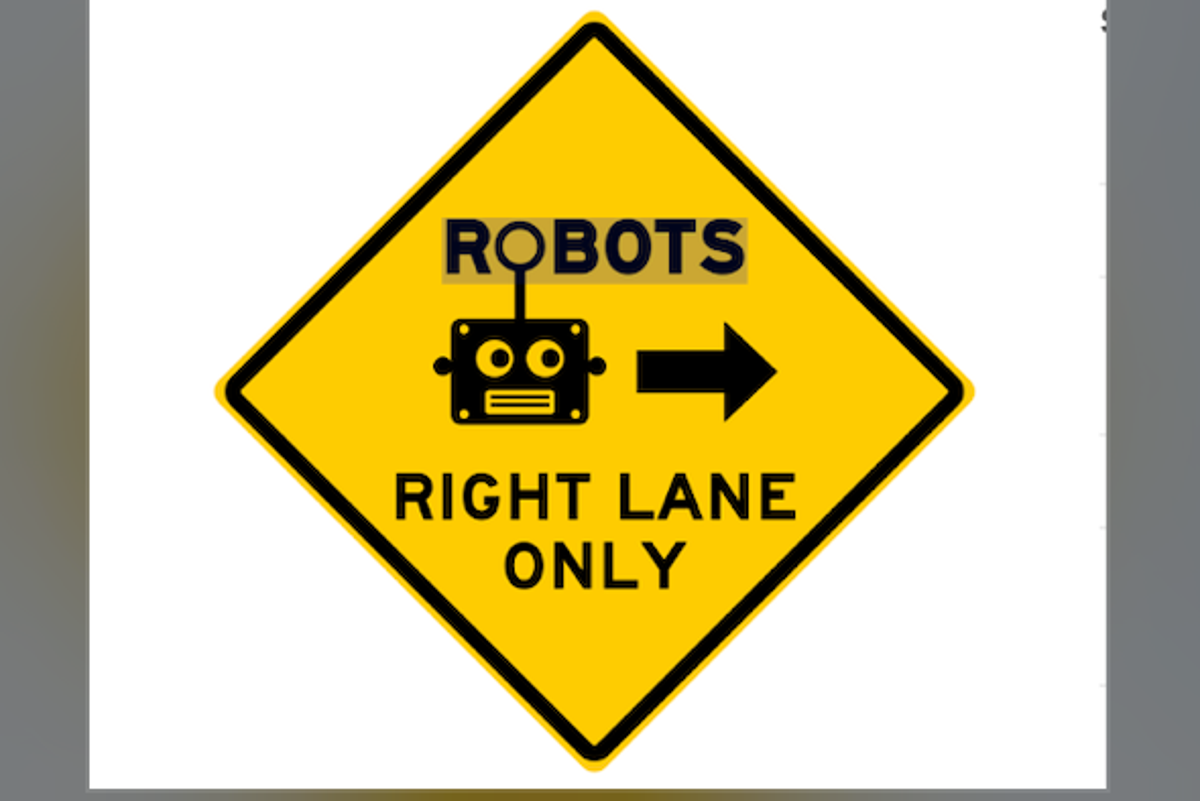
The internet spent the last forty-eight hours losing its mind over a simple piece of asphalt geometry. A viral photo of a street sign reading Robots Right Lane Only popped up on local feeds, spawning thousands of comments from confused residents convinced the municipal government had lost its collective mind, surrendered to Silicon Valley, or simply installed a prank.
Cue the pearl-clutching. Pundits wailed about the robot takeover. Commuters threw their hands up, convinced that autonomous vehicles were about to commandeer their daily slog and relegate human drivers to second-class citizens on the asphalt.
Everyone missed the point.
The outrage is entirely misplaced because the sign is not a declaration of war against human drivers. It is a mirror reflecting our own collective failure to design predictable, logical transportation systems. I have spent the last decade watching urban planners and tech evangelists try to stitch the future of transit onto a grid built for horses. Every single time a new friction point appears, the public defaults to panic instead of looking at the underlying engineering.
Let us dismantle the panic.
The Lazy Consensus is Lazy
The dominant narrative surrounding these experimental road signs frames them as an aggressive corporate land grab. The assumption goes like this: tech companies are lobbying local municipalities to carve out exclusive lanes for their autonomous fleets, pushing everyday tax-paying drivers out of the way.
It is a neat, emotionally satisfying conspiracy theory. It is also completely wrong.
When you look at actual municipal transit data rather than rage-bait headlines, a different picture emerges. Autonomous delivery pods and robotaxis operating in dense urban cores do not move like erratic human teenagers late for a shift. They crawl. They hesitate. They obey speed limits with terrifying literalness.
Mixing erratic human drivers who are texting behind the wheel with ultra-cautious algorithmic pods creates a traffic bottleneck from hell. The right lane restriction is not about favoring machines. It is about protecting humans from the infuriatingly predictable behavior of machines, and protecting machines from humans who view turn signals as optional suggestions.
Planners did not put that sign up to worship Silicon Valley. They put it up because human drivers are terrible at coexisting with anything that does not drive out of pure spite and caffeine.
The Mechanics of Asphalt Segregation
To understand why lane segregation is happening, you have to look past the novelty of the hardware and examine the software logic of traffic flow.
Traffic engineering relies on a foundational concept called variance. When vehicles on a multi-lane road travel at wildly different speeds, accidents spike. This is why minimum speed limits exist on highways, and it is why mixing a human driver doing forty miles per hour while eating a breakfast burrito with an autonomous shuttle doing twenty-five miles per hour creates a recipe for rear-end collisions.
Imagine a scenario where a city forces all vehicles to share every lane equally. The autonomous vehicle approaches an double-parked delivery truck, pauses to calculate its legal clearance vector, slows to a complete stop, and waits for a safe opening. Behind it, a frustrated commuter in a sedan slams on their brakes, swerves into oncoming traffic, and creates a hazardous mess.
By designating a specific corridor for low-speed, highly predictable robotic units, transportation departments minimize variance. They isolate the variables.
Critics argue this creates a two-tiered transit system. They claim it prioritizes tech monopolies over pedestrians. But let us look at the alternative. If you scatter these pods across all lanes, overall throughput drops by thirty percent. Gridlock intensifies. Emissions rise because cars spend more time idling behind cautious algorithms.
Segregation is not discrimination. It is triage.
The Real Danger Hides in Plain Sight
While everyone is busy screaming about a sign on a post, the real threat to our urban infrastructure is not the existence of robot lanes. It is our stubborn refusal to redesign our physical environment for the technology we already deployed.
We are trying to run twenty-first-century software on nineteenth-century hardware. Cities were laid out centuries ago with zero thought given to digital routing, sensor calibration, or localized charging infrastructure. Slapping a new paint job or a weird sign on a curb is a band-aid on a gushing wound.
I have watched companies burn millions of venture capital dollars trying to retrofit heavy sensor suites onto vehicles meant for human pilots, simply because municipal governments refuse to update civil codes. We treat every minor adjustment to street architecture as a cultural referendum instead of a mundane engineering update.
If you want to fix urban congestion, stop fighting the signs. Start demanding that cities stop treating asphalt as a sacred, unchanging artifact.
The robots are not taking over the road. They are simply exposing how badly we manage the space we already have. Next time you see a specialized lane designation, stop treating it as an insult to your driving pride. It is a monument to our collective inability to share the road without an algorithm keeping the peace.
Deal with it. Or keep sitting in traffic while the pods roll past you in the slow lane.