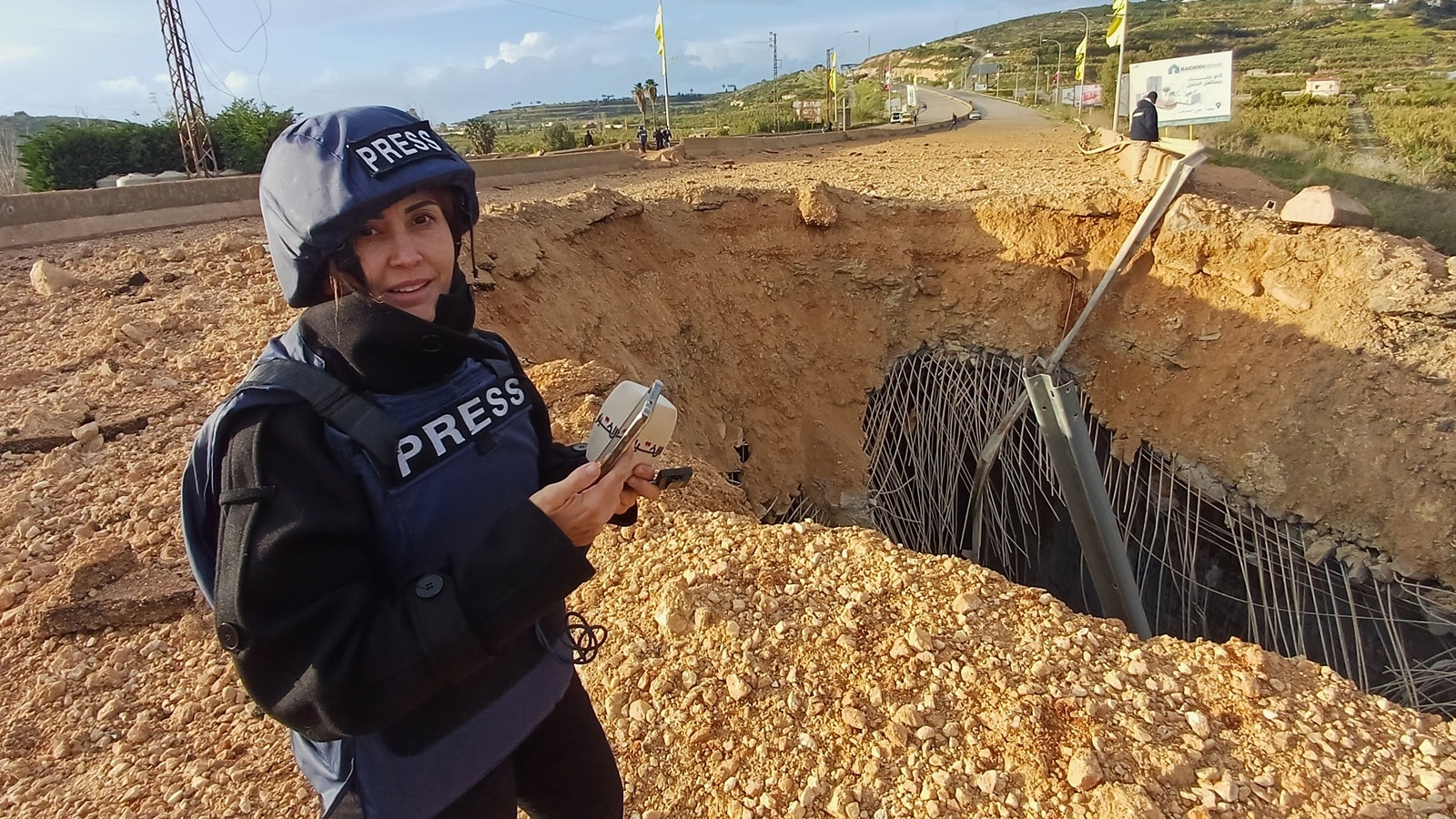
The death of a journalist under rubble in South Lebanon serves as a definitive case study in the breakdown of the Deconfliction Lifecycle. When non-combatants are trapped within an active kinetic environment, their survival is not merely a matter of medical urgency; it is a function of three intersecting variables: structural stability, real-time communication integrity, and the geopolitical permissions required for "safe passage" corridors. This specific incident exposes a systemic failure where the mechanism of humanitarian deconfliction—intended to separate civilian targets from military objectives—collapses under the friction of modern urban warfare.
The Triad of Extraction Failure
The cessation of life in these scenarios follows a predictable, albeit tragic, sequence of operational bottlenecks. These can be categorized into the Structural Phase, the Coordination Phase, and the Kinetic Barrier Phase.
1. Structural Phase: The Physics of Entrapment
The primary variable in the survival of an individual following an aerial strike is the "Golden Hour," but this is compounded by the Void Space Ratio. In reinforced concrete structures, strikes create a pancake collapse or a lean-to collapse.
- Pancake Collapse: Layers of flooring stack directly on each other, leaving minimal air pockets.
- Lean-to Collapse: An outer wall fails while the other remains intact, creating a triangular void.
Survival hinges on the victim occupying a lean-to void with access to oxygen. However, even if the victim survives the initial impact, secondary environmental hazards—dust inhalation leading to acute respiratory distress and the onset of "Crush Syndrome"—begin a biological countdown. Crush Syndrome occurs when muscle tissue, deprived of blood flow by heavy debris, releases toxins (myoglobin and potassium) into the bloodstream. Once the pressure is removed during a late-stage rescue, these toxins can cause systemic kidney failure and cardiac arrest.
2. Coordination Phase: The Deconfliction Paradox
Humanitarian organizations and news agencies utilize a Global Positioning System (GPS) based notification system to inform warring parties of their locations. This is known as Static Deconfliction. The failure in the Lebanese theater suggests a breakdown in Dynamic Deconfliction, which involves the active, real-time movement of rescue teams (Red Cross, Civil Defense) into "hot" zones.
The process requires:
- Notification: The rescue entity submits a movement request with specific coordinates and a time window.
- Acknowledgment: The warring parties receive and theoretically log these coordinates into their Battle Management Systems (BMS).
- Green-Light Authorization: Command-and-control (C2) structures must relay a "hold fire" order to specific units on the ground or in the air.
The bottleneck occurs in the latency between these steps. If the C2 chain is decentralized, or if "Targeting Logic" takes precedence over "Humanitarian Logic," the rescue team becomes a target itself. In this specific case, the inability of rescue teams to reach the journalist for several hours indicates that the Risk-Aversion Threshold of the rescue organizations was exceeded by the persistent kinetic activity at the site.
3. Kinetic Barrier Phase: Area Denial as a Tool
The report of "firing" blocking the rescue indicates a tactical application of Area Denial. This is not necessarily a direct targeting of the victim, but the maintenance of a "Kill Zone" to prevent enemy combatants from repositioning or recovering assets. When a strike occurs, the surrounding area becomes a high-priority surveillance sector. Any movement—including that of an ambulance or a bulldozer—is analyzed through an algorithmic or human lens to determine its threat profile.
The Cost Function of Journalist Safety in Asymmetric War
In a high-intensity conflict, the "Press" vest functions as a psychological deterrent rather than a physical shield. The efficacy of this deterrent has entered a period of diminishing returns due to the evolution of Distance-Based Targeting.
When strikes are executed via unmanned aerial vehicles (UAVs) or long-range artillery, the operator views the target through a multi-spectral sensor. The distinction between a "camera lens" and a "portable anti-tank missile system" can become blurred at low resolutions or under atmospheric interference. Furthermore, the OODA Loop (Observe, Orient, Decide, Act) of modern military operations is now so compressed that the time required for a journalist to identify themselves as a non-combatant is often longer than the time required for an automated system to authorize a strike based on "anomalous movement."
Communication Infrastructure as a Single Point of Failure
A critical and often overlooked factor in the journalist's death was the state of the local telecommunications grid. Survival in the rubble requires the victim to transmit their exact sub-coordinate location.
- Signal Attenuation: Concrete and rebar act as a Faraday cage, significantly weakening cellular signals.
- Power Depletion: Mobile devices used for reporting are often low on battery after a day of field use, leaving little margin for emergency signaling.
- Infrastructure Destruction: If local cellular towers are neutralized as part of a broader electronic warfare strategy, the victim is effectively silenced.
The inability to maintain a continuous data link between the trapped individual and the rescue coordination center turns a "search and rescue" operation into a "search and recovery" operation.
Algorithmic Neutrality vs. Humanitarian Protection
Modern warfare increasingly relies on Pattern of Life analysis. If a journalist’s movements mirror those of a military scout—moving between high-vantage points, utilizing encrypted comms, and operating in proximity to combatants—the algorithm flags them as a "Valid Military Target" (VMT).
The legal framework of the Geneva Convention assumes human-to-human recognition of neutral parties. However, when the targeting chain is digitized, the burden of proof shifts to the civilian to remain "conspicuously non-military." In an urban environment under heavy bombardment, this is an impossible standard to maintain. The "firing" that blocked the Lebanese rescue teams was likely the result of an automated or semi-automated defense system maintaining a perimeter based on pre-set parameters of "Zero Movement."
Tactical Recommendations for Operating in Contested Corridors
The survival of non-combatants in the Levant and similar theaters requires a shift from passive "Press" identification to active Integrated Rescue Systems.
1. Deploying Redundant Signaling Beacons
Field journalists and humanitarian workers must adopt Independent Satellite Beacons (e.g., Garmin InReach or PLBs) that operate on frequencies separate from the local cellular grid. These devices should be programmed to trigger an automatic "distress" burst if a sudden high-G force (indicative of an explosion) is detected.
2. Hardening the Deconfliction Protocol
The current "request-and-wait" model is obsolete. A modernized protocol would involve a Transponder-Based Immunity System, similar to IFF (Identification Friend or Foe) used in aviation. If rescue vehicles and non-combatant hubs transmit a verified, encrypted "Civilian" pulse, it should theoretically trigger an automated firing lock on weapon systems. The limitation here is the willingness of combatants to integrate "neutral" keys into their proprietary fire-control software.
3. Mechanical Pre-Positioning
In regions where the "Firing Barrier" is a known variable, rescue organizations must pivot to Remotely Operated Vehicles (ROVs) for initial debris removal. Small, treaded robots equipped with thermal sensors and oxygen delivery systems can penetrate "Kill Zones" where human rescuers cannot. This removes the "Risk-Aversion" bottleneck by decoupling the rescue attempt from the threat to human life.
The death of the journalist in Lebanon was not an isolated tactical error; it was the inevitable output of an operational system that prioritizes kinetic dominance over humanitarian latency. Until the deconfliction process is moved from the slow realm of diplomatic negotiation into the high-speed realm of automated combat systems, the "Golden Hour" for those under the rubble will continue to be wasted in the silence of bureaucratic and military friction.