Silence.
In the corridors of the West Wing, silence is rarely peaceful; it is the pressurized quiet of a submarine hull descending past its rated depth, where every rivet groans under the weight of unseen water.
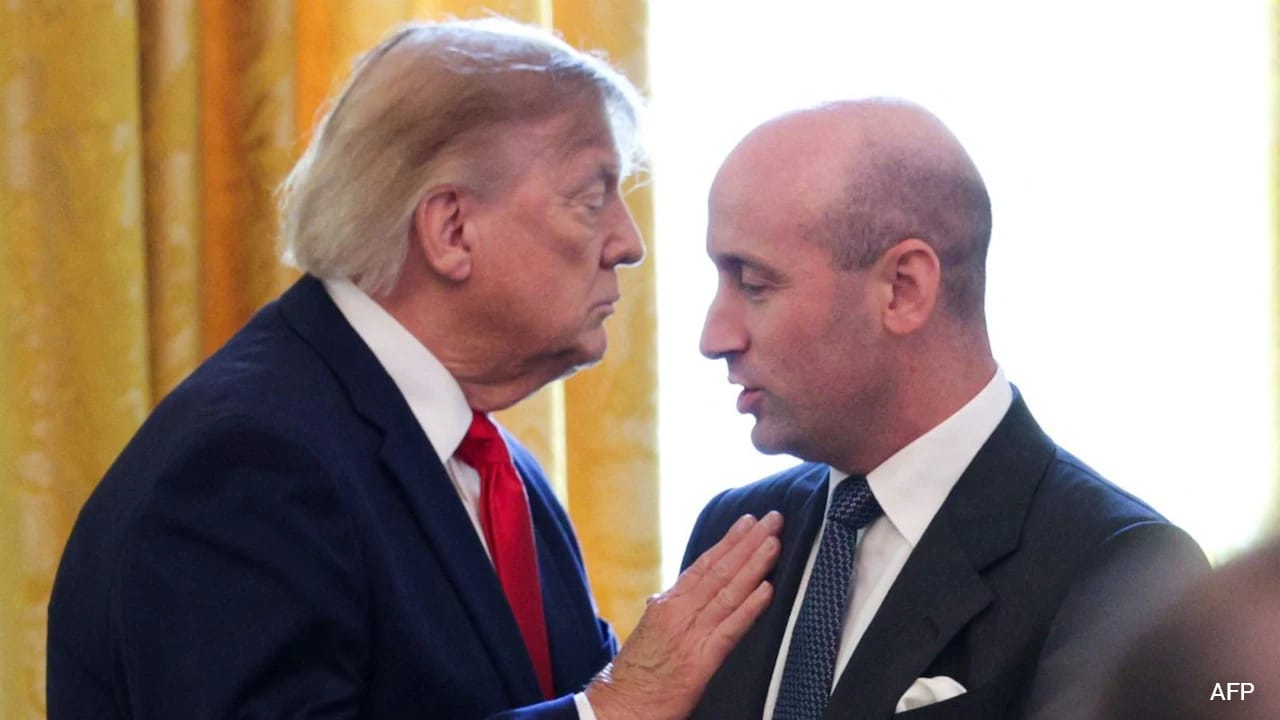
On the morning after a bruising midterm election, that quiet settled over 1600 Pennsylvania Avenue before the coffee had even finished brewing. Outside the wrought-iron gates, television crews stood under harsh white lights, reciting precinct tallies and margin shifts with the practiced cadence of meteorologists tracking a storm that had already made landfall. Inside, behind thick mahogany doors and layers of security clearance, the arithmetic of defeat was being translated into human consequences. When President Donald Trump announced that Stephen Miller would step into the role of White House Chief of Staff following the midterm losses, the news moved across Washington not as a routine personnel shuffle, but as a structural shift in the architecture of American governance.
To understand why a single staffing announcement can alter the temperature of an entire nation, you have to step away from the podium and look at the machinery behind the curtain.
Most people picture the presidency as a lone figure behind the Resolute Desk, signing executive orders with a heavy felt-tip pen. That image is a comforting fiction. A modern presidency is a sprawling, fractious bureaucracy of thousands of officials, cabinet secretaries, legal counsels, and agency heads pulling in competing directions. The Chief of Staff is the air traffic controller of that chaos. Nothing reaches the president’s desk, no cabinet meeting convenes, and no legislative strategy leaves the building without passing through that office. When a president changes Chiefs of Staff after an electoral setback, they are not merely replacing an administrator; they are deciding how they intend to survive the next two years.
Consider a hypothetical family sitting at a kitchen table in suburban Ohio, watching the evening news while dishes clatter in the sink. Let us call them David and Elena. David manages a mid-sized logistics warehouse; Elena teaches eighth-grade history. Neither of them follows the daily turf wars of Washington operatives, nor do they memorize the org charts of the Executive Office of the President. Yet when they hear that the architect of the administration’s strictest immigration and executive-action policies has been handed the keys to the entire White House apparatus, they feel a sudden, instinctive tightening in their chests—though for entirely different reasons. David, frustrated by inflation and anxious about border enforcement, sees a leader finally clearing out hesitant advisors to fulfill campaign promises without apology. Elena, who watches her students carry the anxieties of their parents into the classroom every morning, sees the guardrails coming off.
Both of them are reacting to the same reality. They are sensing the difference between a presidency that negotiates with political reality and one that decides to confront it head-on.
The Architecture of a Counterpunch
History offers a clear warning about what happens in the wake of a midterm rout. In American politics, the party holding the White House almost always loses ground in the first midterm election, a cyclical tide that has humbled presidents from Dwight Eisenhower to Barack Obama. Usually, the textbook response is moderation. A president reads the electoral map, acknowledges the voters' frustration, and brings in a seasoned consensus-builder—someone fluent in the quiet compromises of Capitol Hill—to steady the ship and salvage a legislative legacy.
Trump’s selection of Miller rejects that playbook entirely.
According to political analysts and administration observers cited across major news coverage of the shake-up, the appointment signals a deliberate turn inward toward ideological discipline and executive speed. Miller is not a traditional Washington power broker who spends evenings trading favors at Georgetown dinner parties. Having served across both Trump administrations as a senior advisor and policy architect, he built his reputation on relentless focus, mastery of obscure statutory authorities, and an unwavering commitment to populist nationalism. Where conventional staffers see legal hurdles or congressional bottlenecks, Miller has historically seen tools waiting to be sharpened.
Think of the federal government as an enormous, centuries-old cargo ship. Most Chiefs of Staff spend their tenure trying to persuade the crew to row in unison, negotiating with the harbor masters on Capitol Hill, and checking the weather charts before turning the wheel. Putting Miller on the bridge is the equivalent of locking the wheel hard to starboard, firing the engines to full throttle, and instructing the crew that anyone unwilling to hold on can find another vessel.
For supporters of the president, this is precisely the point. In interviews and public commentary surrounding the announcement, conservative commentators have framed the midterm losses not as a rejection of Trump’s agenda, but as the consequence of an administration slowed down by internal hesitation and external obstruction. From their perspective, voters did not send Trump to Washington to manage the status quo; they sent him to dismantle it. Elevating the aide most closely identified with the administration's core ideological commitments sends an unmistakable message to the base: there will be no retreat.
Yet inside the federal agencies—from the Department of Justice to the Department of Homeland Security—the reaction carries a very different texture. Having covered and observed previous West Wing transitions, I remember the unmistakable smell of ozone and stale paper that hangs over federal office buildings during a sudden leadership purge. Career civil servants who have spent decades interpreting regulations suddenly find their institutional memory treated as suspicion. Phone calls go unreturned. Draft memos sit in limbo while new directives arrive stamped with immediate deadlines. Uncertainty becomes a policy instrument of its own.
The Invisible Stakes of the Gatekeeper
Why does the identity of the Chief of Staff matter so deeply when the president remains the ultimate decision-maker?
Because attention is the scarcest resource in the Oval Office.
A president faces dozens of urgent crises every single day—a currency fluctuation in Asia, a troop deployment debate in the Pentagon, a looming government shutdown, a primary challenge in a swing state. No human being can examine the primary documents for every decision. Instead, the president relies on the person standing outside the door to decide which voices enter the room, which options appear on the briefing sheet, and which warnings are dismissed as bureaucratic timidity.
When Reince Priebus, John Kelly, or Susie Wiles occupied that orbit during different chapters of Trump’s political life, each brought a distinct filter to the Oval Office. Kelly tried to impose military chain-of-command discipline on an inherently improvisational presidency. Wiles earned praise across the political spectrum for running a tight, electorally focused operation that kept competing factions from tearing each other apart during the campaign. Miller represents a third, radically different model: the ideological strategist as chief executive operator.
Let us return to David and Elena at their kitchen table in Ohio, because this abstract shift in West Wing gatekeeping eventually lands on their doorstep in tangible ways.
Suppose a regional manufacturing plant near David’s warehouse relies on seasonal visa workers to keep its assembly lines running during peak autumn shipping months. Under a Chief of Staff focused on economic compromise and business-coalition harmony, warnings from the Chamber of Commerce and local governors about labor shortages reach the president’s desk early, softened with proposals for targeted exemptions. Under Miller’s stewardship, those same warnings are far more likely to be filtered through a strict enforcement lens, where economic friction is viewed as an acceptable short-term price for structural change. David might see higher overtime hours at his warehouse—or he might see supply chain delays that push prices higher at the grocery store.
Meanwhile, Elena sits in a faculty meeting at her middle school, listening to the district superintendent explain new federal guidance affecting Title I funding and student documentation protocols. Policies that once took eighteen months of administrative rulemaking, public comment periods, and inter-agency review can be compressed into weeks when the Chief of Staff prioritizes unilateral executive action over legislative consensus. Elena doesn’t read the Federal Register, yet she feels its tremors in the anxious questions of twelve-year-olds asking whether their families will still be together by summer break.
Critics of the appointment, including Democratic lawmakers and civil rights advocates quoted in the immediate aftermath of the announcement, argue that elevating Miller concentrates extraordinary operational power in the hands of a figure who views political opposition not as a legitimate check in a constitutional republic, but as an adversary to be outmaneuvered. They point to past legal battles over travel restrictions, asylum limits, and civil service reclassifications as previews of a governance style designed to test the outer boundaries of executive authority.
Defenders counter that every modern president—from Franklin D. Roosevelt to Joe Biden—has relied on trusted loyalists to push executive power when Congress refuses to act. To them, the outrage from Washington insiders is simply the predictable roar of an establishment watching its gatekeepers lose their keys.
Both arguments carry a grain of truth, and pretending otherwise would be dishonest. That is what makes this moment so disorienting to watch unfold. We are witnessing a collision between two irreconcilable theories of how American democracy should function when voters deliver a divided verdict.
Governing Against the Tide
There is a lonely, unmistakable energy that takes hold in a White House after a midterm defeat.
The celebratory banners from inauguration week are long gone, packed away in climate-controlled archives. The political capital that seemed limitless twenty-two months earlier has been spent on confirmation fights, tax battles, and executive decrees. Across Pennsylvania Avenue, an emboldened opposition party prepares subpoenas, committee hearings, and budget riders designed to stall the administration’s momentum until the next presidential cycle begins.
In that atmosphere, compromise feels like surrender, and aggression feels like survival.
Step inside the West Wing on a rainy November evening during such a transition, and you can feel the narrowing of the circle. The expansive coalitions that win general elections—the uneasy alliances of suburban moderates, rural populists, tech entrepreneurs, and traditional conservatives—begin to fray under the pressure of electoral disappointment. Fingers point across conference tables. Strategists blame messaging; lawmakers blame candidate quality; donors blame overreach.
Trump’s answer to that blame game was swift and unmistakable. Rather than broadening the tent, he fortified the command post.
By naming Stephen Miller Chief of Staff, the president signaled that the second half of his term will not be spent chasing approval ratings in swing districts or wooing moderate senators over polite lunches. Instead, it will be built around speed, loyalty, and executive execution. Every agency head will know that the person speaking for the president shares the president’s exact instincts, without translation or dilution. Every cabinet secretary will understand that hesitation will be interpreted as resistance.
For the political historian, there is a familiar rhythm to this consolidation. Presidents facing a hostile Congress almost always turn toward the administrative state—the vast network of executive agencies, regulatory bodies, and emergency authorities that operate without needing fifty-one votes in the Senate or two hundred eighteen in the House. What sets this moment apart is the sheer candor of the personnel choice. There is no ambiguity here, no reassuring figure placed at the front door to tell nervous markets and foreign allies that business will proceed as usual.
I will admit something that analysts on television rarely confess: nobody knows with certainty where this road leads. Political forecasting is an exercise in humility disguised as expertise. A Chief of Staff who rules with iron ideological discipline can achieve breathtaking speed in the short term, issuing orders and reshaping agencies before opponents can even draft a legal brief. Yet that same rigidity can fracture fragile legislative majorities, alienate swing voters ahead of the next national election, and turn routine policy disputes into existential constitutional crises.
Power, when concentrated too tightly, becomes brittle. It bends nothing; it either breaks through the obstacle or shatters against it.
The Heavy Door Clicks Shut
Late at night, long after the cable news panels have signed off and the tourists have cleared out of Lafayette Square, the White House settles into a different kind of quiet.
The brass lamps along the colonnade cast long shadows across the Rose Garden. Inside the Chief of Staff’s corner office—just steps away from the Oval Office, separated only by a small pantry and a secretary’s desk—the lights stay on well past midnight. Stacks of briefing binders, executive order drafts, and agency personnel rosters sit neatly aligned on the table.
Tomorrow morning, the phone calls will begin at dawn. Cabinet secretaries will adjust their agendas. Congressional leaders will recalibrate their strategies. Markets will price in the probability of regulatory upheaval, and millions of ordinary citizens like David and Elena will wake up, pour their coffee, and step into a country whose governing temperament shifted while they slept.
A presidency is ultimately defined not by the speeches delivered on election night, when the confetti is still falling and every promise feels effortless, but by the choices made on the morning after defeat, when the margins narrow and the real work begins.
In the quiet corridor outside the Oval Office, a heavy mahogany door swings shut, and the click of the latch echoes down the hall.


