The tea was still warm on the counter when the whistling started.
It is a peculiar sound, unlike the thunder of heavy artillery or the sharp crack of small arms fire. It is a long, thin scream descending from the stratosphere, a tearing of the atmosphere that gives a human mind precisely two seconds to negotiate with reality. Is that close? Is it heading for the market? Or is it coming here?
In the apartments of central and southern Ukraine, those two seconds belong to an ancient, desperate calculation. You do not grab your coat. You do not look for your keys. You grab the nearest child, the family cat, or simply a pillow to cover your head, and you throw yourself into the hallway, away from the windows, hoping against mathematical probability that the reinforced concrete of your Soviet-era block will hold against a weapon engineered to erase it.
Seven people did not make it to the hallway.
They died in the quiet hours when cities are supposed to be breathing out, when the day’s exhaustion yields to the fragile illusion of rest. Across office complexes, residential high-rises, and structures that bore the quiet weight of local history and cultural memory, the drones arrived. Not the high-altitude strategic bombers of old, but buzzing, delta-winged machines powered by lawnmower engines—cheap, relentless, and sent in swarms to bleed a nation of its sleep, its architecture, and its people.
The Geometry of Ruin
To understand what happens when a drone strikes an apartment building, you have to strip away the abstractions of war maps and casualty counts. You have to look at the geometry of domestic life.
A modern apartment is an archive of human accumulation. Books collected over decades, wedding photographs tucked into cheap frames, houseplants coaxed through winter on windowsill sunbeams, children's drawings held to the refrigerator by magnets. It is a monument to normalcy.
When a loitering munition packed with high explosives impacts the seventh floor of a residential block, it does not merely destroy concrete. It atomizes biography.
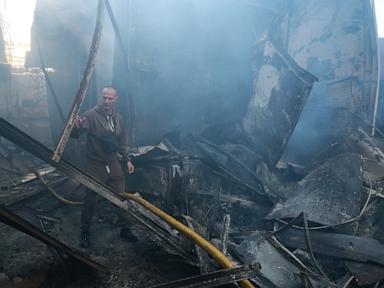
Consider the blast radius not as a circle on a military briefing slide, but as a domestic disaster. The shockwave blows out every window for a block, turning safety glass into a million glittering shards that rain down on parked cars. The fire follows instantly, fueled by curtains, rugs, and the synthetic fabrics of modern living. In seconds, the intimate space where a family argued about dinner or watched a late-night movie becomes an open-air charnel house, exposed to the indifferent night sky.
The official reports are clean, clinical, and necessary. They tell us that seven lives were extinguished. They list the districts hit. They mention the damage to an office building and a landmark that had stood as a cultural anchor for generations. But statistics are designed to protect our sanity. They give us a safe distance from the raw horror of a life interrupted mid-sentence.
The Long Hum in the Dark
The weapon itself is an ugly triumph of modern engineering. It does not require a sophisticated air force or a multi-million-dollar guidance system. It is constructed from off-the-shelf commercial electronics, a fiberglass hull, and a payload of military-grade explosives. It is designed for saturation. It is designed to exhaust the air defense operators who track them on flickering radar screens through the small hours of the morning, hour after hour, night after night.
Imagine sitting in a cold, darkened room fifty miles away, staring at a green glowing blip. You know what it carries. You know that beneath its flight path lie sleeping children, bakers starting their early shifts, students cramming for morning exams. You hear the mosquito-like drone of its engine echoing through audio sensors arrayed across the countryside. You track it. You vector a mobile defense group toward its projected coordinates. Sometimes, you catch it in the crosshairs of a heavy machine gun, and it blooms into a harmless ball of orange fire in the empty sky.
And sometimes, you miss.
That missed intercept is measured not in navigational errors, but in sirens that begin to wail too late, in the sudden blinding flash that turns night into day, and in the frantic digging of rescue workers through pulverized masonry with bare hands and flashlights.
The Architecture of Memory
Buildings are stubborn things. They remember the people who built them and the societies that grew up around them. When a cultural landmark—a place where poetry readings were held, where children learned to paint, where old men played chess in the courtyard—is struck, the loss is cultural as well as physical.
An office building can be rebuilt with steel girders and drywall. A commercial ledger can be backed up in the cloud. But a cultural landmark holds the invisible social glue of a community. It is where identity is anchored. When you strike those buildings, the message is not merely tactical; it is psychological. It is an attempt to convince the inhabitants that their history is temporary, that their future has been cancelled, and that nowhere—not in their beds, not at their desks, not in the halls of their shared heritage—is safe.
Yet the most striking thing about these mornings after is not the smoke or the crushed concrete. It is the sweepers.
By dawn, long before the international news crews arrive with their cameras, the people emerge from the basements and shelters. They carry brooms. They carry plastic buckets. They begin to sweep the glass from the sidewalks. They stack the shattered bricks in neat piles by the curbside. An elderly woman rescues a single, soot-blackened framed photograph from the rubble of her kitchen, wipes it clean with the hem of her coat, and places it carefully on a crate.
It is an act of quiet, stubborn defiance. It says that while the machines can tear open a wall and steal a life, they cannot legislate despair. It is a recognition that life, in all its fragile, ordinary domesticity, must somehow resume under a sky that remains unfriendly.
The tea on the counter goes cold. The sirens fade into the hum of morning traffic. And the city, scarred and bleeding, quietly begins to rebuild the walls of the living room.