The Sound of the Panic Alarm
The hallway of a tertiary care hospital at 3:00 AM does not sleep. It hums. Fluorescent lights buzz with a cold, relentless frequency. Underneath that hum lies the rhythmic click of rubber-soled shoes on linoleum, the hiss of automated blood pressure cuffs, and the low, collective murmur of a skeletal night staff.
To a veteran charge nurse, these sounds are a comfort. To a third-year nursing student, they are a countdown.
Let us look at a student we will call Sarah. She is twenty-one years old, caffeinated beyond medical advice, and standing outside Room 412. Inside that room is a patient whose vitals are beginning a slow, agonizing drift into the red zone. Sarah knows the theory. She has highlighted the textbook passages in three different colors of ink. She has memorized the fluid resuscitation protocols, the electrolyte balances, and the exact dosage calculations for epinephrine.
But her hands are shaking.
Her palms are slick with sweat inside her nitrile gloves. Her heart is hammering against her ribs so loudly she can barely hear her own thoughts. The gap between knowing what a crisis looks like on a glossy page and standing over a human being who is actively suffocating is an ocean. If she makes a mistake here, the consequences do not involve a red pen or a lower GPA. They involve a crash cart.
Every year, thousands of nursing students across Alberta face this exact chasm. They are brilliant, dedicated, and terrified. The traditional clinical placement model—the holy grail of nursing education—is fracturing under the weight of an overstretched healthcare system. There are too many students, too few preceptors, and a finite number of hospital beds. Sometimes, a student can spend an entire six-week rotation in a ward and never witness a code blue, an acute postpartum hemorrhage, or a sudden pediatric respiratory arrest.
Then they graduate. They pass their licensing exams. They clock in for their first real shift.
And then the panic alarm rings.
The Cold Math of Clinical Hours
The math behind nursing education in Western Canada is unforgiving. To graduate, a nursing student must log hundreds of hours of direct clinical experience. It sounds robust on paper. In practice, it is a game of chance.
Consider the variables. A student might be assigned to a rural clinic where the pace is slow and the acute cases are rare. Another might be placed in a bustling urban emergency department but spend their days observing routine assessments because the high-stakes traumas are too chaotic to allow for student intervention. The learning experience is wildly asymmetrical.
Compounding this is a stark reality: hospitals are full, but they are also understaffed. Busy staff nurses are asked to mentor students while simultaneously managing their own heavy patient loads. It is an exhausting double duty. When a patient’s condition deteriorates rapidly, the mentor must step in to save the patient. The student is gently but firmly pushed to the periphery. They watch. They do not do.
Psychologists call the result of this dynamic "clinical shock." It is the paralyzing realization that despite four years of rigorous university education, a new graduate feels profoundly unequipped to handle the messy, unpredictable reality of human illness.
We have tried to fix this with plastic mannequins. High-fidelity simulation labs are staples of modern nursing schools. They feature rubber figures that blink, breathe, and even possess recorded voices that cry out in pain. But anyone who has ever stood in a brightly lit university basement simulating a code on a $50,000 piece of plastic knows the truth.
It feels fake.
You can see the ceiling tiles of the classroom. You can see your professor holding a clipboard three feet away, watching your every move. The stakes are absent. The lizard brain—the part of the human mind that registers genuine urgency and builds the neural pathways of muscle memory under stress—remains completely unbothered.
Something had to change. The old ways were leaving new nurses vulnerable, and when a nurse is vulnerable, the patient bears the cost.
Stepping Into the digital Ward
This is where an ambitious pilot project in Alberta enters the frame, fundamentally shifting how a student learns to save a life. Educators looked at the limitations of the physical world and decided to bypass them entirely through immersive technology.
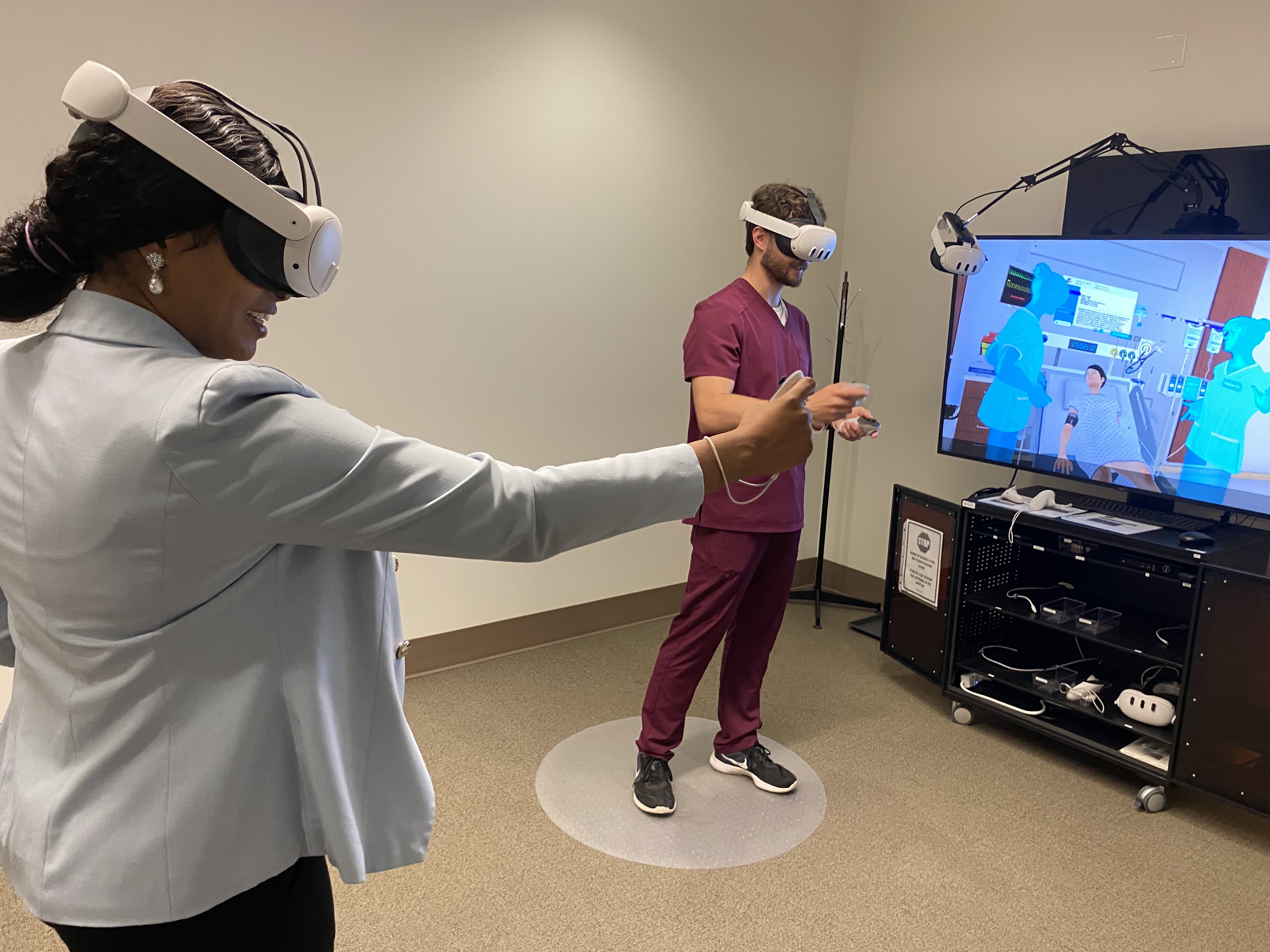
Picture a classroom at an Alberta post-secondary institution. It is empty save for a few desks and a dozen students standing in open space, wearing bulky plastic visors over their eyes and holding controllers in their hands. To an outside observer, they look absurd. They are gesturing at thin air, stepping over invisible obstacles, and talking to walls.
But look through Sarah’s visor.
The classroom is gone. She is standing inside a hyper-realistic, three-dimensional reconstruction of an intensive care unit. The lighting is identical to that 3:00 AM hospital hum. To her left, an intravenous pump is blinking an amber warning light. In front of her lies a patient—not a plastic doll, but a digital human whose chest rises and falls with shallow, labored breaths.
The audio is binaural. If Sarah turns her head away from the patient to check the cardiac monitor, the sound of the patient’s gasping shifts realistically to her left ear. The environment is designed to overwhelm. It is designed to mimic the sensory overload that causes new nurses to freeze.
In this virtual space, Sarah is not an observer. She is the primary nurse.
The software presents her with a patient exhibiting signs of sepsis—a systemic infection that can turn fatal in a matter of hours if left unchecked. The clock is ticking. The digital patient’s blood pressure is dropping. The monitor is chiming a persistent, high-pitched alert.
Sarah must act. She uses her controllers to palpate the patient’s radial pulse. She selects the correct oxygen mask from a virtual supply cart, fits it over the patient's face, and turns the dial to fifteen liters per minute. She listens to the lungs through a virtual stethoscope, hearing the distinct, wet crackle of fluid accumulation.
Then, she makes a mistake.
She administers the wrong intravenous fluid. In the real world, this could trigger a catastrophic fluid overload, damaging the patient's lungs and heart. In the traditional classroom, it would mean a deducted point on a rubric.
In the virtual simulation, the patient’s oxygen saturation drops instantly. The cardiac monitor’s chime turns into a flatline drone. The digital avatar loses consciousness.
Sarah feels a cold jolt of genuine adrenaline. Her stomach drops. It is a psychological gut punch.
But here is the miracle of the technology: she can hit the reset button.
The Power of the Safe Failure
The true value of Alberta's virtual reality pilot project is not found in its advanced graphics or its complex algorithms. It is found in the psychology of safe failure.
In a live hospital setting, failure is unacceptable. The primary directive is patient safety, which means students are kept on a tight leash. They are rarely allowed to experience the natural consequences of an incorrect clinical decision because the human cost is too high. Therefore, they never truly learn where the boundaries of safety lie.
Virtual reality creates an environment where failure is not only permitted; it is instructive.
When Sarah’s virtual patient flatlined, she did not face a malpractice lawsuit, an investigation, or the lifelong trauma of having harmed a human being. Instead, her instructor paused the simulation. Together, they looked at the digital data log. They traced the exact moment her decision-making process veered off course. They discussed the pathophysiology of why the patient reacted the way he did.
Then, Sarah stepped back into the headset. She ran the scenario again. And again.
By the fourth attempt, her movements were fluid. The hesitation was gone. When the patient's blood pressure dropped, her hand moved instinctively to the correct intervention. She had transformed abstract textbook knowledge into experiential muscle memory.
This is not a replacement for real-world clinical hours. No one is suggesting that a nurse should be minted entirely through a computer screen. The Alberta pilot project is designed as a bridge. It ensures that when a student finally steps onto a real hospital floor for their clinical placement, they are not wasting precious hours learning where the oxygen dials are or panic-freezing at the sound of an alarm. They have already run the gauntlet. They have already failed, corrected, and succeeded in the digital ether.
The Human Return on Investment
It is easy to analyze this shift through the lens of institutional efficiency. We can talk about how virtual reality reduces the strain on scarce hospital preceptors. We can calculate the cost-effectiveness of a software license compared to maintaining a fleet of mechanical mannequins that require constant repair and dedicated lab space.
But the true return on this investment cannot be measured in spreadsheets. It is measured in human resilience.
Nursing is facing an unprecedented retention crisis. Burnout is at an all-time high. A significant portion of that burnout takes root in the first twelve months of practice, born from the brutal shock of that transition from student to professional. When we throw young nurses into high-stress environments without the psychological scaffolding of confidence, we break them. We lose them to anxiety, to moral distress, and to other professions entirely.
Technology is often accused of coldness, of alienating us from one another, of replacing human touch with glass and code.
Yet, in this quiet corner of Western Canada, a piece of technology is doing the exact opposite. It is preserving the human element of medicine. By providing a digital sanctuary where students can confront their worst fears, make their worst mistakes, and build their clinical confidence without fear of catastrophe, we are protecting them.
We are ensuring that when the real crisis comes—when the room is cold, the family is crying in the hallway, and the real panic alarm is piercing the 3:00 AM silence—the nurse standing at the bedside will not freeze.
She will take a breath. Her hands will be steady. She will know exactly what to do.