Midnight in Singapore smells like wet asphalt, bruised lime, and the sweet, heavy exhaust of a passing SBS Transit bus. It is an honest smell, born of sweat and concrete. But on the night of August 12, 2016, the air smelled like something else entirely. It smelled like disbelief.
Try standing on Orchard Road at three in the morning. Normally, the neon hums over empty sidewalks, the retail fortresses locked tight against the humidity. Yet on this specific night, the tarmac thrummed with a different vibration. Car horns blared. Strangers wept into each other's shoulders, clutching smartphones as if the glowing screens might evaporate if held too loosely.
They were watching a screen broadcasting from the Riocentro pavilion half a world away.
For fifty-one years, the island nation had chased a ghost. Since its messy, weeping birth as an independent republic in 1965, Singapore had sent athletes across oceans, deserts, and time zones to the Olympic Games. They carried flags, they ran, they swam, they shot, they sailed. They returned home with bronze. They returned home with silver. Mostly, they returned home with empty hands and the quiet, crushing weight of a national expectation that felt less like a dream and more like an impossible tax.
Small nations are fragile things. When your entire territory can fit inside the margins of a standard map, you look for validation in giants. You build skyscrapers that pierce the clouds. You engineer the world’s most efficient port. You construct an airline that wins every award. But sports—sports are different. You cannot engineer a champion in a spreadsheet. You cannot buy a gold medal with a sovereign wealth fund.
Enter Joseph Schooling.
Picture him at age thirteen. Skinny, knock-kneed, his eyes wide behind swimming goggles that always leaked a little bit around the left bridge of his nose. He had a poster of Michael Phelps taped to his bedroom wall in Marine Parade. Not because Phelps was an icon, but because Phelps was a god, and Joseph wanted to know what it felt like to touch the hem of a god's robe.
His parents did what thousands of Asian parents do: they invested their life savings, their hopes, their sleep, and their sanity into a child's improbable obsession. They shipped him off to the Bolles School in Florida—a grueling aquatic factory where chlorine eats your skin and the pool water tastes like tears and bleach. He grew up fast. He traded the familiar humidity of Southeast Asia for the biting winter mornings of the American South.
He swam until his shoulders popped. He swam until his lungs burned with a metallic taste that refused to leave his throat even during math class.
And then came Rio de Janeiro.
The 100-meter butterfly final. Eight lanes. Eight men who were genetic anomalies, forged in the fires of athletic programs boasting budgets larger than small island nations' GDPs. In lane four stood Michael Phelps. The undisputed king. The man with twenty-two Olympic golds hanging heavy around his neck.
In lane five stood Joseph.
We forget how silence sounds when it stretches across a population of millions. In living rooms from Jurong to Tampines, conversations simply stopped. Fans held their breath so hard their chests ached.
Consider the mathematics of a sprint butterfly race. It is fifty seconds of pure, unadulterated violence disguised as grace. Every stroke is a metabolic explosion. The lactic acid floods the muscles so violently that the brain begins to scream for cessation. Your vision narrows to a tunnel. Your arms feel like blocks of lead wrapped in wet wool.
When the starter's gun cracked, it didn't just echo in the Brazilian arena. It reverberated through the soul of a country that had spent half a century wondering if it was destined to always be the bridesmaid, the efficient runner-up, the nation that almost made it.
Joseph didn't just swim. He attacked the water. Every pull was an act of defiance against the narrative of limitation.
At the fifty-meter mark, he turned first.
The broadcast commentators lost their composure. The digital clocks flashed splits that defied human physiology. Phelps was coming. You can never count out a shark smelling blood in the water. Phelps closed the gap, churning the foam into a white fury.
Fifty-one point two one seconds.
That was the time. An Olympic record.
When Joseph touched the wall and looked up at the scoreboard, his mouth fell open in a shape that every mother, every father, every immigrant, and every underdog instantly recognized. It was the face of a boy who had just caught the moon with his bare hands and couldn't quite figure out how heavy it was.
He looked over at Phelps. Phelps, dripping wet and smiling a genuine, wide grin, swam over, grabbed Joseph by the arm, and pointed right at him.
You did this, the gesture said. You earned this.
Back home, the sirens went off. Not emergency sirens—something better. The national carrier, Singapore Airlines, flashed special messages across flight arrival boards. Fast-food restaurants offered free chicken nuggets. Politicians tripped over themselves to draft congratulatory motions in Parliament.
But beneath the political posturing and the corporate bandwagon, something real shifted in the national consciousness.
Singaporeans are conditioned to believe in safety. We insure everything. We plan three generations ahead. We look at risk the way a sailor looks at a typhoon—something to be avoided through meticulous preparation and rigid protocols.
Yet Joseph’s victory was the exact opposite of safe. It was a gamble. It required a family to uproot their lives, send a teenager across the globe, and bet everything on a wet tile floor in Florida. It was messy. It was terrifying. It was human.
When Joseph landed back at Changi Airport, the arrivals hall was a sea of red and white. Thousands of people had skipped work, skipped school, skipped sleep. They didn't come to see a politician. They came to touch a piece of their own impossible dream made flesh.
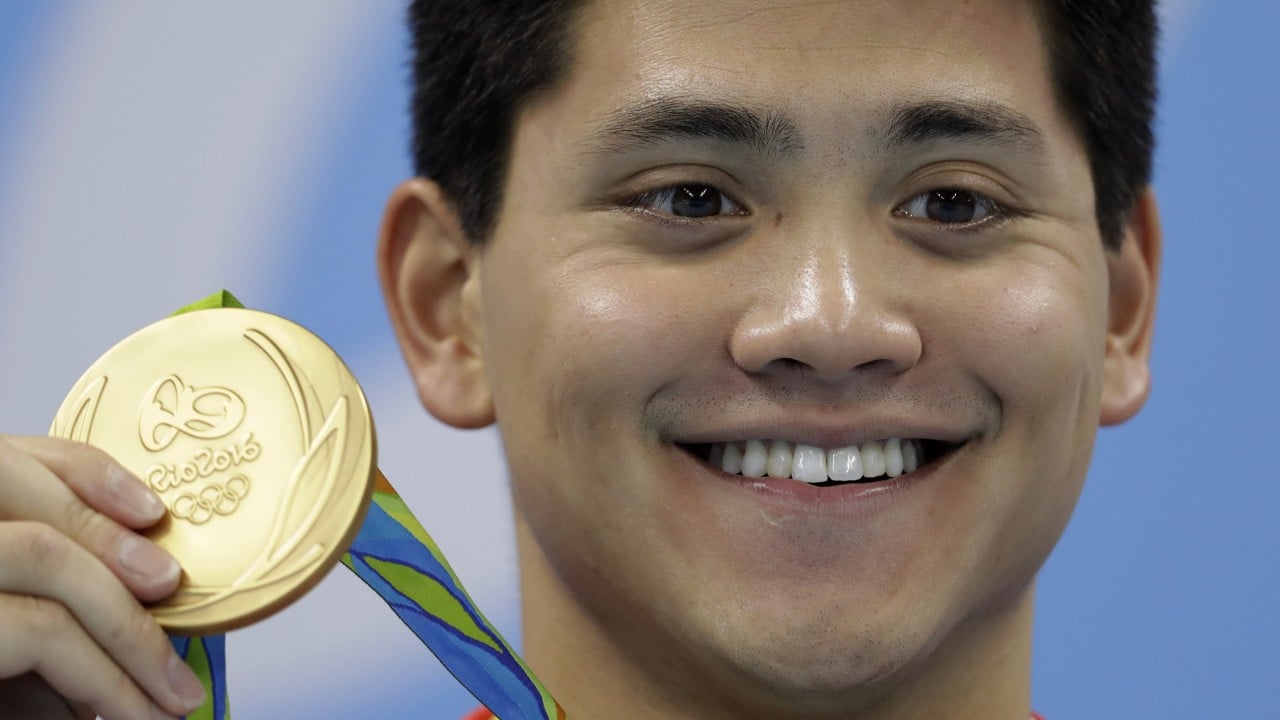
He held up the gold medal. It gleamed under the fluorescent lights of Terminal 3, catching the reflections of a thousand smartphone screens. It wasn't just a heavy piece of recycled silver plated with six grams of gold, minted by the Brazilian mint.
It was a key.
A key that unlocked a quiet, stubborn truth long buried under pragmatic compromises and economic survival: that greatness does not care about the size of your passport, and that sometimes, a tiny red dot on the world map can roar loud enough to wake up the entire planet.