Laser pointers induce chronic behavioral frustration in domestic cats by stimulating the visual cortex and motor systems without allowing the animal to complete the evolutionary predatory sequence. To eliminate the resulting stress, redirected aggression, and obsessive-compulsive behaviors, owners must replace intangible light stimuli with physical enrichment tools that provide tactile capture, resistance, and oral gratification.
The Architecture of the Feline Predatory Sequence
Understanding why a beam of light degrades feline mental health requires breaking down the hardwired neurobiological loop known as the predatory sequence. Unlike omnivores or scavengers, Felis catus is an obligate carnivore whose brain chemistry is calibrated around a rigid, four-stage hunting protocol.
- Stare and Stalk: Visual and auditory acquisition of a target, triggering low-level dopamine release to sustain focus.
- Chase: High-velocity pursuit, elevating heart rate, cortisol, and adrenaline.
- Pounce and Catch: Physical interception of the target using forelimbs and claws, delivering immediate tactile feedback.
- Kill Bite and Consume: Mechanical manipulation with the jaws, followed by ingestion, which triggers the release of endorphins and serotonin to downregulate the sympathetic nervous system.
When a domestic cat interacts with a toy, it is not engaging in abstract recreation. It is executing a survival simulation. Every phase of the sequence relies on the subsequent phase to resolve the neurochemical arousal generated at the start.
A laser pointer isolates Stages 1 and 2 while making Stages 3 and 4 physically impossible. The light emits zero heat, offers zero mass, and cannot be pinned against the floor. When the cat pounces on the red dot, its paws strike empty carpet, and the dot instantly teleports onto the wall or vanishes entirely when the button is released.
The Neurochemical Cost Function of Incomplete Hunts
Repeatedly activating the sympathetic nervous system without providing a somatic resolution creates a measurable deficit in the cat's stress-regulation pathways. Veterinarians and applied animal behaviorists classify this state as frustration-induced arousal.
Dopamine Loops Without Endorphin Resolution
The erratic movement of a laser dot exploits the feline eye's extreme sensitivity to rapid motion. This hyper-stimulates the mesolimbic dopamine pathway—the brain's seeking and anticipation circuit. In a functional hunt, the physical capture of prey shifts neurotransmission from dopamine (seeking) to endorphins and serotonin (satisfaction and calm). Because a laser cannot be caught, the dopamine loop remains open. The cat is left in a state of heightened vigilance with no biological off-switch.
Redirected Aggression and Compulsive Disorders
When high levels of adrenaline and cortisol remain unspent at the end of a play session, the energy must discharge elsewhere. In multi-cat households, this frequently manifests as redirected aggression, where the frustrated hunter attacks a nearby housemate immediately after the laser turns off. In single-cat environments, the animal often develops displacement behaviors such as excessive over-grooming, tail chasing, or pacing.
The worst-case clinical outcome is shadow- and light-chasing syndrome, a recognized feline compulsive disorder. Cats exposed to frequent laser play can become hyper-fixated on reflections from wristwatches, phone screens, or sunlight filtering through blinds. They spend hours staring at blank walls, waiting for the phantom prey to reappear, which severely degrades their sleep architecture and baseline welfare.
Ocular and Physical Safety Hazards
Beyond psychological strain, Class 3R and Class 3B consumer laser pointers pose direct physiological risks. The feline tapetum lucidum—a reflective layer behind the retina that enhances night vision—amplifies incoming light. Even brief, accidental sweeps of a standard laser across a cat's eye can cause temporary flash blindness or permanent retinal lesions.
Rapid, erratic laser movements also encourage reckless kinematics. Because the user controls the light with a flick of the wrist, the target moves at angles and speeds no biological prey could achieve. Cats routinely slam into furniture, hyperextend joints on slick flooring, and suffer soft-tissue injuries while tracking a beam that violates basic physics.
Evaluating Alternative Enrichment Systems
Replacing a laser pointer requires auditing toys against a single operational metric: does the object allow the cat to complete all four stages of the predatory sequence? Effective feline enrichment must bridge the gap between visual stimulation and physical capture.
Kinetic Wand Toys (Interactive Simulation)
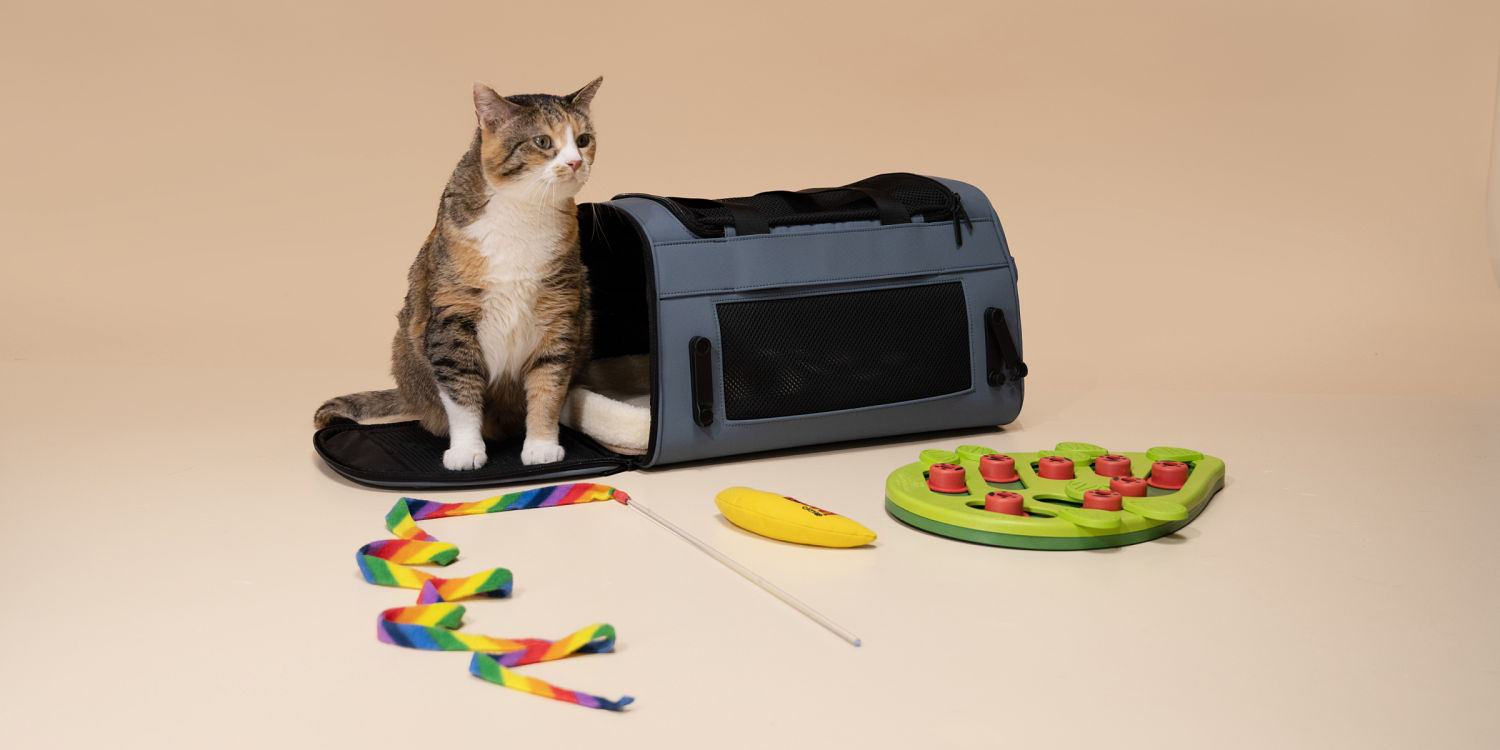
Wand toys—comprising a flexible rod, a length of cord, and a detachable lure made of feathers, fur, or fabric—represent the gold standard for human-guided play.
- Mechanism: The human operator mimics the erratic, ground-hugging movements of a rodent or the fluttering trajectory of a bird.
- Tactile Resolution: Unlike a laser, the lure has mass and texture. When the cat pounces, its claws sink into the material. The operator must intentionally drop tension on the line, allowing the cat to drag the "prey" away, deliver a simulated kill bite, and bunny-kick the object.
- Operational Limitation: Wand toys require active human participation and deliberate pacing. Moving the lure too fast replicates the frustration of a laser; the operator must allow the cat to catch the lure every two to three minutes to maintain engagement.
Self-Propelled and Automated Mechanical Toys
For periods when human operators are unavailable, battery-operated or motorized toys provide autonomous movement, though they carry distinct design constraints.
- Mechanism: Devices such as concealed-motion mats (where a wand rotates beneath a fabric skirt) or erratic motorized balls trigger the stalk-and-pounce reflex through unpredictable, obscured movement.
- Tactile Resolution: The cat can physically pin the moving component through the fabric or trap the ball against a baseboard.
- Operational Limitation: Feline habituation occurs rapidly with predictable algorithms. If a motorized toy moves on a fixed timer or identical geometric loop, the cat will classify it as inanimate furniture within days. These devices require rotation—deployed for 20 minutes and stored out of sight between sessions—to preserve novelty.
Kicker Toys and Heavy Plush Lures
Standard small mice toys fail to satisfy the wrestling reflex required during Stage 4 of the predatory sequence.
- Mechanism: Elongated, cylindrical plush toys (typically 10 to 14 inches in length) filled with dense cotton, crinkle material, or catnip allow the cat to grapple with its forepaws while raking forcefully with its hind legs.
- Tactile Resolution: This "bunny-kicking" behavior is an evolutionary adaptation used to disembowel larger prey. Heavy kickers absorb high-force claw strikes without tearing, offering deep proprioceptive feedback that drains excess physical energy.
- Operational Limitation: Kicker toys have zero independent movement. They must be introduced manually during high-arousal play or tossed directly into the cat's path to trigger the grappling response.
Food-Dispensing Puzzles and Foraging Devices
To fully close the predatory loop, play must transition directly into caloric intake. Food puzzles merge Stage 3 (capture) with Stage 4 (consumption).
- Mechanism: Rolling treat balls, stationary sliding-block boards, or slow-feeder bowls force the cat to use its paws and snout to extract dry kibble or freeze-dried meat.
- Tactile Resolution: The cat experiences direct cause-and-effect agency. Physical manipulation yields an immediate, edible reward, triggering the parasympathetic "rest and digest" response.
- Operational Limitation: Difficulty must be scaled precisely. Introducing a complex, multi-step puzzle to a cat accustomed to free-feeding from an open bowl causes immediate abandonment. Operators must start with low-friction, high-yield puzzles where kibble falls out with minimal paw contact, gradually increasing mechanical resistance over several weeks.
Executing the Transition Protocol
If a household has relied heavily on a laser pointer, removing it abruptly without replacing the stimulation outlet will cause vocalization and restlessness. Owners must execute a structured transition that recalibrates the cat's expectations around play.
- Immediate Decommissioning: Remove the laser pointer from the cat's environment entirely. Do not use it as a warm-up tool. Even brief exposure re-triggers the incomplete dopamine loop.
- The Bridge Technique (For Laser-Fixated Cats): If a cat refuses to engage with physical toys due to laser conditioning, use the laser once to lead the cat directly onto a stationary physical object, such as a dense kicker toy or a pile of treats. The instant the cat pounces on the physical object, turn the laser off permanently. This transfers the hunting focus onto a tangible target.
- Structured Session Pacing: Conduct two to three 10-minute wand play sessions daily, timed immediately before scheduled meals. Mimic natural prey behavior: move the lure away from the cat rather than shoving it in its face, utilize corners and furniture to break line-of-sight, and slow the lure down when the cat prepares to pounce.
- The Wind-Down Sequence: Never end a play session at peak velocity. During the final two minutes of wand play, reduce the speed of the lure, letting the cat catch and hold it for extended periods. Once the cat loses interest in the "dead" prey, immediately serve its meal or deploy a loaded food puzzle.
Strategic Recommendation for Feline Enrichment
Audit your current inventory of cat toys and eliminate any device that generates visual stimulation without physical resistance. Standardize your household enrichment around a closed-loop system: initiate high-intensity movement with an interactive wand toy, allow physical capture and wrestling via a heavy kicker, and terminate every session with a caloric reward delivered through a foraging puzzle. If a laser pointer remains in the home, restrict its use exclusively to emergency scenarios—such as luring a panicked cat out from under an inaccessible structure during a medical crisis or evacuation—and immediately follow the capture with high-value wet food to neutralize the resulting stress spike.