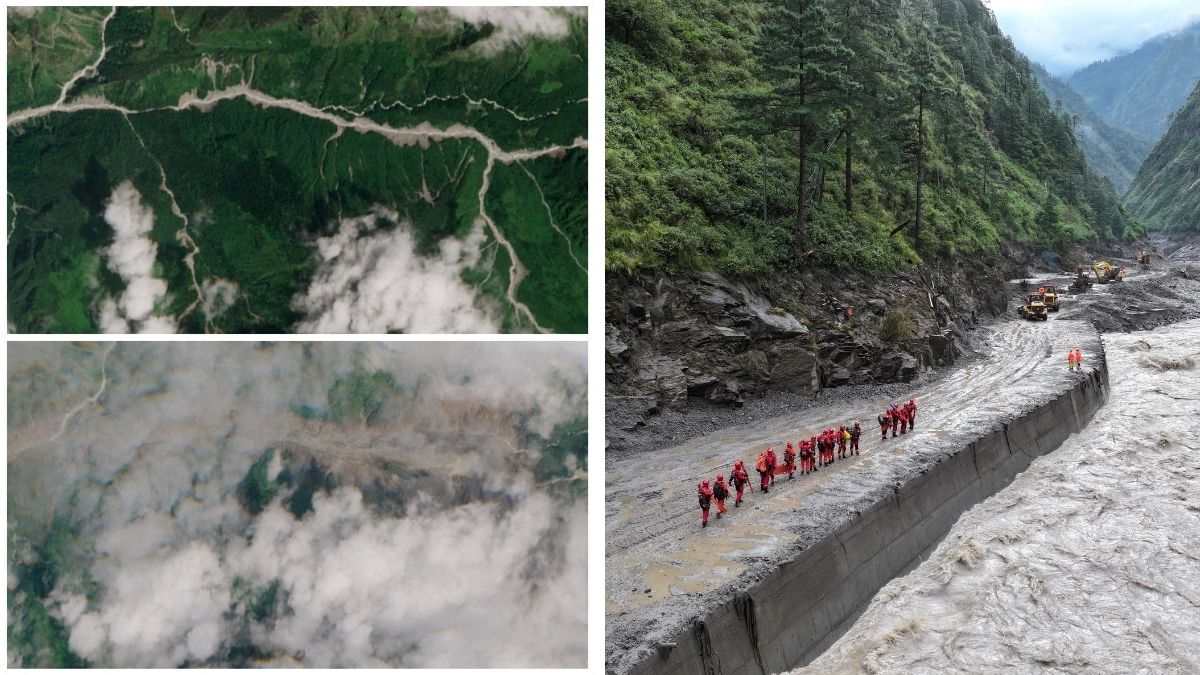
Panic swept through Nepal's rugged northern valleys when a massive landslide-dammed lake on the Chinese border began overflowing. Teams searching for survivors of a catastrophic flash flood had to drop their tools and run for high ground.
The disaster began with a sudden glacial collapse in the Himalayas. Tons of ice, rock, and mud tore down mountain slopes, wiping out settlements, bridges, and critical infrastructure. It left hundreds dead and nearly a thousand missing across Nepal and Tibet. But the immediate violence of the initial flood was only the first act. Debris choked the river channels, forming an unstable barrier lake that is now swelling rapidly.
The Anatomy of a Secondary Disaster
When a natural dam forms overnight, danger multiplies exponentially. Water pours into the basin faster than it can escape. Chinese state media and engineering teams monitoring the site reported that the reservoir swelled past 2.5 million cubic metres. That volume equals roughly one thousand Olympic-sized swimming pools held back by loose gravel, mud, and shattered rock.
Authorities on both sides of the border faced an agonizing choice. With water spilling over the edges of the makeshift dam, the risk of a catastrophic blowout forced an immediate halt to rescue operations. Chinese response units pulled back their personnel and heavy vehicles to safe zones. Nepalese officials sounded sirens in vulnerable downstream towns like Bidur, prompting residents to scramble up steep hillsides with whatever belongings they could grab.
Ground teams searching through thick layers of mud for trapped survivors at sites like the Upper Trishuli-1 Hydropower Project had to evacuate instantly. Every minute spent waiting for the barrier lake to stabilize is a minute lost for people trapped in pockets beneath the rubble or inside flooded tunnels.
Why Himalayan Infrastructure Is Breaking Down
This catastrophe exposes a harsh reality about high-altitude engineering and climate pressures. Glacial retreats are accelerating across the Himalayas. As permafrost thaws and glaciers destabilize, massive chunks of rock and ice break loose with little warning.
When these materials crash into narrow river gorges, they act like concrete mixers. They pick up debris, smash through hydropower dams, and bury remote access roads. The Gyirong Port crossing and surrounding trade routes between Nepal and Tibet have been completely fractured. Heavy machinery cannot reach the most critical choke points because the roads themselves were washed away or buried under meters of sludge.
Governments are struggling to respond. China deployed specialized engineering teams equipped with drones and 3D modeling software to assess the structural integrity of the barrier lake. President Xi Jinping and senior leadership called for rigorous scientific tracking of glacial lakes to prevent future surprises. Meanwhile, Nepal deployed thousands of security personnel to scour remote riverbanks, relying heavily on helicopters because ground routes no longer exist.
The Reality on the Ground
Numbers tell a grim story, but they miss the human cost. Entire families vanished within seconds as walls of water swallowed mountain villages. Survivors left standing in evacuation camps face ruined local economies, contaminated water supplies, and blocked relief channels.
The overflowing border lake acts as a literal ceiling on recovery efforts. Until engineers can safely drain or breach the barrier without triggering a secondary wave, food, medicine, and rescue workers cannot move freely into the hardest-hit gorges.
Local authorities continue to monitor water levels along the Bhotekoshi and Trishuli rivers hourly. Residents living downstream remain on high alert, sleeping near evacuation routes with bags packed. The mountain has not finished speaking, and the communities below are bracing for whatever comes next.