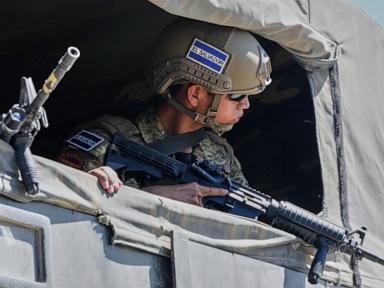
Nayib Bukele’s offer to fix Haiti’s gang crisis is a calculated geopolitical play designed to solidify his domestic political brand and extract diplomatic capital from Washington. Facing upcoming electoral cycles and lingering economic stagnation at home, the Salvadoran president is exporting his most successful political product—iron-fisted security—to a collapsing Caribbean nation. While the move frames El Salvador as an indispensable regional stabilizer, it carries immense operational risks for Salvadoran forces and threatens to expose the limits of the "Bukele Model" when stripped of its unique local conditions.
To understand why San Salvador is looking toward Port-au-Prince, you have to look at the ledger of Salvadoran politics. Bukele did not rise to near-absolute power on economic miracles. He rose on the back of the Territorial Control Plan and a prolonged state of exception that dismantled MS-13 and Barrio 18, turning the murder capital of the world into one of the safest countries in the Western Hemisphere. Expanding on this idea, you can find more in: Inside the Mass Email Bomb Threat Crisis Paralyzing Italian Schools.
That security dividend, however, has a shelf life. Voters eventually stop thanking you for yesterday's safety and start asking about today's grocery bills.
The Domestic Calculus Behind Foreign Intervention
In Central American politics, foreign policy is almost always domestic theater. By volunteering El Salvador’s security apparatus to pacify Haiti, Bukele accomplishes three immediate objectives without deploying a single soldier onto Caribbean soil. Experts at USA Today have also weighed in on this matter.
First, it reinforces his image as a historic strongman capable of solving problems that baffle global superpowers. When the United States, Canada, and the United Nations appear paralyzed by the anarchy in Port-au-Prince, Bukele steps forward with a simple, seductive proposition. He offers order where others offer committees. For a domestic electorate consuming state-curated media, seeing their president lecture the international community on security competence is intoxicating.
Second, it distracts from stubborn structural vulnerabilities at home. El Salvador remains saddled with high public debt, sluggish foreign direct investment, and a high cost of living. Bitcoin adoption, once touted as a silver bullet for financial inclusion and tourism, has failed to transform the daily economic reality of the average Salvadoran worker. Projecting power abroad keeps the national conversation anchored firmly on security—the one arena where Bukele holds an undisputed monopoly on success.
Third, it serves as pre-election insurance. Even when electoral outcomes appear heavily tilted in favor of the ruling party, authoritarian-leaning populists rely on continuous momentum. They cannot afford to look static. A bold foreign intervention—or even the mere credible offer of one—generates endless news cycles, rallies nationalist pride, and paints domestic critics as unpatriotic defeatists.
Exporting the Bukele Model Across the Caribbean
The premise of Bukele’s Haiti pitch is deceptively straightforward. If Salvadoran police and military units could neutralize tens of thousands of hardened gang members in San Salvador, they can theoretically do the same against the armed coalitions terrorizing Haiti.
This logic ignores the fundamental mechanics of how El Salvador actually won its gang war.
The Salvadoran crackdown succeeded because of three specific, localized factors that do not exist in Haiti:
- Institutional Cohesion: Despite decades of corruption, El Salvador possessed a functioning, centralized military and national police force with clear chains of command, reliable intelligence networks, and total loyalty to the executive branch.
- Geographic Containment: El Salvador is the smallest country in continental America, possessing a relatively modern road network and manageable borders. Gang members had nowhere to hide once the state decided to saturate every neighborhood simultaneously.
- Absolute Legal Suspension: Bukele’s government suspended constitutional rights, eliminated due process, and built mega-prisons like CECOT capable of holding tens of thousands of detainees indefinitely without trial.
Haiti offers none of these baseline conditions.
Port-au-Prince is not a functioning state dealing with a severe crime wave; it is a collapsed state where armed federations—such as the Viv Ansanm alliance—outgun, outnumber, and outmaneuver the remnants of the Haitian National Police. There is no intact judicial system to process arrests, no prison infrastructure capable of holding thousands of combatants without immediate jailbreaks, and no reliable local bureaucracy to hold territory once it is cleared.
Furthermore, the nature of the adversaries differs wildly. Salvadoran maras were deeply embedded in local communities, relying on visible tattoos, strict hierarchies, and localized extortion rackets that made them relatively easy for state intelligence to map once political will was applied. Haitian gangs operate more like decentralized warlord militias. They control critical infrastructure, ports, fuel terminals, and major highways, effectively holding the entire national economy hostage while blending seamlessly into dense, unmapped urban slums.
The Washington Angle and Diplomatic Leverage
To view this maneuver purely through a Latin American lens is to miss half the board. Bukele’s overture is aimed directly at Washington.
For years, the relationship between the White House and San Salvador has been frosty, strained by U.S. sanctions on Bukele’s inner circle, criticism of democratic backsliding, and the dismantling of judicial independence. Yet, Washington desperately needs a solution in Haiti. A full-scale collapse in Port-au-Prince guarantees a massive migration wave toward the southern U.S. border and the Florida coast—a political nightmare for any U.S. administration during an election year.
Washington does not want to put American boots on the ground in Haiti. The ghosts of past interventions—from the 1915 occupation to the 1994 operation—still haunt the Pentagon. Relying on distant partners like Kenya to lead a multinational security mission has proven slow, underfunded, and logistically fraught.
Enter Bukele.
By offering Salvadoran expertise, intelligence, and tactical units, Bukele is positioning himself as the ultimate pragmatic partner. He is essentially telling Washington that if they want the Haitian migration crisis solved before ballots are cast in the U.S., they need to deal with him. In exchange for helping clean up a mess in America’s backyard, San Salvador expects tangible diplomatic rewards:
- Easing of Diplomatic Pressure: A quiet dialing back of State Department rhetoric regarding human rights, press freedom, and constitutional norms in El Salvador.
- Multilateral Financial Backing: U.S. support—or at least a lack of obstruction—at the International Monetary Fund (IMF) and the Inter-American Development Bank, where El Salvador urgently needs billions in financing to stabilize its debt load.
- Security Assistance: Renewed funding, military hardware, and intelligence sharing for the Salvadoran armed forces, framed as necessary support for regional peacekeeping.
It is a classic transactional play. Bukele understands that in geopolitics, usefulness trumps virtue every single time.
The Trap of Asymmetric Urban Warfare
If this remains a diplomatic bluff or a limited advisory mission, Bukele wins easily. He collects the headlines, banks the goodwill in Washington, and risks nothing.
If Salvadoran troops actually deploy to Port-au-Prince in a combat role, the entire calculus flips.
Urban counter-insurgency in a foreign country is a meat grinder for even the most elite militaries. Salvadoran soldiers, while battle-hardened against domestic street gangs, are not expeditionary forces. They lack heavy air support, advanced medical evacuation capabilities, and deep logistical supply chains required to sustain high-intensity operations overseas.
Worse, they would be operating blind.
In El Salvador, soldiers knew the streets, spoke the language, and understood the cultural codes of the neighborhoods they patrolled. In Haiti, Salvadoran troops would face a severe linguistic barrier—operating in a French and Haitian Creole environment—while navigating a hostile terrain where every rooftop and alleyway is contested by locals who view foreign forces with deep historical suspicion.
A hypothetical scenario illustrates the danger: imagine a platoon of Salvadoran special forces pinned down in the dense, labyrinthine corridors of Cité Soleil. Without immediate overhead drone surveillance, heavy armored extraction, and reliable local intelligence, a routine patrol turns into a prolonged firefight. The moment the first flag-draped coffins return to San Salvador, the narrative of effortless invincibility shatters.
Domestic opposition in El Salvador, currently marginalized and disorganized, would suddenly possess a potent rallying cry. Mothers do not easily forgive leaders who send their sons to die in foreign wars that have no direct bearing on their own safety.
The Illusion of the Quick Fix
The broader danger of Bukele’s Haiti gamble lies in the seductive lie it sells to the rest of the hemisphere. Across Latin America—from Ecuador and Honduras to Chile and Peru—politicians are frantically trying to copy-paste the Salvadoran security blueprint to appease terrified voters.
Haiti represents the ultimate stress test for this ideology.
Security crackdowns can clear streets, fill prisons, and temporarily halt extortion. They cannot build courts, educate youth, create formal jobs, or forge a social contract where none exists. In El Salvador, the state already existed; it merely needed to assert its monopoly on violence. In Haiti, the state itself must be invented from scratch before any security gain can become permanent.
Bukele is betting that the optics of decisive action will outweigh the messy realities of nation-building. He is wagering that he can leverage his reputation as a gang-slayer to extract concessions from global powers while keeping his domestic base hypnotized by his ambition.
History suggests that exporting a domestic political miracle rarely works as advertised. Strongmen thrive when they control every variable on the board, from the courts to the cameras, and Haiti is the one place on earth where nobody controls anything at all.


