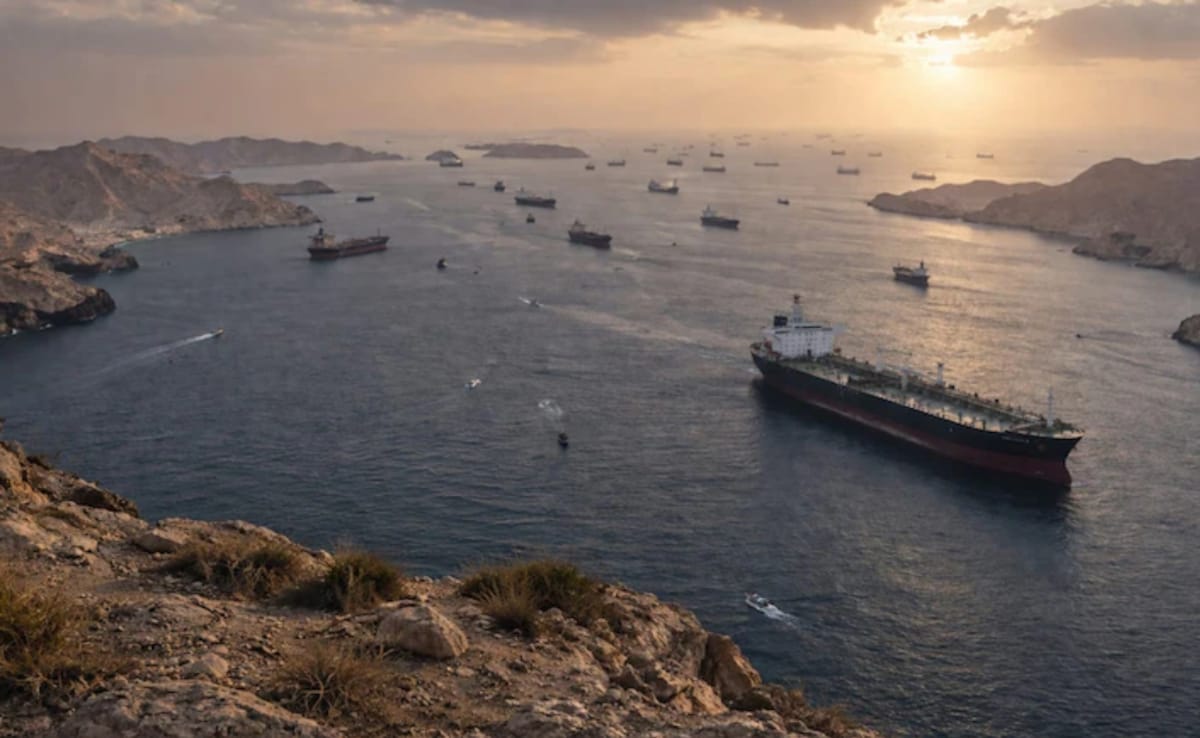
The headlines are screaming about a US-led blockade of Iranian ports as if we are back in 1914. It is a seductive narrative for cable news producers and defense contractors looking for a bump in stock price. It suggests a world where the US Navy can simply park a fleet in the Strait of Hormuz, turn off the lights, and starve the Iranian regime into submission.
It is also a total fantasy.
If you believe a "blockade" is a viable strategic move in 2026, you are reading the wrong map. We are witnessing the death of traditional naval dominance in the face of asymmetric drone swarms and precision-guided ballistic systems. A blockade is no longer a show of force; it is an invitation to a localized slaughter that the West is currently ill-equipped to win without escalating to a nuclear threshold.
The Logistics of a Ghost Blockade
Most analysts treat the Strait of Hormuz like a garden hose you can just kink with a thumb. It’s 21 miles wide at its narrowest point. But the actual shipping lanes—the deep-water channels where the massive VLCCs (Very Large Crude Carriers) move—are only two miles wide.
The "lazy consensus" says the US controls these lanes. In reality, Iran’s Islamic Revolutionary Guard Corps (IRGC) has spent thirty years turning the northern shore into an unsinkable aircraft carrier.
A blockade requires "on-station" presence. You have to be there. You have to stay there. You have to intercept, board, and search. In the age of the Khalij Fars anti-ship ballistic missile and the Shahed-136 loitering munition, putting a multi-billion dollar Destroyer within 50 miles of the Iranian coast is the maritime equivalent of standing in a dark room with a target painted on your chest while your opponent has night-vision goggles.
I’ve spent enough time in risk-assessment rooms to know that "maritime security" is often a polite term for "praying the insurance premiums don't spike." A blockade doesn't stop Iran; it destroys the global insurance market. The moment the first US vessel attempts a hard boarding in the Strait, the "War Risk" premiums for every tanker in the Persian Gulf will go parabolic. You aren't blockading Iran; you are blockading the global economy.
The Drone Swarm vs. The Aegis Myth
We love to talk about the Aegis Combat System. It’s a marvel of engineering. It can track hundreds of targets. But it is a victim of simple math.
An SM-2 interceptor missile costs roughly $2 million. A swarm of 50 carbon-fiber drones, launched from the back of a civilian truck on the Iranian coast, costs less than a luxury SUV.
Iran doesn't need to sink a US carrier to win a blockade confrontation. They just need to achieve "saturation." If they fire 100 cheap projectiles and only 5 get through, the mission is a success. If a US ship exhausts its vertical launch cells (VLS) defending itself, it has to retreat to a friendly port to reload. There is no "mid-sea" reloading for VLS.
A blockade isn't a wall; it's a sieve. And right now, the sieve is made of very expensive, very finite material.
The China Factor Everyone Is Ignoring
The competitor articles love to frame this as a three-way fight: US, Iran, Israel. They are missing the biggest player in the room.
China buys roughly 90% of Iran’s sanctioned oil. They don't do this through official channels. They use the "Dark Fleet"—a collection of aging tankers with spoofed AIS (Automatic Identification System) signals, flying flags of convenience, and performing ship-to-ship transfers in the middle of the night.
Does the US have the political stomach to seize a tanker that is effectively a Chinese floating asset?
Imagine a scenario where a US boarding party climbs onto a "Panamanian" flagged tanker, only to find the cargo is prepaid by a Chinese state-owned enterprise and the "security" on board is provided by a private firm with deep ties to Beijing.
A blockade of Iran is a direct kinetic confrontation with Chinese energy security. The US isn't just threatening Tehran; it’s poking the dragon’s gas tank. The White House knows this. The Pentagon knows this. The only people who don't seem to know this are the ones writing "LIVE Update" tickers.
Why Iran Actually Wants This Escalation
The status quo is a slow death for the Iranian economy. Sanctions are a grinding, boring misery.
A blockade, however, is a "Force Majeure" event. It allows Iran to:
- Consolidate Domestic Power: Nothing kills a protest movement like a foreign fleet at the gates.
- Weaponize Oil Prices: Iran doesn't need to export oil if they can drive the price of Brent Crude to $150 per barrel by simply threatening the Strait. They make more money on half the volume.
- Test the "Axis of Resistance": It forces Hezbollah, the Houthis, and Iraqi militias to activate.
The Western obsession with "containing" Iran through naval pressure is an outdated 20th-century solution to a 21st-century distributed-warfare problem. We are using a sledgehammer to try and hit a cloud of mosquitoes.
The Precision Strike Fallacy
"We will just take out their coastal batteries," says the armchair general.
The IRGC has spent decades building "missile cities"—deep, underground bunkers carved into the Zagros Mountains and coastal cliffs. These aren't just storage sheds; they are launch facilities. You can't "take them out" with a few Tomahawks. You need a sustained, weeks-long bombing campaign that would require the total suppression of Iranian air defenses—an endeavor that would make the opening days of the Iraq War look like a training exercise.
Furthermore, Iran’s naval strategy is built on the Bavar-373 and the Khordad-15 systems. While Western media mocks Iranian tech, these systems are increasingly capable of making high-altitude operations extremely risky for anything other than F-35s.
The Energy Transition Irony
The irony of a 2026 blockade is that it accelerates the very thing Iran fears most: the global shift away from fossil fuels. But in the short term—the next 24 to 60 months—the world is still addicted to the 21 million barrels of oil that pass through the Strait daily.
If the US actually initiates a blockade, they aren't just fighting Iran. They are fighting the gas stations in Ohio, the factories in Germany, and the trucking fleets in India.
The US is an energy exporter, yes. But oil is a fungible global commodity. If the Strait closes, the price goes up everywhere. The political blowback of $7-per-gallon gasoline in an election cycle is a more potent weapon against the US government than any missile Iran possesses.
Stop Asking if the Blockade Will Work
The question isn't whether a blockade will stop Iran’s nuclear program or its regional meddling. It won't.
The real question is: Who benefits from the illusion of a blockade?
- The Military-Industrial Complex: Who gets to sell more interceptors and "littoral" ships that don't actually work in high-intensity zones.
- Hardliners in Tehran: Who get to justify their existence and their budget.
- Short Sellers: Who are betting on the collapse of global logistics.
A blockade is a theatrical performance. It is a high-stakes game of chicken where both drivers are blindfolded and the spectators are the ones who will get hit.
The US Navy is the finest force ever assembled, but it is designed for open-ocean dominance and carrier group projection. It is not designed to sit in a bathtub filled with 20,000 "smart" mines and thousands of suicide boats.
The moment we commit to a blockade, we surrender the initiative. We hand Iran the "red button" for the global economy. We move from a position of strategic ambiguity to a position of tactical vulnerability.
If you want to disrupt Iran, you don't park a ship in their front yard. You dismantle their shadow banking networks in Dubai, you aggressively target their drone supply chains in Asia, and you provide the Iranian people with the tools to bypass the IRGC's internal "blockade" of the internet.
But that doesn't make for a very good "LIVE Update" headline, does it?
The Strait of Hormuz isn't a chokepoint for Iran. It's a trap for the West. And we are currently steaming toward it at full speed, cheering all the way.
The blockade is a ghost. The threat is a distraction. The real war is being fought in the code, the chips, and the dark-market ledgers where the US Navy has no jurisdiction and no cannons.
Stop looking at the ships. Look at the insurance premiums and the AIS spoofing data. That is where the war is being won, and right now, the West is losing.