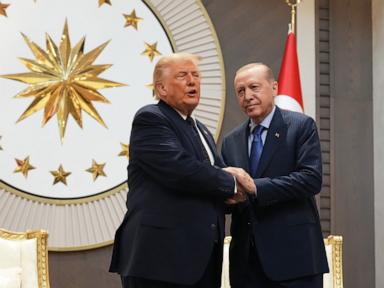
The North Atlantic Treaty Organization is throwing a multibillion-dollar shopping party in Ankara, and the guest of honor is completely unimpressed. On Tuesday, European leaders gathered at a defense industry forum in the Turkish capital to unveil a massive wave of arms contracts. The timing is deliberate. The "Big Reveal," as alliance officials dubbed it, was carefully engineered to land just hours before U.S. President Donald Trump arrived for the annual summit. The objective was simple: demonstrate that Europe is finally buying its own teeth.
It is a desperate strategy. By rolling out tens of billions of dollars in new commitments for air defense systems, naval vessels, and high-tech surveillance platforms, NATO leadership hoped to pre-empt the president's predictable fury over defense spending. But interviews with senior diplomats, defense analysts, and administration officials reveal a harsh reality. This grand display of economic muscle is failing to address the fundamental shift in Washington. Trump is no longer just looking at accounting spreadsheets. He wants absolute geopolitical obedience, a demand that Europe cannot, and will not, fulfill.
The Illusion of the Big Reveal
The contracts announced in Ankara are massive on paper. Under intense pressure, European capitals have signed off on procurement plans that would have been politically unthinkable five years ago. The Dutch government is pushing through a three-billion-euro package for collaborative air defense with Belgium and joint naval construction with Britain. Canada has finally moved forward on a long-delayed naval modernization plan, selecting Germany’s TKMS to build up to 12 new submarines. Meanwhile, the alliance is replacing its ancient fleet of U.S.-made AWACS surveillance aircraft with Sweden’s Saab GlobalEye system.
The numbers look staggering. NATO Secretary-General Mark Rutte proudly noted that European allies and Canada injected 90 billion dollars more into defense in 2025 than the previous year, pushing total non-U.S. alliance spending past 570 billion dollars.
But look closer at the fine print. Most of these deals were planned, negotiated, or even quietly signed months before anyone set foot in Turkey. The alliance merely bundled these existing industrial milestones into a singular, manufactured public relations event. It is theater. It is an attempt to create a sudden wall of spending data to deflect American criticism.
This corporate stage-management ignores the structural rot in European manufacturing capacity. Signing a contract is not the same as taking delivery of a missile. European defense factories are choked by supply chain bottlenecks, a lack of skilled labor, and fragmented national regulations. A contract signed in Ankara today will likely not yield operational hardware on the ground until the end of the decade. The alliance is flaunting paper commitments while its actual, immediate stockpiles remain dangerously depleted.
Shifting the Goalposts to Five Percent
The financial baseline has shifted completely. During his first term, Trump fixated on the historic two percent of gross domestic product spending target established at the 2014 Wales summit. That number is now ancient history. At the 2025 retreat in The Hague, intense American pressure forced member states to agree to an astonishing new benchmark: five percent of GDP by 2035.
The breakdown of this goal exposes the internal panic. Allies are expected to direct 3.5 percent of their economic output straight to core defense budgets. The remaining 1.5 percent must go toward civilian infrastructure, including roads, bridges, railways, and ports designed to move heavy military hardware rapidly across the continent.
The enforcement mechanism has arrived. U.S. Ambassador to NATO Matt Whitaker explicitly warned that the Ankara summit would serve as the first hard measurement of progress toward this five percent threshold. Washington is demanding concrete, immediate roadmaps, not vague promises for the mid-2030s. Some nations are moving quickly. Poland, the Baltic states, and the Nordic countries are already leading the surge. Germany claims it is on track to hit the five percent mark by 2029.
Others are openly resisting. Spain has publicly balked at the sheer scale of the financial commitment, arguing that its security contributions cannot be measured solely by arbitrary accounting percentages. Trump’s response to this hesitation was characteristically transactional, with the president threatening total trade cutoffs for underperforming nations. The White House is actively drawing up potential economic and diplomatic penalties for countries that lag behind. The historic principle of unconditional mutual defense is dying, replaced by a pay-to-play security pact.
The Loyalty Test Europe Failed
The true fracture in the alliance has nothing to do with money. It is about the war in Iran. When Washington and Israel launched military operations against Tehran, European capitals pointedly refused to join the conflict. While they granted the U.S. military permission to utilize European airspace and logistical bases, they kept their own forces out of the fighting.
The political fallout was immediate. Trump viewed this hesitation as a betrayal of the highest order. In recent public statements, the president dismissed the alliance's spending increases out of hand, stating bluntly that Washington does not need Europe's money, but rather its total loyalty.
This creates an impossible dilemma for European leaders. Their voters are deeply hostile to a wider Middle Eastern war that has already destabilized global energy markets and sent shockwaves through the continental economy. European prime ministers cannot politically afford to send their troops into a conflict they did not vote for, yet failing to do so validates Trump’s belief that NATO is a one-sided arrangement. The multi-billion-dollar arms buying spree in Ankara is a desperate attempt to substitute cash for combat compliance. It is a bribe that Washington has no intention of accepting.
The Posture Review and NATO 3.0
The American withdrawal is already underway. This is not a rhetorical threat for a future term. The Pentagon has launched a comprehensive posture review and has begun systematically drawing down its military footprint on the continent. Five thousand American troops are being reassigned out of Germany. Crucial strategic assets, including an aircraft carrier group, aerial refueling tankers, advanced fighter squadrons, and long-range surveillance drones, are being quietly stripped from NATO’s immediate defense plans.
The Pentagon calls this transition NATO 3.0. The strategic logic is transparent. Washington wants to completely outsource the conventional defense of Europe to European governments, freeing American military resources to focus entirely on China and the Indo-Pacific theater.
The consequence is an unhealthy, panicked rush toward defense privatization. To fund this sudden military buildup, European states are turning to massive debt accumulation. The European Union is establishing a system of cheap loans funded by raising up to 170 billion dollars on capital markets. The European Stability Mechanism recently issued a stark warning that this debt-fueled militarization is rapidly becoming the central fiscal crisis of the decade. Europe is borrowing billions from its economic future to buy weapons today, all to placate an American administration that is structurally reorienting its empire away from the Atlantic.
Erdogan Intermediary Advantage
The choice of Ankara for this summit is a masterclass in geopolitical leverage. Turkish President Recep Tayyip Erdogan occupies a unique position within the alliance. He maintains deep, complex economic ties with Russia, purchases Moscow's air defense hardware, and regularly frustrates his Western peers. Yet he enjoys a uniquely warm, personal rapport with Trump.
Turkey is using this summit to cash in. Behind the scenes, Turkish officials are leveraging their relationship with the White House to undo years of military sanctions. Ankara is pushing hard to rejoin the F-35 fighter jet program, from which it was expelled in 2019 after purchasing Russia's S-400 missile system.
This horse-trading infuriates other alliance members and key regional players. Israeli Prime Minister Benjamin Netanyahu has actively lobbied Washington against restoring Turkey's access to the F-35, arguing that it would fundamentally upset the balance of power in the region. But Trump’s foreign policy thrives on these exact types of personalized bilateral deals, bypassing institutional NATO channels entirely. While European leaders try to present a unified front of 32 nations, individual actors like Turkey are successfully negotiating their own security arrangements directly with the American president.
The Dangerous Illusion of Safety
Europe’s leaders are trapped in a profound delusion. They believe that if they spend enough money, sign enough contracts, and buy enough American-made munitions, the transatlantic relationship will return to its twentieth-century status quo. They are wrong. The structural forces driving the American pivot away from Europe are permanent, spanning across both political parties in Washington.
The billions of dollars unveiled in Turkey will not change this trajectory. The weapons on display are a drop in the bucket compared to the massive operational capabilities that the United States is currently withdrawing from the continent. Europe cannot buy its way out of geopolitical responsibility anymore. The true test facing the continent is not whether it can please a volatile American president with a well-timed press release, but whether it can survive standard conventional deterrence entirely on its own.


