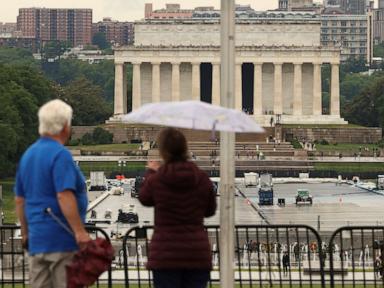
The Lincoln Memorial Reflecting Pool is hemorrhaging 16 million gallons of water every year into the marshy soil of the National Mall. For over a century, this 2,000-foot mirror has been the stage for the nation’s most sacred gatherings, but beneath the surface, it is a structural sieve. The latest repair efforts have ballooned into a $15 million battle of ideologies, pitting traditional conservation against a "quick-fix" culture that threatens to permanently alter the aesthetic of the capital.
While recent reports focus on the sheer cost of the repairs, the real crisis lies in the repeating cycle of failure that has plagued the basin since 1922. The pool was built on dredged river clay and soft mud, a foundation that essentially ensures the structure will never stop sinking. Every decade, the federal government throws millions at a problem that physics has already decided is unsolvable without a total, multi-year reconstruction.
The Marshland Curse
Washington D.C. was famously built on a swamp, and the Reflecting Pool is the ultimate victim of that geography. The original 1920s design lacked a proper foundation, leading to decades of uneven settling. By the time the Obama administration stepped in with a $34 million overhaul in 2010, the pool was leaking hundreds of thousands of gallons a week.
That massive project was supposed to be the "forever fix." Engineers drove 2,133 timber pilings 40 feet deep into the bedrock to support a new concrete basin. They installed a modern filtration system to replace the old method of simply draining and refilling the pool when it got too dirty. Yet, within weeks of reopening in 2012, the pool was choked with algae. Within five years, the leaks returned. The soil shifted, the joints cracked, and the cycle began anew.
The current $15 million expenditure is not a single project but a desperate accumulation of triage. This includes $6.9 million for a controversial resurfacing contract and millions more in lost water costs and emergency plumbing repairs. We are paying a premium to keep a sinking ship afloat.
Blue Paint and No Bid Contracts
The most recent chapter of this saga involves a radical departure from federal preservation standards. In early 2024, the administration bypassed the traditional, multi-year procurement process—which had estimated a full granite replacement at $301 million—in favor of an "urgent" $1.5 to $2 million resurfacing.
The choice to use a "no-bid" contract was justified by the White House as a necessity to prevent "serious injury" to the government’s image ahead of the 2026 bicentennial celebrations. The result is a vibrant "American Flag Blue" industrial coating applied directly over the historic granite floor. Critics and preservationists call it a "sin" against the monument's integrity. They argue that painting over high-end granite with a swimming-pool liner is the equivalent of putting a plastic slipcover over a Sheraton sofa.
There is a hard truth at play here. The $301 million alternative, proposed under the previous administration, would have taken three to four years to complete. That timeline would have left a giant, muddy construction pit in front of the Lincoln Memorial during the nation's 250th-anniversary events. The $15 million "patchwork" strategy is a political choice to prioritize optics over engineering longevity.
The Algae and Parasite Paradox
Water loss isn't the only ghost in the machine. The pool’s shallow depth—only 18 inches at the edges—creates a perfect incubator for biological issues. When the sun hits those six million gallons of water, it creates a stagnant, warm environment where algae thrives.
The 2012 upgrade introduced an ozone disinfectant system, but it has proven insufficient against the sheer volume of organic matter dropped by the local duck population. In 2017, the pool had to be drained after a parasitic outbreak killed nearly 100 ducks and posed a risk of "swimmer's itch" to tourists who dared to dip their toes.
The "blue" resurfacing is pitched as an algae deterrent, with a slicker surface that is easier to scrub. However, if the underlying leaks in the 2.5 miles of expansion joints aren't sealed perfectly, the water will continue to migrate behind the new coating. This creates "bubbles" in the liner, leading to even more expensive repairs within three to five years. We are trading a stone-and-water problem for a chemical-and-plastic one.
The Price of Stalling
The National Park Service (NPS) currently faces a $22 billion maintenance backlog across its entire portfolio. Spending $15 million on a cosmetic "band-aid" for the Reflecting Pool means seven other historic fountains or monuments go without critical care.
Taxpayers are effectively paying for the same repair every decade because the government refuses to commit to the $300 million "final" solution. It is a classic case of being "too poor to buy cheap." By opting for the $15 million short-term fix, the government is essentially guaranteeing that a future administration will have to spend $500 million when the current "American Flag Blue" coating inevitably fails and the granite underneath is found to be further degraded.
The Reflecting Pool is a metaphor for the Mall itself: magnificent on the surface, but crumbling underneath due to a century of deferred maintenance and the unforgiving reality of the land it sits on.
Investors and taxpayers should look at the $15 million figure not as a total cost, but as a down payment on a recurring debt. The leaks will return. The algae will bloom. The blue will fade. Unless we are willing to close the Mall for four years and rebuild the basin from the bedrock up, we are simply buying time at a rate of $1.5 million per year. Stop treating the symptoms and start admitting that the foundation is the disease.