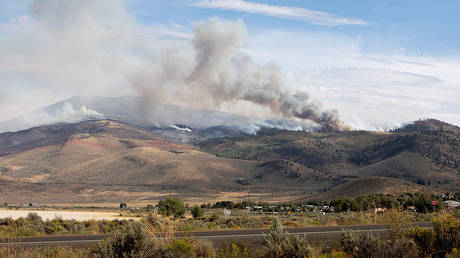
Ash does not fall like snow. Snow has a gentle architecture, a quiet drifting quality that hushes the world. Ash is heavy, greasy, and aggressive. It smells of burnt pine, melted plastic, and the finality of things that took centuries to grow disappearing in minutes.
When the air turns the color of a bruised plum, time splits into two distinct eras: before the smoke came, and everything after.
Forty-two thousand people learned that division in a matter of hours. They packed birth certificates into glove compartments, coaxed terrified pets into plastic crates, and watched their rear-view mirrors fill with a wall of orange that painted the desert sky like an open wound.
Nevada is a land accustomed to harsh extremes. People out here respect the sun, the alkali flats, the distance between water sources. But respect is a transaction based on predictable rules. Fire does not care about rules. Fire is an appetite with a wind behind it.
To understand what happened when the flames devoured the acreage outside Reno, you have to look past the cold digits reported on the evening news. You have to look at the human element. Statistics are sanitized. Forty-two thousand is just a number until you realize it represents forty-two thousand individual kitchen tables left abandoned mid-meal. It represents coffee cups still warm on counters, bedroom doors left wide open, and the frantic, instinctual scramble to save whatever fits in the trunk before the power grid fails and the traffic lights go dark.
Consider what happens next: the highway becomes a parking lot of blinking hazard lights.
I know this panic intimately. I know the metallic taste of fear that coats your tongue when the local emergency alert blares at three in the morning, piercing the dark with a tone that bypasses logic and speaks straight to the lizard brain. You do not think about your possessions. You think about breathing. You think about the people you love.
Officials would later confirm the root cause with a flat, bureaucratic certainty that felt almost insulting against the backdrop of so much ruin. It was human-caused. Not a lightning strike from a dry storm cell rolling off the Sierra Nevada. Not an act of distant geological indifference. Someone, somewhere, did something careless. A dragging trailer chain throwing sparks against the asphalt. An unextinguished cigarette tossed from a window. A campfire left smoldering in the brush.
A momentary lapse in judgment translating into a catastrophe of biblical proportions.
That is the terrifying vulnerability of modern life. We live in vast landscapes connected by delicate infrastructure, yet our collective fate often hangs on the smallest, most preventable errors. A single spark dropped in high-velocity winds can outrun a car, outmaneuver a localized evacuation plan, and rewrite the geography of a county before the fire crews even pull out of the station.
Evacuation centers swelled with displaced residents, filling school gymnasiums with the low murmur of shock. Cots were lined up row by row. Strangers shared coffee from paper cups, bonded by the sudden, violent erasure of their daily routines. Children clutched stuffed animals rescued at random, their eyes wide and dry, old beyond their years because they had just seen the hills behind their neighborhoods turn into a furnace.
Emergency responders worked in shifts that blurred into days, their faces caked in black soot, eyes red-rimmed from exhaustion and heat. They threw themselves between the advancing wall of flames and the suburbs, fighting a desperate holding action with water drops from heavy aircraft and bulldozer lines cut deep into the dry earth.
Air quality indexes hit hazardous levels, turning the entire region into a toxic zone where every breath felt like inhaling fine glass. Schools closed. Businesses shuttered. The economy of an entire community paused, holding its breath while the wind shifted, praying for a merciful drop in temperature or a sudden change in direction.
Yet, amidst the chaos, something elemental and enduring emerged. Neighbors who had never spoken across chain-link fences found themselves loading elderly residents into pickup trucks. Animal shelters mobilized volunteers to wrangle terrified livestock and stray pets. Food banks overflowed with donations from neighboring towns that watched the plumes rise and instantly understood that next time, the wind might blow toward them.
This is the hidden cost of our friction with nature. We build sprawling communities at the edge of the wilderness, pushing deeper into brushlands that have evolved to burn. We carve out lives in the dry heat, banking on the assumption that modern technology will always be there to bail us out when the bill comes due.
The hills will eventually green over. New foundations will be poured where chimneys now stand as lonely sentinels over ash heaps. The traffic will return to the highways, and the memory of the smoke will fade into the background noise of seasonal anxiety.
Until the wind picks up again.
Until the sky turns plum-colored once more.
And forty thousand people look in their rear-view mirrors, searching for a horizon that has vanished behind the orange tide.