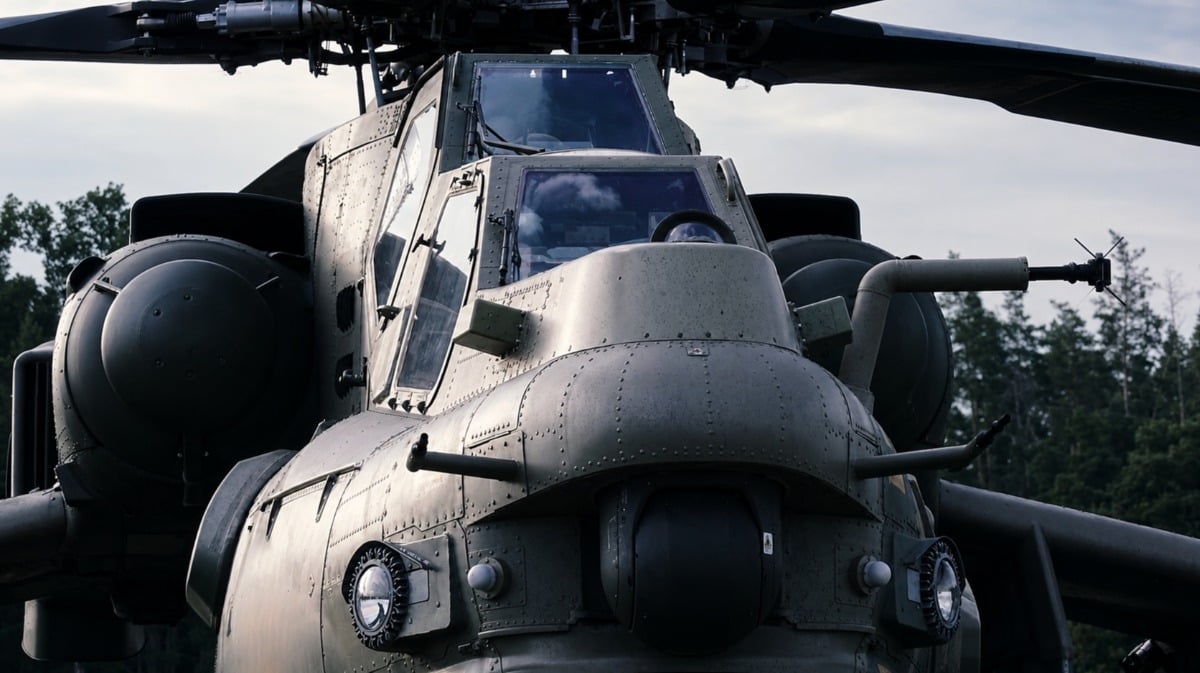
The mainstream defense media is currently swooning over reports that Russia has upgraded its Mi-28NM "Night Hunter" attack helicopter to hunt down Ukrainian reconnaissance and kamikaze drones. The narrative is comforting, cinematic, and profoundly stupid.
Commentators are painting a picture of high-tech dominance: a massive, heavily armored gunship using advanced radar, thermal imaging, and specialized air-to-air missiles to sweep the skies clean of cheap plastic quadcopters. It sounds like a triumph of adaptation.
It is actually a symptom of absolute desperation.
Deploying a $15 million to $18 million manned rotary-wing aircraft to hunt down $500 first-person view (FPV) drones is not a masterstroke. It is a mathematical and tactical failure. In the frantic rush to solve the defining battlefield threat of the 2020s, military planners are falling back on twentieth-century hardware biases, ignoring the brutal reality of attritional economics and physics.
The Deadly Fallacy of the Asymmetric Math
Spend five minutes reading standard defense blogs and you will see the same lazy consensus: Helicopters have guns, drones are slow, therefore helicopters can kill drones. Let’s look at the real math. The Mi-28NM is a magnificent piece of engineering for its original purpose—smashing tanks and providing close air support. It carries a 30mm Shipunov 2A42 cannon, R-74M short-range air-to-air missiles, and Vikhr anti-tank guided missiles.
Now look at the target. A Ukrainian Leleka-100, Shark, or a standard commercial DJI Mavic modified for reconnaissance. These platforms have a radar cross-section roughly equivalent to a large bird. They emit minimal thermal signatures. They hover close to the tree line or fly at altitudes where ground clutter completely blinds traditional airborne radar systems.
To engage these targets with a 30mm autocannon, the Mi-28NM must close the distance. It has to fly low, slow, and predictable.
I have watched defense procurement teams throw millions at "quick-fix" hardware modifications for decades, and the result is always the same: you cannot patch a systemic doctrine flaw with a new software update. By sending a massive twin-engine helicopter into the low-altitude airspace saturated with man-portable air-defense systems (MANPADS), electronic warfare jamming, and thousands of hostile kamikaze drones, you are risking a irreplaceable crew and a multi-million-dollar asset to kill a disposable piece of plastic.
The math is broken. If the helicopter shoots down twenty drones and gets taken down by one shoulder-fired missile or a lucky FPV drone strike to the tail rotor, the enemy wins the economic engagement by a factor of hundreds.
The Technical Nightmare of the Low-Altitude Hunt
Proponents of the Mi-28NM upgrade point to its upgraded N025 mast-mounted radar and the integration of the product 305 (LMUR) lightweight multi-purpose missile. They claim these tools allow the crew to spot and engage small aerial targets from a safe distance.
This ignores how radar works near the ground.
Doppler radar systems rely on the movement of a target relative to the background. When a drone is moving at 40 miles per hour over a windy forest where tree branches are swaying and the ground is reflecting radar waves, distinguishing the drone from the noise is an algorithmic nightmare. It creates massive amounts of radar clutter.
Furthermore, standard air-to-air missiles require a thermal or radar lock. Small electric drones do not put out the heat signature of a jet engine. A heat-seeking missile like the R-74M will struggle to lock onto a battery-powered quadcopter from miles away.
What about the 30mm cannon? The Shipunov 2A42 is devastating against an armored personnel carrier. But firing unguided kinetic rounds at a tiny, highly maneuverable drone while the helicopter itself is vibrating and moving creates a massive margin of error. The ammunition expenditure alone to down a single drone via manual gunnery defies the logic of sustained warfare.
Imagine a scenario where a Mi-28NM spots a reconnaissance drone at three kilometers. The pilot hovers to stabilize the aircraft for a gun run. In that exact window, the helicopter becomes the most visible, high-value target on the battlefield for every long-range artillery piece, anti-tank missile team, and kamikaze drone operator within a ten-mile radius. You have turned the hunter into the ultimate prize.
Moving the Goalposts: The Real Drone Threat
The question shouldn't be "Can a helicopter shoot down a drone?" The question must be "Is a helicopter the most efficient way to clear the skies?"
The answer is an absolute no.
Air defense must be cheap, distributed, and ground-based or automated. Relying on manned aviation to fix a drone problem is proof that the military industrial complex is failing to scale. The solution to a swarm of cheap, autonomous, or semi-autonomous machines is not a bigger machine with two humans inside it. The solution is ground-based directed energy weapons, automated electronic warfare networks, and short-range gun systems utilizing programmable airburst ammunition.
Using the Mi-28NM for drone hunting is the equivalent of using a Ferrari to plow a field because you don't have a tractor. It might technically move the dirt, but you ruin the car, waste a fortune in fuel, and eventually break the transmission.
The Operational Reality
Militaries that survive high-intensity conflicts learn that flexibility is everything. The Russian Aerospace Forces (VKS) have already lost significant numbers of modern attack helicopters to ground fire in this conflict. Pulling these assets away from their primary role—stopping armored breakthroughs and providing fire support to ground troops—to act as expensive, makeshift air defense platforms creates a dangerous capability gap elsewhere on the front line.
Every hour a Mi-28NM spends hunting quadcopters is an hour of flight strain put on its complex engines, rotors, and gearboxes. The maintenance footprint for these machines is massive. You are burning through precious airframe hours to accomplish a task that should be handled by a truck-mounted radar and a localized jamming unit.
Stop celebrating the adaptation. Start recognizing it for what it is: a desperate stopgap measure by a military that failed to build a functional, low-cost, short-range air defense umbrella for its troops.
The era of the lumbering attack helicopter dominating the low-altitude sky is over. The sky belongs to the swarm. Trying to fight that swarm with a twenty-ton legacy gunship isn't innovation. It is obsolescence looking for an excuse.
Land the helicopters. Build more electronic warfare trucks. Stop fighting tomorrow's war with yesterday's ego.