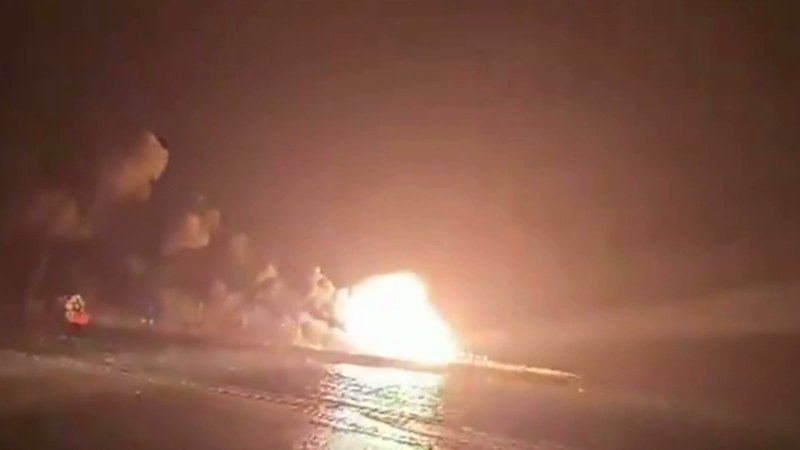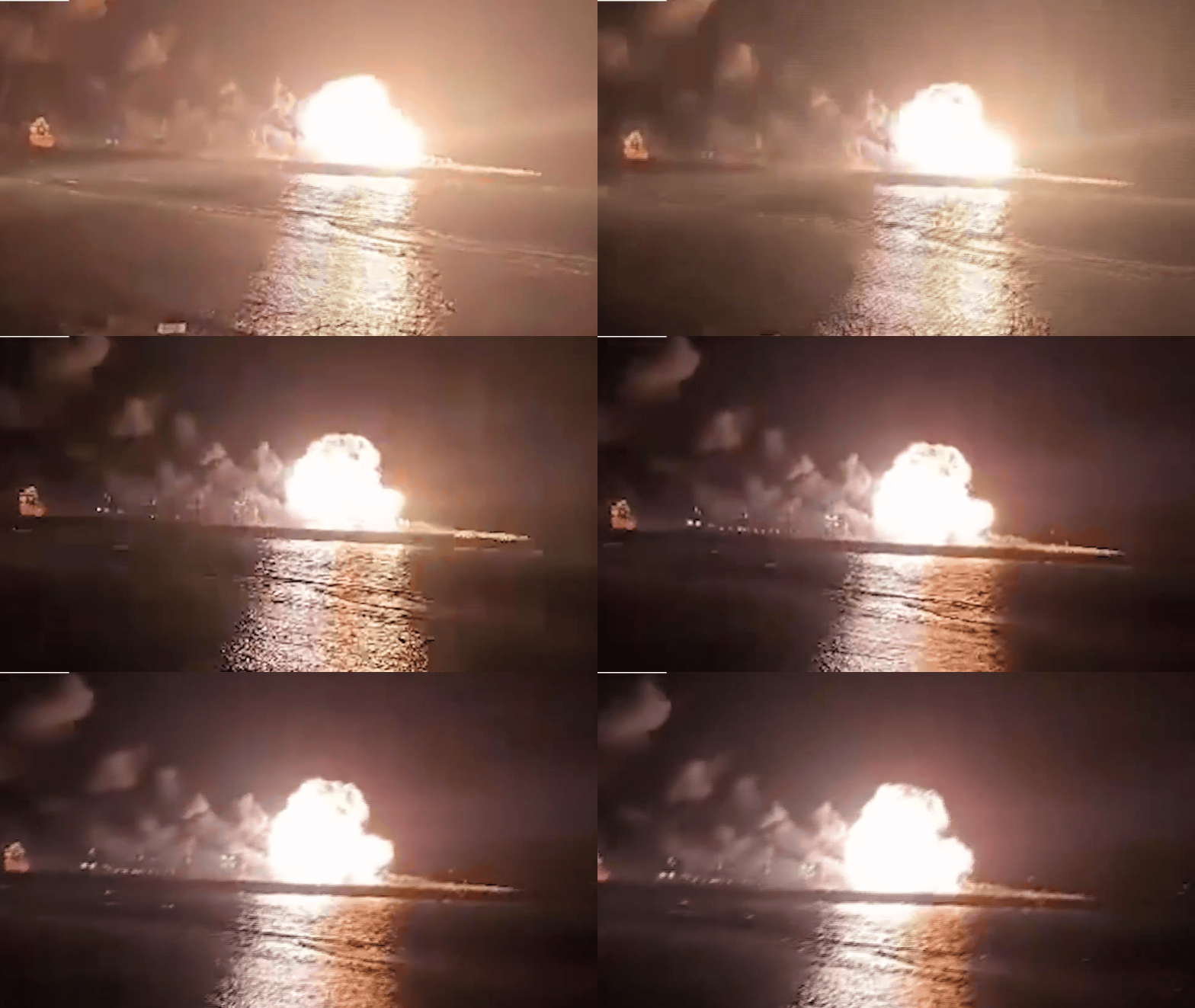
Reports and viral footage showing a Russian naval vessel engulfed in flames off the coast of Libya point to a suspected Ukrainian drone strike far outside the Black Sea theater. While initial viral clips focus on the spectacle of a burning hull, the real story is the sudden collapse of Russia’s geographic sanctuary in the central Mediterranean, proving that Ukrainian long-range maritime and aerial asymmetric capabilities can now threaten Moscow’s strategic logistics hubs thousands of miles from Kyiv.
For years, defense analysts treated the Black Sea and the Mediterranean as operationally distinct arenas. Moscow relied on that separation. After Ukrainian naval drones forced the bulk of the Black Sea Fleet out of Sevastopol and into ports like Novorossiysk, the Kremlin leaned heavily on its Mediterranean task force and North African logistics corridors to project power, rotate troops, and supply its Africa Corps operations across the Sahel. If Ukrainian operatives or allied proxies successfully struck a Russian warship near Libyan waters, the operational calculus for the Russian Navy just changed permanently.
Why Libya Became Moscow's Critical Maritime Lifeline
To understand why a burning Russian ship near Libya matters more than another skirmish near Crimea, you have to follow the supply lines. Since the collapse of Moscow’s unchallenged dominance in the eastern Mediterranean and ongoing friction around Syrian ports like Tartus, the Kremlin has poured resources into securing reliable maritime access along the Libyan coast, particularly around Tobruk and Benghazi.
Libya is not a peripheral theater for Russia. It is the central logistics hub connecting Russian ports to sub-Saharan Africa. Heavy cargo vessels, landing ships, and auxiliary tankers regularly run the gauntlet from the Baltic and Black Seas through the Strait of Gibraltar or the Suez Canal to offload armored vehicles, air defense systems, and mercenaries in eastern Libya. From there, cargo moves south into Mali, Burkina Faso, Niger, and the Central African Republic.
Warships accompany or support these shipments for two reasons. First, they provide deterrent cover in contested international waters. Second, auxiliary naval vessels often carry high-value military hardware that Moscow cannot risk moving on easily tracked commercial hulls.
When a Russian warship catches fire in those waters, whether from a low-flying unmanned aerial vehicle, a smuggled first-person-view drone launched from a nearby commercial vessel, or an unmanned surface vessel, it exposes a glaring vulnerability. Russia’s Mediterranean squadron lacks the dense, layered air and coastal defense networks that protect its home ports. Ships operating off Libya are forward-deployed, lightly supported, and suddenly operating without a safe rear area.
How Ukraine Stretches the Battlefield Thousands of Miles
Skeptics immediately ask how Kyiv could execute a precision strike in the central Mediterranean without a local naval base. The answer lies in the evolution of modern irregular warfare, a playbook Ukrainian intelligence services have refined from Sudan to Syria.
You do not need a destroyer to sink or cripple a warship anymore. You need a shipping container, a commercial fishing trawler, or a discreet coastal launch site, paired with off-the-shelf satellite communications and autonomous navigation.
Consider a hypothetical example of how an operation like this works in practice. A small team operating under commercial cover charters a civilian vessel in international waters dozens of miles off the North African coast. Inside standard maritime containers sit disassembled long-range attack drones or compact unmanned surface craft. Once the target warship slows down for replenishment, anchorage, or port entry—the exact moments when naval crews drop their highest alert status—the drones launch from beyond the horizon. By the time shipboard radar picks up a low-RCS (radar cross-section) target skimming the waves, the crew has seconds to react.
Ukraine’s Main Directorate of Intelligence (HUR) and the Security Service of Ukraine (SBU) have already demonstrated both the intent and the reach to hunt Russian assets globally. Ukrainian special forces have conducted documented operations against Russian mercenaries in Sudan and targeted Russian military infrastructure in Syria. Extending that campaign to Russian naval assets off Libya follows the exact same strategic logic: force Moscow to defend everywhere at once.
The Vulnerability of Soviet-Era Damage Control
Footage of Russian ships burning—from the flagship Moskva in 2022 to landing ships in Feodosia and patrol corvettes off Crimea—consistently reveals a secondary, fatal flaw beyond the initial impact. Russian naval vessels suffer from notoriously poor damage control.
Modern Western warships are built with strict compartmentalization, automated fire-suppression systems, and crews drilled relentlessly in firefighting under combat conditions. Many Russian vessels operating in the Mediterranean are aging hulls from the Northern or Baltic Fleets, deployed on grueling, extended rotations with worn-out equipment and undertrained conscripts filling out technical billets.
When a drone warhead packed with high explosives and incendiary material hits a ship’s superstructure or fuel lines, the initial blast rarely sinks the vessel. Fire does. Once blaze spreads into electrical conduits and ammunition lockers, a lack of automated suppression and exhausted crews turn a manageable hit into a catastrophic total loss.
The Fog of War and Competing Explanations
Veteran reporters treat early viral videos from conflict zones with immediate caution, and the incident off Libya demands that same skepticism. While Ukrainian involvement is the primary hypothesis circulating among defense observers, two alternative explanations cannot be ruled out without independent forensic verification of the hull.
First, Libya remains a fractured battlespace awash in rival militias, foreign intelligence operatives, and regional powers with competing interests in eastern Libya. While Khalifa Haftar’s Libyan National Army controls the eastern ports and enjoys Russian backing, rival factions in western Libya—and their international sponsors—have every incentive to disrupt Russian military consolidation on their doorstep.
Second, catastrophic shipboard fires are hardly unprecedented in the Russian Navy even without enemy action. In recent years, Moscow has lost or severely damaged aircraft carriers, submarines, and corvettes during routine maintenance or transit due to welding accidents, faulty wiring, and fuel leaks. In an era of instant social media amplification, an accidental engine-room fire off Tobruk is guaranteed to be claimed—or framed—as a daring drone strike before the smoke even clears.
Yet whether the ignition source was a Ukrainian warhead or a catastrophic mechanical failure amplified by Ukrainian information warfare, the strategic fallout for Moscow is identical. Insurance rates for commercial vessels chartered by Russia’s shadow fleet spike. Port authorities in North Africa grow nervous about hosting Russian hulls that might attract kinetic strikes onto their own docks.
What a Mediterranean Front Means for Global Maritime Security
If Kyiv has indeed operationalized anti-ship drone strikes in the Mediterranean, the implications reach far beyond the Russia-Ukraine war.
For decades, naval power projection depended on expensive blue-water fleets capable of controlling choke points like the Strait of Gibraltar, the Suez Canal, and the Bab el-Mandeb Strait. Between Houthi anti-ship missiles in the Red Sea and Ukrainian maritime drones in the Black Sea and potentially the Mediterranean, asymmetric warfare has inverted naval economics. A drone costing fifty thousand dollars can mission-kill a warship worth hundreds of millions, operating thousands of miles from the attacker’s homeland.
For NATO planners watching from Naples and Norfolk, the incident serves as an uncomfortable warning. The central Mediterranean is one of the busiest commercial shipping corridors on earth, crisscrossed by undersea fiber-optic cables, energy pipelines, and LNG tankers. Introducing uncrewed strike warfare into those waters creates massive escalation risks and complicates maritime surveillance for every navy operating in the region.
Moscow now faces an impossible resource allocation problem. The Kremlin cannot pull air defense batteries or electronic warfare suites from the front lines in Donbas to guard ships anchored off Libya, nor can it easily replace damaged hulls when its shipyards are choked by sanctions and supply bottlenecks. Every warship Russia sends into the Mediterranean must now treat every commercial vessel on the horizon as a potential drone carrier, turning what was once a routine logistics run into a high-stress combat patrol.