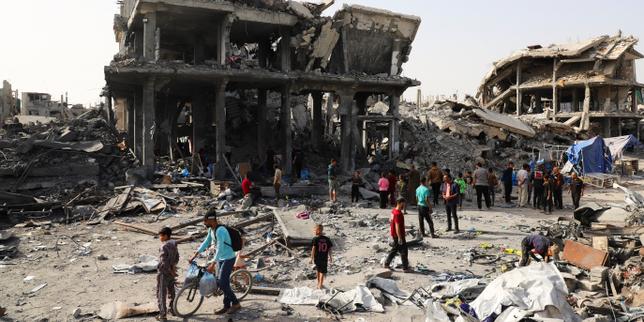
The characterization of the Gaza conflict as a diplomatic, political, and military "black hole" inaccurately implies a random, chaotic phenomenon. In reality, the current deadlock is a highly structured equilibrium driven by incompatible strategic incentives, asymmetric warfare dynamics, and the absence of a viable post-conflict governance model. The failure of international mediation and military operations to achieve a decisive resolution is not a failure of effort, but a predictable outcome when the core actors operate under zero-sum payoff matrices.
To understand why traditional diplomatic levers have failed, the situation must be decoupled from emotional rhetoric and analyzed through three distinct structural vectors: the asymmetric attrition function, the domestic political survival loop, and the breakdown of regional security architecture.
The Asymmetric Attrition Function and Military Limits
Conventional military doctrine dictates that victory is achieved by destroying an adversary’s center of gravity or rendering their command structure non-functional. In the Gaza theater, this framework collapses due to an asymmetry in how both sides define and calculate strategic costs.
For a conventional military force, cost is measured in terms of personnel casualties, economic strain, ammunition consumption rates, and international diplomatic capital. The operational objective is a rapid, decisive victory to minimize these expenditures. Conversely, an asymmetric non-state actor operating in a dense urban environment utilizes an entirely different cost function.
The Urban Inversion Effect
In subterranean and high-density urban warfare, physical destruction does not linearly correlate with a reduction in operational capability. Instead, it creates an inversion effect:
- Subterranean Operational Continuity: The utilization of extensive underground infrastructure insulates defensive forces from precision aerial bombardment, decoupling surface destruction from combat degradation.
- Tactical Decentralization: Command structures are intentionally fragmented into autonomous cells. The elimination of high-level leadership fails to paralyze the organization because tactical execution is localized.
- Recruitment Mechanics: The collateral damage inherent to high-density urban operations serves as a structural recruitment mechanism, replenishing the non-state actor's human capital faster than conventional military operations can deplete it.
This asymmetry creates a strategic bottleneck. The conventional force achieves tactical victories—seizing territory, destroying surface infrastructure, neutralizing mid-level commanders—but cannot convert these into a definitive strategic outcome. The non-state actor achieves its strategic objective simply by surviving, as survival in the face of an overwhelming force is interpreted politically as a victory. The result is a state of permanent attrition where increased military expenditure yields diminishing strategic returns.
The Domestic Political Survival Loop
Diplomacy relies on the premise that state and non-state actors will negotiate rationally to maximize national or collective well-being. This premise fails when the personal political survival of leadership structures becomes decoupled from, or directly opposed to, the broader strategic interests of their constituencies.
+-------------------------------------------------------------+
|               Domestic Political Survival Loop              |
+-------------------------------------------------------------+
|                                                             |
|   +-----------------------+       +---------------------+   |
|   |  De-escalation /      | ----> |  Loss of Coalition  |   |
|   |  Diplomatic Compromise|       |  Support / Power    |   |
|   +-----------------------+       +---------------------+   |
|               ^                               |             |
|               |                               v             |
|   +-----------------------+       +---------------------+   |
|   |  Perpetuation of      | <---- |  Incentive for      |   |
|   |  Conflict / Deadlock  |       |  Maximalist Stance  |   |
|   +-----------------------+       +---------------------+   |
|                                                             |
+-------------------------------------------------------------+
The Coalition Bottleneck
On one side of the conflict, leadership is bound by complex governing coalitions. A shift toward a moderate or compromise position regarding post-conflict governance or a permanent ceasefire risks fracturing the political coalition, triggering an immediate loss of power. Consequently, the leadership is structurally incentivized to maintain a maximalist stance, prioritizing the continuation of operations to defer domestic accountability.
The Legitimacy Dilemma
On the other side, the non-state actor’s domestic legitimacy is entirely derived from its identity as a resistance movement. Engaging in a compromise that strips it of its military capabilities or governance role equals political suicide. If the leadership agrees to a framework that disarms the group, it forfeits its core raison d'être, rendering it vulnerable to more radical internal or external factions.
Because both leadership structures face catastrophic domestic political costs for choosing de-escalation, the rational choice for both parties on an individual level is to perpetuate the conflict. This creates a self-sustaining feedback loop where the status quo of deadlock, despite its immense human and economic toll, remains the path of least political resistance for the decision-makers involved.
The Breakdown of Regional Security Architecture
The international community routinely attempts to apply historical mediation frameworks—such as the Camp David, Oslo, or Abraham Accords models—to the Gaza conflict. These attempts fail because the regional security architecture has fundamentally shifted from a state-to-state balance of power to a multi-layered, proxy-driven network.
The External Sponsor Equilibrium
The conflict cannot be treated as an isolated bilateral dispute. It functions as a focal point for regional proxy dynamics, primarily managed by external sponsors seeking to project power without engaging in direct state-to-state warfare.
- Strategic Distraction: For external patrons, a protracted conflict in Gaza consumes the diplomatic, military, and financial resources of Western powers and their regional allies. This distraction reduces pressure on other geopolitical fronts.
- Leverage Generation: The conflict provides external actors with significant geopolitical leverage. They can modulate the intensity of the crisis through the supply of funding, logistics, and intelligence to their proxies, using the conflict as a bargaining chip in broader regional negotiations.
- The Normalization Disruption: A primary strategic objective of the non-state actor and its backers was the disruption of emerging regional alliances, specifically the normalization of relations between major Arab states and Israel. The perpetuation of the conflict successfully freezes these diplomatic realignments, as Arab governments cannot easily advance normalization agreements while public anger remains elevated.
This regional layer removes the incentive for localized compromise. Even if local actors wished to negotiate, the financial and logistical dependencies on external sponsors mean that any resolution must align with the broader, non-localized strategic goals of those patrons.
The Governance Vacuum and Post-Conflict Failure Modes
The most critical structural flaw in current strategic planning is the inability to define a viable "Day After" scenario. A successful transition out of conflict requires a governance structure that possesses internal legitimacy, external financial backing, and the physical capability to maintain security. Currently, no entity meets these criteria, creating a total governance vacuum.
The Three Hypothetical Models and Their Flaws
The international community frequently proposes three potential governance models, each presenting an operational failure mode that prevents its implementation.
The first model is the return of a reformed West Bank-based administrative authority to Gaza. The limitation here is a fundamental crisis of domestic legitimacy. This authority is widely viewed by the local population as inefficient and politically compromised. Forcing it into Gaza on the back of a foreign military campaign would permanently destroy its credibility, rendering it incapable of governing without constant, external military enforcement.
The second model involves an international or regional Arab peacekeeping force. This option is structurally unviable due to the unacceptable distribution of risk. Regional Arab states refuse to deploy forces into an active theater where they would be viewed as an occupying force by the local population and targeted by remaining insurgent factions. No sovereign state is willing to absorb the casualties required to police a ruined urban center for an indefinite duration without a pre-existing, comprehensive political settlement.
The third model is a prolonged, direct military administration by the opposing state force. The operational cost of this model is prohibitive. It requires a permanent, high-density troop deployment to suppress a continuous insurgency, alongside the total financial and administrative responsibility for the welfare of millions of displaced civilians. This would trigger severe long-term economic strain and catastrophic, compounding diplomatic isolation.
The Strategic Path Forward
Breaking the structural deadlock requires moving away from the binary framing of total military victory versus immediate ceasefire. Neither outcome is stable under current conditions. A realistic stabilization framework must systematically alter the incentive structures of the actors involved rather than appealing to diplomatic goodwill.
The first operational step requires the creation of an independent, technocratic governance vehicle for Gaza, detached from existing political factions. This entity must be explicitly limited to administrative, reconstruction, and humanitarian distribution functions. By stripping the governance model of ideological and political identity, it lowers the domestic political cost for regional states to fund and support it.
The second step involves shifting the security paradigm from external enforcement to localized containment. Regional powers must establish a strict, verifiable maritime and terrestrial interdiction regime that permanently cuts the flow of advanced weaponry from external sponsors. This does not require solving the political dispute; it requires rendering the asymmetric attrition function unsustainable for the non-state actor by physically limiting their supply of strategic materiel over a multi-year horizon.
Finally, Western and regional partners must align their economic aid packages to a strict conditionality framework. Future reconstruction capital must be tied directly to the marginalization of radical elements within the governance structure. If the local population understands that economic recovery is mathematically contingent on the exclusion of militant factions, the internal social contract changes, eroding the non-state actor's domestic support base from the bottom up.
Without these structural shifts, any negotiated pause in hostilities will merely serve as a re-arming period, ensuring the re-emergence of the conflict in an identical loop. Strategic clarity demands acknowledging that until the payoff structures for the decision-makers are fundamentally altered, the deadlock will persist as a rational, calculated equilibrium.