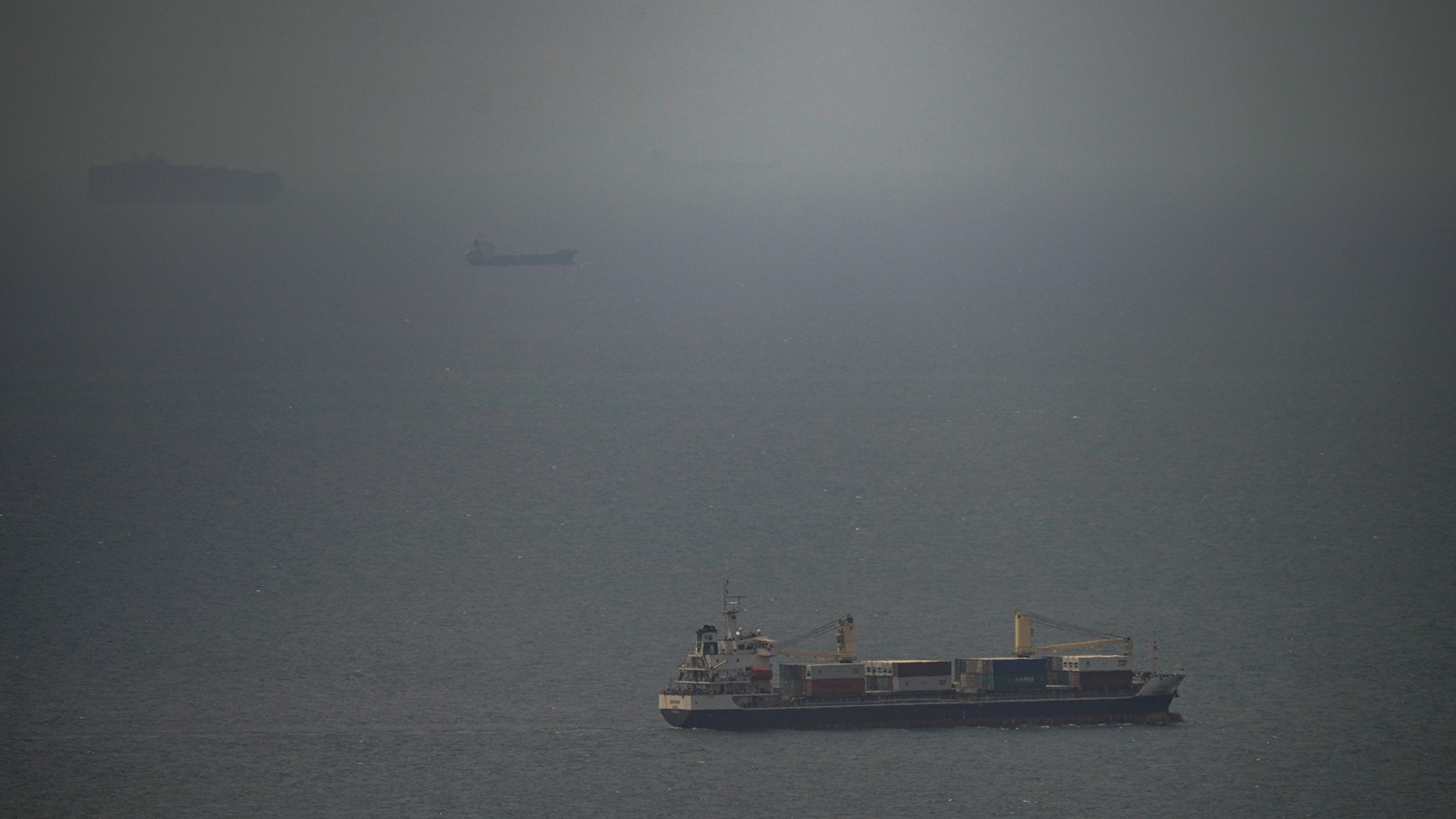
The Strait of Hormuz functions less as a traditional waterway and more as a global economic pressure valve where the physics of geography intersect with the ambiguity of international maritime law. When the United States characterizes Iranian ship seizures as violations while Tehran frames them as regulatory enforcement, the disagreement is not merely rhetorical. It represents a fundamental clash between two divergent frameworks of sovereignty: the Freedom of Navigation (FoN) doctrine versus the Internal Waters/Security Control model.
The Geographic Bottleneck and the Chokepoint Multiplier
To understand the volatility of the Strait, one must first quantify its physical constraints. At its narrowest point, the shipping lanes consist of two two-mile-wide channels for inbound and outbound traffic, separated by a two-mile wide buffer zone. This confined space forces the world's most massive VLCCs (Very Large Crude Carriers) into the territorial waters of Oman and Iran.
The strategic value of this transit is defined by the Volume-to-Risk Ratio. Approximately 20-21 million barrels of oil flow through this corridor daily, representing roughly 20% of global liquid petroleum consumption. Because there are no viable immediate-capacity bypasses—the East-West Pipeline (Abqaiq-Yanbu) and the Abu Dhabi Crude Oil Pipeline can only handle a fraction of this volume—the Strait acts as a "single point of failure" for global energy markets.
The Conflict of Legal Frameworks: UNCLOS vs. Customary Law
The primary friction point originates from the non-ratification of the United Nations Convention on the Law of the Sea (UNCLOS) by both the United States and Iran, albeit for different reasons. This creates a legal vacuum filled by competing interpretations of Innocent Passage and Transit Passage.
- Transit Passage (The US Position): The US argues that all ships and aircraft enjoy the right of unimpeded transit through international straits. Under this doctrine, a coastal state cannot suspend, hamper, or contest the passage of a vessel as long as the vessel proceeds without delay and refrains from the threat of force.
- Innocent Passage (The Iranian Position): Iran adheres to a more restrictive interpretation. They maintain that foreign warships and certain commercial vessels must obtain prior authorization. Furthermore, they argue that if a vessel violates environmental regulations or local "security" laws, its passage is no longer "innocent," granting the coastal state the right to board and seize.
This legal divergence allows Iran to weaponize "regulatory compliance." By citing environmental hazards or private legal disputes (e.g., debt recovery for state-owned enterprises), Tehran converts a kinetic military action into a bureaucratic enforcement action. This lowers the threshold for escalation, as seizing a ship for "pollution" is harder to categorize as an act of war than a direct missile strike.
The Three Pillars of Iranian Maritime Strategy
Iran’s approach to the Strait of Hormuz is not chaotic; it is a calibrated application of Asymmetric Maritime Attrition. This strategy relies on three distinct operational pillars:
1. Gray Zone Calibrations
Iran operates in the "Gray Zone"—the space between peace and open conflict. By using the Islamic Revolutionary Guard Corps Navy (IRGCN) rather than the regular Navy (Artesh), they employ fast-attack craft (FAC) and fast-inshore attack craft (FIAC). These smaller, highly maneuverable vessels can swarm a high-value target, making it difficult for a destroyer’s traditional defense systems to engage without risking significant collateral damage or appearing as the aggressor.
2. The Legal Pretext Engine
Seizures are rarely framed as political retaliation. Instead, Iran utilizes a "Legal Pretext Engine" where they identify vessels with technical vulnerabilities. A minor collision or an alleged oil leak becomes the catalyst for a boarding party. This forces the international community into a lengthy legalistic debate rather than a swift military response, buying Iran time to use the vessel as diplomatic collateral.
3. Proxy Deterrence and Internal Signaling
The seizures serve an internal function, demonstrating to domestic audiences that Iran can challenge a superpower. Externally, they signal to regional neighbors that the US security umbrella is "porous." If a US-flagged or US-protected ship can be detained for weeks, the perceived reliability of US maritime protection diminishes, incentivizing regional players to negotiate directly with Tehran.
The Economic Cost Function of Maritime Insecurity
The impact of these seizures is measured in the Risk Premium added to global shipping. When a seizure occurs, the cost of transit does not just rise due to potential oil supply disruptions; it rises due to the immediate recalibration of insurance variables.
- War Risk Premiums: Specifically, the "Additional Premium" (AP) charged by underwriters for vessels entering the Persian Gulf. After a series of seizures, these rates can spike by 500% to 1000% within a 48-hour window.
- Operational Friction: Increased transit times due to vessels "hugging" the Omani coastline or waiting for naval escorts.
- Security Overhead: The cost of hiring Private Maritime Security Companies (PMSCs) to provide onboard protection, though these teams are often ineffective against state-actor boarding parties.
The total cost function $C_t$ for a shipping firm can be expressed as:
$$C_t = O_c + I_r(v) + S_e$$
Where $O_c$ is operational cost, $I_r(v)$ is the insurance risk premium as a function of regional volatility, and $S_e$ is the cost of security enhancements. As $v$ (volatility) increases, $I_r$ becomes the dominant variable, potentially making certain routes economically unviable for smaller operators.
Tactical Limitations of Naval Escorts
The US and its allies often respond by increasing the density of naval assets (e.g., Operation Prosperity Guardian or the International Maritime Security Construct). However, the "escort model" has significant structural limitations:
- The Escort-to-Vessel Gap: There are thousands of commercial transits monthly through the Strait. No navy possesses enough hulls to provide a 1:1 or even a 1:10 escort ratio.
- Rules of Engagement (ROE) Constraints: Naval commanders face a "Proportionality Paradox." If an IRGCN boat approaches a tanker, the destroyer cannot fire until a "hostile act" or "hostile intent" is clearly established. By the time an Iranian boarding party is on the deck of a tanker, the use of kinetic force by a nearby destroyer risks killing the very crew they are trying to protect.
- The Drone Variable: The introduction of One-Way Attack (OWA) Unmanned Aerial Vehicles (UAVs) has shifted the calculus. A ship can now be disabled from miles away by a cheap drone, rendering the traditional "boarding" scenario obsolete and requiring expensive surface-to-air interceptors (like the SM-2 or SM-6) to defend a $2,000 drone with a $2,000,000 missile.
Strategic Outlook: The Shift to "Enforcement Tit-for-Tat"
The pattern of ship seizures indicates a move toward a "Tit-for-Tat" enforcement cycle. When the US Department of Justice seizes Iranian oil on the high seas to enforce sanctions (as seen with the Suez Rajan), Iran views this as a "violation" of its economic sovereignty. Tehran's subsequent seizure of a Western-linked tanker is not viewed by them as a violation of law, but as a reciprocal enforcement of their own "sanctions."
This creates a Stalemate of Sovereignty. Both sides are now using the mechanics of international trade and maritime law as weapons. The traditional binary of "peaceful shipping" vs. "piracy" is no longer applicable. We have entered an era of State-Led Disruptive Enforcement, where the goal is not to stop trade entirely, but to tax it through risk until the political cost of sanctions becomes higher than the benefit.
The future of the Strait of Hormuz will not be determined by a single naval battle, but by the endurance of global insurance markets and the ability of shipping conglomerates to absorb the "volatility tax" imposed by Iranian maritime doctrine. The only way to decouple the global economy from this chokepoint is a multi-decade shift in energy transit infrastructure—a prospect that remains technically and politically out of reach for the near term.
The most effective immediate counter-strategy involves the standardization of "Automatic Identification System" (AIS) spoofing defenses and the deployment of persistent, unmanned surface vessels (USVs) to provide 24/7 "eyes on" monitoring. This creates a high-fidelity digital record that strips away the "regulatory pretext" Iran uses to justify seizures, forcing them to either retreat or engage in a more overt—and thus more politically costly—violation of international norms.