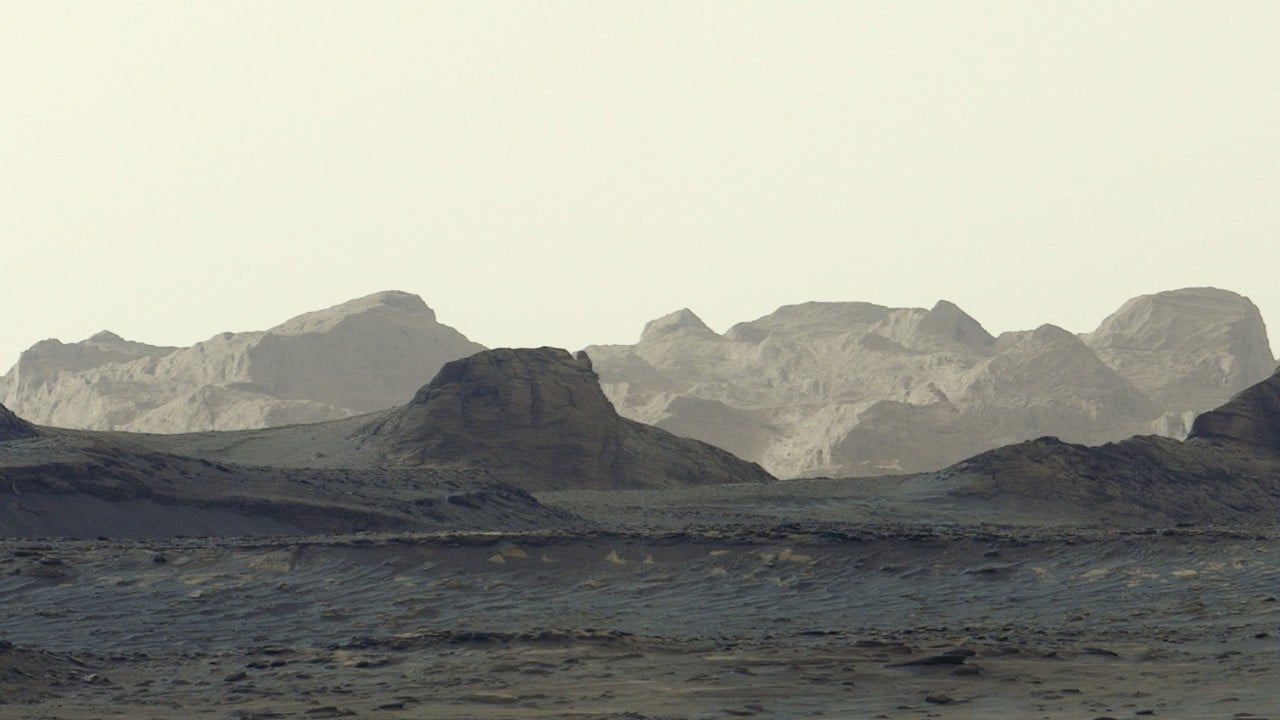
Planetary surface exploration functions as a long-term amortization problem. Agencies deploy capital-intensive hardware into high-entropy environments to extract localized data, attempting to reconstruct billion-year geological sequences from sparse physical samples. When the Curiosity rover captured a panoramic view of dawn illuminating the northwestern reaches of Mount Sharp on Sol 4,982, the resulting transmission offered more than aesthetic utility. It exposed a distinct structural anomaly within Gale Crater: the yardang layer.
Understanding this formation requires deconstructing the stratigraphic column that Curiosity has spent over a decade ascending.
The Stratigraphic Break
Mount Sharp rises roughly five kilometers from the floor of Gale Crater. Its lower elevations comprise a continuous depositional record—sedimentary strata laid down by ancient lakes and streams. These layers follow standard chronological stacking, where older material resides at the base and younger material accumulates upward.
However, the yardang layer disrupts this linear model. Extending roughly sixteen kilometers across the mountain's flank, these wind-carved ridges exhibit geometric and compositional discrepancies that signal a fundamental break in planetary history.
The formation violates the expected continuity in three distinct ways:
- Positional Incongruity: The elevation and spatial distribution do not align with the uniform sediment accumulation observed in lower strata.
- Angular Disparity: The internal layers tilt at angles inconsistent with the underlying sedimentary bed.
- Spectral and Visual Variance: The hue and albedo of the material differ sharply from the surrounding rock matrix, presenting an appearance that planetary geologists describe as superficially plastered onto the older surface.
This discontinuity defines a geological unconformity—a missing temporal record where active erosion stripped away previous layers before an entirely different depositional regime laid down new material.
Mechanisms of Eolian and Volcanic Deposition
To account for the physical state of the yardang stratum, researchers evaluate two primary generative hypotheses. Both models must account for how loose particulate matter transforms into towering, wind-sculpted ridges over geological timescales.
The first hypothesis centers on localized volcanic activity. Under this model, massive explosive eruptions distributed ash across Gale Crater. Pyroclastic fallout settles uniformly regardless of prior hydrological features, creating a cap layer with distinct mineralogical properties and structural density.
The second hypothesis posits a shift in atmospheric circulation patterns that drove sustained eolian transport. In this scenario, climate shifts altered dominant wind vectors, causing massive sand accumulations to blanket eroded surfaces.
Once deposited, the raw material underwent extensive mechanical weathering. Over millions of years, persistent saltating sand driven by Martian winds scoured the softer matrix, carving the elongated, streamlined ridges known as yardangs. The efficiency of this wind erosion depends directly on atmospheric density, particle size distribution, and the cementation strength of the rock. On Mars, the absence of liquid water or thick vegetation allows wind to act as the primary landscape-modifying agent, preserving sharp relief features that would quickly weather down on Earth.
Data Processing Realities and Optical Calibration
Publicly released imagery from planetary missions frequently undergoes automated digital processing to maximize utility for human observers. Standard protocols apply white balancing algorithms to normalize color profiles, referencing familiar terrestrial lighting conditions to render shadows and highlights into recognizable palettes.
The dawn panorama transmitted in October 2026 diverged from this baseline. Mission operators elected to preserve the raw sensor output without standard white balancing. This technical choice retains the authentic chromatic signature of early morning light under a thin carbon dioxide atmosphere suspended with fine dust particulates.
Rayleigh scattering and dust suspension dictate the optical physics of a Martian sunrise. Unlike Earth, where nitrogen and oxygen molecules scatter shorter wavelengths to produce blue skies, Martian atmospheric dust scatters light differently. The suspended iron-oxide-rich particles permit longer wavelengths to dominate the ambient daytime view while creating cool, blue-shifted hues near the solar disk during twilight transitions. Retaining these unfiltered color ratios provides analytical value, preventing algorithmic distortion of mineralogical color signatures present in the distant rock faces.
Forward Operations and Tactical Ascent
The strategic value of this visual dataset lies in its operational roadmap. Curiosity is currently navigating a gradual ascent up the slopes of Mount Sharp, having already gained over one kilometer in vertical elevation—a historical benchmark for robotic mobility on an extraterrestrial body.
Current trajectory models project that the rover will reach the base of the yardang formation. Reaching this threshold will transition the mission from remote sensing to direct contact sampling.
Upon arrival, the rover's suite of contact instruments will execute targeted analyses. The Alpha Particle X-Ray Spectrometer will determine elemental composition, while the Chemistry and Mineralogy instrument will use X-ray diffraction to identify crystal structures. By acquiring granular chemical assays of the unconformity boundary, mission scientists aim to resolve whether the yardang layer originated from ancient volcanic ejecta or aeolian dune migration. This physical ground-truthing will calibrate broader planetary climate models, constraining the timeline of environmental transition from a wet, habitable early Mars to the arid desert state observed today.