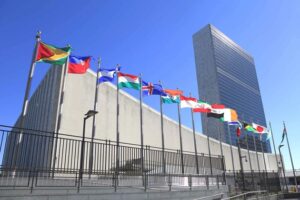
The concrete smells like rain and old paperwork. Standing outside the glass gates in New York, the air carries a specific weight—the heavy accumulation of promises made in high-ceilinged rooms where the microphones always pick up the nervous clicking of pens.
To the casual observer, it is just architecture. A monolith of green glass and stark marble rising beside the East River, built during an era when the world still believed it could draft a rulebook for peace and never look back. Inside, translators sit behind thick glass, turning anger into English, desperation into French, and quiet ultimatums into diplomatic Mandarin.
They have been doing this for eighty years.
Yet, walking these corridors today reveals a subtle, terrifying shift. The map on the wall no longer matches the terrain outside. The lines drawn in 1945—the permanent seats, the vetoes held like loaded dice, the institutional muscle memory of a different century—are buckling under the pressure of a reality they were never designed to contain.
We find ourselves at a strange, quiet precipice. The kind of historical joint where the bones of civilization pop, and nobody quite knows if the result will be flexibility or fracture.
Consider what happens when a system built to prevent global war tries to manage a world where war has dissolved into code, shadow, and supply chain strangulation.
Elena knows this dissonance intimately. She is not a diplomat, nor is she a delegate holding a placard with a country name. She is a data analyst stationed in a regional logistics office whose name rarely makes the evening news. For twelve years, her job has been tracking the invisible machinery of global cooperation—the grain shipments, the emergency medical stockpiles, the quiet corridors where peacekeeping funding meets bureaucratic quicksand.
"We are very good at writing obituaries for crises," Elena told me over bad coffee, watching cargo barges crawl up the gray water outside her window. "We are remarkably bad at changing the weather before the storm hits."
Her frustration is the institutional heartbeat of the United Nations right now. On paper, the organization is a marvel of multilateral engineering. It feeds hundreds of millions of people through the World Food Programme, eradicates diseases through the World Health Organization, and maintains fragile ceasefires across continents through blue helmet deployments. These are not small achievements. They are the scaffolding that keeps the ceiling from falling entirely onto our heads.
But beneath that scaffolding, the foundation is eroding.
The core architecture rests on a fundamental paradox. The very nations tasked with enforcing global law hold the power to veto any law they dislike. It is akin to putting arsonists in charge of the municipal fire department and giving them each a master valve to turn off the water. When major powers lock horns, the machinery seizes. Resolutions become hollow monuments of compromised language—words scrubbed of their teeth until they mean nothing at all.
Look at the statistics. In moments of acute geopolitical friction, the Security Council's paralysis reaches near-total stasis. Meanwhile, transnational threats—climate displacement, algorithmic destabilization, unregulated artificial intelligence, and widening economic chasms—do not wait for consensus. They do not check their credentials at the security desk.
This is the uncertainty. The feeling that the steering wheel is spinning freely, disconnected from the tires.
And yet, alongside that uncertainty sits a stubborn, stubborn thread of opportunity.
History teaches us that institutions like this rarely evolve because of enlightenment; they evolve because of exhaustion. The San Francisco Conference of 1945 did not happen because humanity suddenly became wise. It happened because sixty million people had just died, and the survivors looked at the smoking ruins of Europe and Asia and realized the alternative to talking was total extinction.
We are not at 1945 yet. But we are at a moment where the cost of institutional inertia is becoming too loud to ignore.
Reform is no longer a polite academic debate reserved for university seminars in Geneva. It is a baseline survival requirement. The voices demanding change are no longer just western capitals; they are the nations of the Global South—countries representing billions of people whose futures are decided in rooms where they hold no permanent seat. They look at the current configuration of power and see a relic of a colonial afternoon that refuses to check its watch.
If the multilateral system is to survive, it must undergo a profound, almost painful decentralization. It must learn to share authority not just among traditional superpowers, but with regional coalitions, civil society networks, and adaptive coalitions of the willing that can move faster than a bureaucratic behemoth.
Imagine, for a moment, a different kind of diplomatic architecture. (This is a structural projection, not a current reality). Picture a system where legitimacy is derived not solely from victory in a war eighty years ago, but from current demographic reality, climate vulnerability, and contribution to global public goods. Picture a Security Council that actually reflects the planet as it breathes today, rather than the planet as it bled in 1945.
It sounds impossible. Every vested interest will scream that it cannot be done. The permanent members will clutch their vetoes like security blankets, terrified of the cold air outside.
But institutions are human creations. What was built by human hands can be dismantled and rebuilt by human hands.
The choice is stark, stripped of diplomatic euphemism. We can cling to a comfortable, decaying fiction until it shatters under the weight of the next systemic shock, or we can do the grueling, unglamorous work of renovation while the lights are still on.
Elena is back at her desk now. The barge has passed out of view, replaced by the gray swell of the river. Somewhere in the building across town, a committee is drafting a resolution about a future that is already arriving too fast.
The microphone clicks on. The translation begins. And the world holds its breath, waiting to see which version of tomorrow wins.