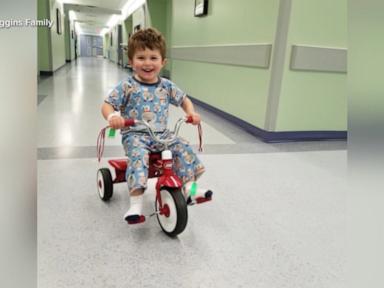
Most eleven-year-old boys measure their universe in very specific, terribly mundane units. The distance from the middle school backstop to the bike rack. The exact number of minutes left before curfew. The weight of a slightly overstuffed canvas backpack sagging against one shoulder as the autumn wind rattles the chain-link fence.
Leo measured his in milligrams and hours.
When a body is eleven, it is supposed to be elastic. It is supposed to absorb skin-grazing tumbles from skateboards and recover overnight. It is supposed to grow awkward, long limbs that knock over lamps and stretch through sleeves too fast. It is not supposed to learn the cold, clinical vocabulary of oncology. It is not supposed to know what an infusion pump sounds like when its battery begins to chirp at three in the morning, a rhythmic, mechanical pulse that echoes against bare hospital walls like a persistent ticking clock.
Yet, there he was, sitting cross-legged on a floral twin mattress that had long lost its bounce, holding a black marker in his left hand.
He was mapping.
On the white poster board spread across his knees, there was no geography of rivers or state capitals. Instead, he drew a jagged, branching tree of lines—his own private itinerary through the unknown. He labeled the branches with the precision of a cartographer who has no choice but to map the terrain he is forced to cross. The Bad Days. The Days with Pudding. The Waiting Room with the Broken Clock.
Cancer does not merely disrupt a childhood; it hijacks the entire narrative arc. One moment, a family is arguing about chores or math homework; the next, an MRI machine is humming its low, subterranean bass, vibrating through the floorboards and shaking the loose change in a father’s pocket.
We often talk about pediatric illness in terms of statistics. We speak of survival curves, protocols, and remission rates as if human beings can be reduced to points on a scatter plot. But numbers do not capture the weight of silence in a hallway after a doctor closes a chart. They do not describe the distinct, sterile smell of hospital corridors—a strange mix of lemon floor cleaner, latex gloves, and copper.
Leo understood this instinctively. Perhaps that is why he turned to a camera.
When adults speak to sick children, they tend to lower their voices into a soft, unnatural register. They use words like brave and fighter as heavy armor, wrapping the child in expectations that can sometimes feel suffocating. But Leo didn't want to be a symbol. He wanted to be a narrator.
Through the lens of a small, scratched digital camera, he began to record what the brochures left out. He didn't film the sterile triumphs or the dramatic speeches. He filmed the ordinary, heartbreaking absurdity of his new reality. He filmed his mother mixing up a batch of ginger tea that neither of them wanted to drink. He filmed the peculiar, fuzzy shadow his head cast against the hospital wall after his hair began to fall out in clumps—a process he documented with a wry, quiet shrug that carried more dignity than a thousand rallying cries.
"People think you're either sad all the time or you're a superhero," Leo explained in one unedited clip, his voice cracking slightly on the consonants, caught somewhere between the high, clear pitch of childhood and the rough gravel of adolescence. "You're just... sitting here. Waiting for the medicine to stop making your bones feel hot."
That phrase—making your bones feel hot—lingers. It is an extraordinary description of a thoroughly miserable physical sensation, born of chemotherapy coursing through marrow. It strips away the clinical detachment of medical charts and replaces it with visceral truth. It reminds us that behind every diagnosis is a nervous system trying desperately to process a storm it never asked for.
Consider what happens when a child is pulled from the ecosystem of a classroom. The sudden rupture is absolute. The locker stays locked. The desk collects dust. The inside jokes of the playground continue without him, evolving into new slang and new alliances that he can only watch from the periphery of a group chat.
Isolation is one of the quietest griefs of chronic illness. A child's world shrinks rapidly, contracting from the wide, sunlit expanse of a soccer field down to the four corners of a hospital room, then down further to the perimeter of a bed, and finally, on the hardest days, down to the space behind closed eyelids.
Yet, human resilience is rarely loud. It does not usually announce itself with trumpets. More often, it looks like an eleven-year-old boy adjusting the tripod legs on a tabletop so his viewfinder captures the exact angle of the afternoon light hitting his IV pole. It looks like a slow, deliberate act of reclaiming authorship.
When we watch a young person document his own fracture, we are forced to confront our own fragile assumptions about time. We treat health as a permanent address rather than a temporary rental. We assume the future is a sprawling, guaranteed highway, forgetting that it is built day by day, often out of very little material at all.
Leo’s video diary was not a tragedy, nor was it a Hallmark card. It was a record of witness. He was watching the disease, yes, but more importantly, he was watching himself. He was making sure he wasn't erased by the machinery of his treatment.
By the time the final frames of his recorded journey flickered on a glowing monitor, something subtle had shifted in the room. The sterile hum of the infusion pump hadn't stopped. The chalky taste of the anti-nausea medication hadn't vanished. The future remained stubbornly, terrifyingly unwritten.
But the map was complete. And for an eleven-year-old boy navigating the dark, uncharted territory of a broken year, drawing the lines was the first step toward finding his way back home.