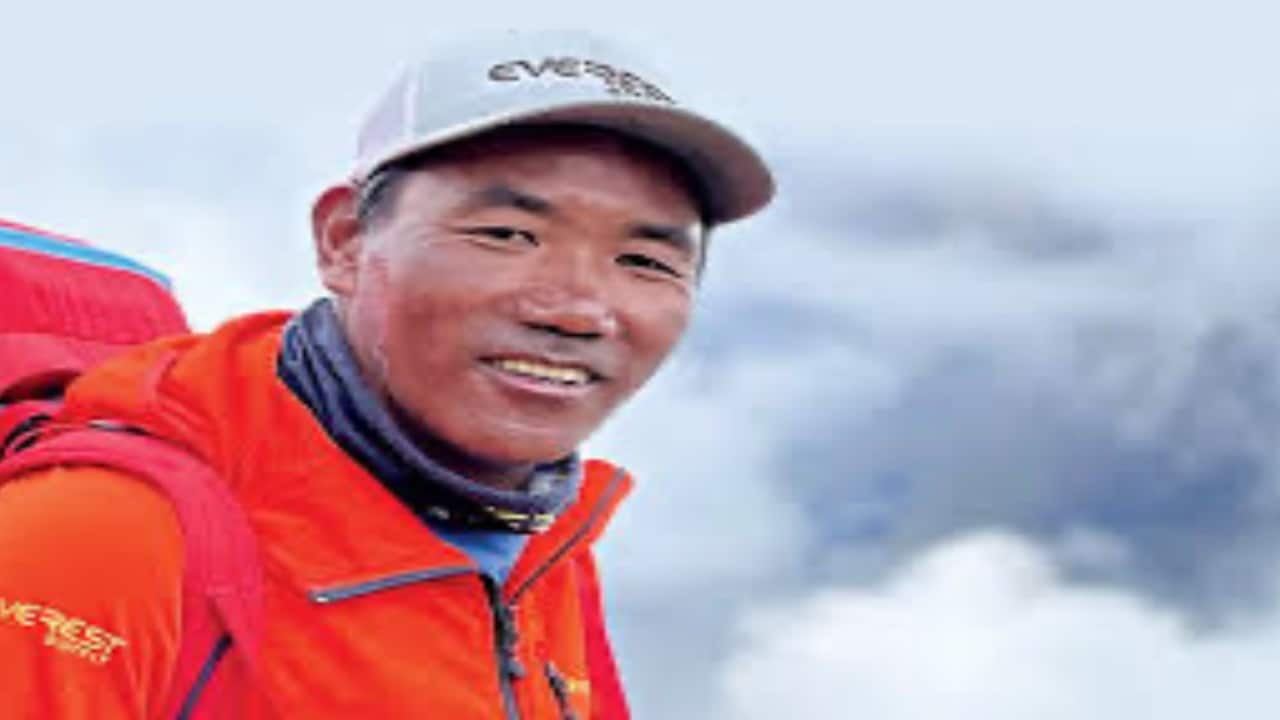
The air at 29,000 feet does not want you to live. It is a thin, starved thing, containing only a third of the oxygen found at sea level. Up there, your brain swells, your blood thickens to the consistency of sludge, and your lungs scream for a substance the atmosphere refuses to give. Every single step requires a conscious, agonizing negotiation with your own mortality. Most people who manage to survive this place treat it as the singular, terrifying pinnacle of their lives. They take a blurry photograph, weep through frosted goggles, and spend the rest of their days telling the story of how they conquered the death zone.
Then there is Kami Rita Sherpa.
He treats the roof of the world like a grueling, repetitive commute.
In May 2026, while the rest of the world watched from the safety of glowing screens, Kami Rita stepped onto the shifting ice of the Khumbu Icefall, moved past the skeletal remains of old expeditions, and climbed into the freezing dark. A few days later, he stood on top of Mount Everest for the thirty-second time. He did not just break the world record. He broke his own record, a benchmark he has been resetting almost annually with the casual regularity of a man clocking into a shift at a factory.
To look at the raw statistics is to miss the entire point of what is happening in the Himalayas. The numbers—32 summits, 8,848 meters, decades of survival—are impressive, but they are cold. They turn a profoundly human epic into an arithmetic exercise. If we want to understand the true weight of what Kami Rita has achieved, we have to look away from the record books and look instead at the invisible stakes, the quiet sacrifices, and the heavy cultural mantle carried by the people who actually build the mountain every spring.
The Illusion of the Solo Conqueror
Western mountaineering lore has long been obsessed with the myth of the solitary hero. We love the narrative of the rugged individualist testing their mettle against the cruel indifference of nature. This is a lie.
Consider a hypothetical climber named Richard. Richard is an executive from London or New York who paid $75,000 for a commercial Everest expedition. He has trained for two years, bought the finest down suits money can buy, and visualizes himself standing alone at the summit, a triumphant explorer.
But when Richard actually arrives in Nepal, reality looks very different. Before Richard even sets foot in Base Camp, a team of Sherpas known as the Icefall Doctors has already risked their lives to thread miles of nylon rope and aluminum ladders across a labyrinth of collapsing crevasses. Before Richard breathes his first puff of supplemental oxygen, a Sherpa has carried that heavy green cylinder up the Lhotse Face on his back. When Richard feels like dying at Camp IV, it is a Sherpa who boils the water, checks his harness, and physically anchors him to the planet.
Kami Rita is not an anomaly; he is the ultimate manifestation of this invisible backbone. Born in the high-altitude village of Thame, his life was mapped out by the topography of his home. His father was among the first professional Sherpa guides after Nepal opened its peaks to foreigners in the 1950s. His brother, Lhakpa Rita, has summited Everest 17 times. In this community, climbing the highest peak on Earth is not a recreational pursuit or a spiritual vision quest.
It is the family business.
The Heavy Price of Ice and Gold
There is a distinct sensory language to high-altitude mountaineering that standard news reports never capture. It is the metallic taste of frozen oxygen running through a plastic mask. It is the rhythmic, deafening crunch-crunch-crunch of crampons biting into blue glacial ice in the middle of the night. Most of all, it is the sound of the mountain moving. A low, guttural groan from deep within the glacier that tells you the ice beneath your boots is alive, heavy, and perfectly capable of crushing you in a heartbeat.
Kami Rita began his career in 1992 as a deep-winter porter, carrying heavy loads for other climbers. He didn't summit Everest until 1994, when he was 24 years old. Since then, his life has been a steady, relentless accumulation of vertical miles. He has climbed K2, Cho Oyu, Lhotse, and Manaslu. But Everest remains his constant companion.
To survive the death zone three dozen times requires a level of physical genius that science is still trying to fully comprehend. Studies have shown that native lowlanders suffer profound cellular damage at high altitudes because their bodies produce too many red blood cells, thickening the blood and increasing the risk of strokes. Sherpas, however, possess a genetic adaptation refined over thousands of years. Their bodies use oxygen with astonishing efficiency, burning glucose instead of fat to produce more energy per molecule of breath.
But biology only gets you to the base of the mountain. The rest is psychological endurance.
The mountain takes a toll that biology cannot fix. Every time Kami Rita says goodbye to his wife, Lakpa Jangmu, and their children in Kathmandu, an unspoken dread hangs in the air. The Khumbu Icefall does not care how many times you have crossed it. It does not respect records. In 2014, an avalanche in the icefall killed 16 Sherpa guides in a single morning. In 2015, an earthquake triggered an avalanche that devastated Base Camp, killing another 19 people. Kami Rita was there for both disasters. He has lost friends, cousins, and neighbors to the snow.
When you ask him why he keeps going back to a place that has swallowed so many of his people, his answer is devastatingly simple. He does it so his children won’t have to. The income from guiding wealthy foreigners allowed him to move his family to Kathmandu, to put his children through good schools, and to offer them a future where their survival does not depend on stepping over frozen bodies at 28,000 feet.
The Changing Face of the Mother Goddess
The mountain Kami Rita climbs today is fundamentally different from the one he first summited in 1994.
Everest—known as Chomolungma, the Mother Goddess of the World, to the Sherpa people—is changing under the dual pressures of global warming and intense commercialization. The pristine, snow-covered pyramid of global imagination is increasingly a landscape of exposed black rock and rotting ice. Glaciers are thinning at an alarming rate, exposing long-buried garbage and making old climbing routes increasingly unstable.
At the same time, the human traffic jams at the Hillary Step have become infamous. Images of hundreds of climbers waiting in a single-file line in the death zone regularly go viral, sparking fierce debates about overcrowding, safety, and the ethics of adventure tourism.
Yet, amidst the chaos of the modern Everest circus, Kami Rita remains a figure of quiet, unshakeable dignity. While Western media debates whether the mountain has lost its soul, he continues to wake up at 1:00 AM in the freezing dark of the high camps, strap on his crampons, and lead the way through the blackness. He does not seek the spotlight. He does not have a massive PR team or a multi-million-dollar apparel sponsorship. He is a working man who happens to work in the stratosphere.
There is a profound humility in his dominance. When he reached the summit for the 32nd time, there was no grandstanding, no flags waved with theatrical bravado. He checked the safety of the clients under his care, took a brief moment to look out over the curved horizon of the Earth, and turned around to begin the most dangerous part of the journey: the descent.
The Last Horizon
We are living in an era obsessed with optimization, hacking our biology, and finding shortcuts to greatness. We want the summit, but we want it delivered quickly, comfortably, and with maximum visibility.
Kami Rita Sherpa is the antithesis of this modern impulse. His greatness was not achieved through a sudden, spectacular leap, but through the patient, terrifying accumulation of single steps. He has spent months of his life in a zone where the human body is literally dying by the minute, all to ensure that others can live out their dreams.
The next time you see a headline about a wealthy tourist standing on top of the world, look closely at the background of the photograph. Look for the shadowed figure standing just out of frame, holding the safety line, checking the oxygen gauge, and staring quietly into the thin blue air.
That is where the real history of mountaineering lives. Not in the thrill of conquest, but in the quiet, repeating miracle of a man who refuses to stop walking up the sky.