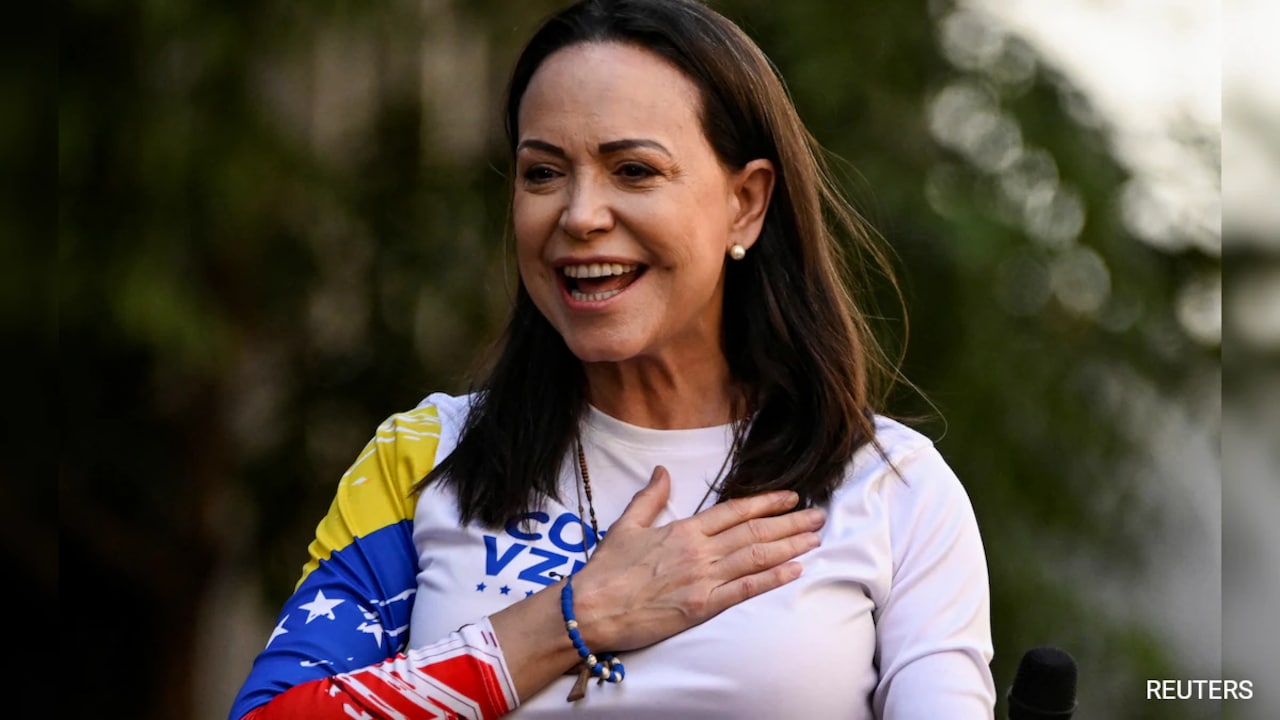
María Corina Machado has announced her return to Venezuela following her Nobel Peace Prize recognition, turning a diplomatic victory in Oslo into a high-stakes political gamble in Caracas. By stepping back onto Venezuelan soil after months of clandestine movement and international advocacy, the opposition leader is forcing a direct confrontation with the Nicolás Maduro administration, gambling that her global stature will deter immediate arrest while revitalizing a domestic movement exhausted by years of state repression.
The announcement immediately alters the political calculus across Latin America. For months, conventional wisdom among diplomatic circles held that accepting international honors abroad effectively meant accepting permanent exile, a well-worn trap used by authoritarian governments to neutralize dissidents by separating them from their base. Machado is refusing that script.
The Anatomy of a Calculated Risk
Returning to a country where arrest warrants, travel bans, and state surveillance remain standard operating procedure is not an act of spontaneous bravery. It is a cold political calculation. When an opposition figure leaves a country under pressure, their influence typically decays in direct proportion to their distance from the street.
Look at the recent history of Venezuelan opposition politics. Leaders who relocated to Madrid, Miami, or Bogotá initially commanded massive media attention, yet within months, their ability to mobilize crowds in Caracas or Maracaibo evaporated. Exile creates a structural disconnect between the leadership's international strategy and the daily survival struggles of citizens dealing with hyperinflation, crumbling infrastructure, and arbitrary detention.
Machado understands this dynamic better than anyone in her coalition. Her entire political brand over the past decade was built on a refusal to leave, even when barred from holding public office and restricted from boarding domestic flights. By framing her trip abroad for the Nobel Peace Prize not as an escape, but as a temporary diplomatic mission with a fixed return ticket, she aims to neutralize the regime's favorite narrative that opposition leaders abandon the country while asking citizens to sacrifice.
How the Nobel Shield Actually Works
A Nobel Peace Prize does not stop a bullet, nor does it unlock a prison cell at El Helicoide. Yet in the mechanics of international statecraft, the award significantly raises the political cost of overt state violence against the laureate.
When a government detains or harms a Nobel laureate, the diplomatic fallout ceases to be a regional dispute and becomes a global crisis. Governments that normally maintain pragmatic or neutral relations with Caracas—including key neighbors like Brazil and Colombia, as well as European trading partners—face immense domestic and international pressure to sever ties or impose targeted sanctions.
Consider the historical precedent. In 1991, the award to Aung San Suu Kyi transformed a domestic Burmese political struggle into an unavoidable fixture of Western foreign policy for two decades. Similarly, Liu Xiaobo's 2010 award forced Beijing into an aggressive diplomatic posture that damaged its soft power across Europe. Neither award immediately toppled the respective governments, and both laureates endured prolonged detention. However, the international spotlight fundamentally restricted how far those states could go without triggering severe economic and diplomatic isolation.
For the Maduro administration, Machado's return presents a binary dilemma, and neither option is attractive.
- Arresting her immediately risks collapsing fragile backchannel negotiations over oil licenses, debt restructuring, and diplomatic normalization. It instantly validates every accusation of authoritarian brutality and hands the opposition a powerful martyr.
- Allowing her to operate freely enables her to reorganize grassroots networks, hold mass rallies, and expose the administration's vulnerability to a domestic audience that rarely sees the state back down.
The most likely response from Caracas falls into a gray area between those two extremes. Rather than a dramatic tarmac arrest broadcast to global cameras, state security apparatuses typically rely on asymmetric pressure. This means arresting mid-level campaign organizers, confiscating sound equipment, blocking highways leading to rally sites, and auditing businesses that provide logistical support to her movement. By choking off the infrastructure around her while leaving her physically untouched, the state attempts to isolate her without triggering the international alarm bells that a direct arrest would set off.
The Structural Reality on the Ground
International headlines often reduce Venezuelan politics to a simple morality play between a Nobel laureate and an entrenched strongman. That framing misses the complex institutional machinery that keeps the current government in power.
Over the past twenty years, the ruling United Socialist Party of Venezuela has fused party, state, and military into a single interlocking system. The Bolivarian National Armed Forces are not merely a defense institution; they control key sectors of the economy, including mining, port logistics, food distribution, and oil services. Senior officers have deep financial and legal incentives to maintain the status quo, as a political transition carries the immediate threat of prosecution or asset forfeiture.
Furthermore, the Venezuelan judiciary and the National Electoral Council operate without institutional independence. Legal disqualifications, party interventions, and sudden changes to electoral rules are deployed routinely to fracture opposition coalitions before votes are ever cast.
Machado's return does not dismantle this machinery overnight. A crowd of one hundred thousand people in Caracas demonstrates popular sentiment, which is crucial for legitimacy, but popular sentiment alone does not compel military commanders to break ranks or force electoral officials to certify unfavorable results. Bridging the gap between massive street support and actual institutional power remains the central, unresolved problem of the Venezuelan opposition.
What the Competitor Coverage Misses
Standard wire reports treat Machado's announcement as a straightforward human-interest milestone—a celebrated dissident bravely heading home. That superficial reading ignores three critical dynamics currently reshaping the political environment inside Venezuela.
1. The Fragmentation of the Opposition Coalition
While Machado commands overwhelming popularity among opposition voters, her relationship with traditional opposition parties remains tense. Several established parties favor incremental negotiation, participating in regional elections, and securing minor institutional concessions from Caracas. Machado has historically advocated a maximalist approach, viewing partial agreements as traps that legitimize the government without altering the underlying power structure. Her return forces these rival factions to either fall in line behind her leadership or risk total irrelevance among an electorate tired of compromises.
2. Shifting Regional Alliances
The geopolitical terrain in South America has shifted noticeably. Left-leaning governments in Brasília and Bogotá, which initially sought to reintegrate Venezuela into regional diplomacy, have grown increasingly frustrated by Caracas's refusal to honor basic democratic commitments and the resulting migration pressures on their own borders. At the same time, Washington's energy policy balances domestic fuel price concerns against human rights benchmarks, creating a fluctuating sanctions environment. Machado is returning at a moment when Caracas has fewer unconditional allies in the region than it did two years ago.
3. Economic Exhaustion and the Migration Factor
Roughly eight million Venezuelans have left the country over the past decade, representing one of the largest displacement crises in modern history. Those who remain are largely focused on daily economic survival in a dollarized, deeply unequal economy. While political anger remains high, the capacity for sustained, multi-month street protests has been eroded by sheer exhaustion and the departure of millions of young, politically active citizens. Machado's challenge is not just inspiring hope, but convincing a weary population that political participation will yield tangible results rather than another cycle of repression and disappointment.
The Logistics of Operating in the Shadows
When Machado returns, she will not be stepping into a conventional political campaign. For much of the recent political cycle, she has operated semi-clandestinely, moving between safe houses, avoiding standard telecommunications to evade state intelligence, and relying on decentralized networks of citizen volunteers rather than formal party offices.
This decentralized model is both a necessity and a strategic innovation. Traditional political parties are easy for state intelligence agencies to infiltrate and dismantle; you simply arrest the regional coordinators and freeze the party's bank accounts. A distributed network of small, autonomous local committees—where citizens organize on their own blocks using encrypted messaging and personal resources—is far harder to decapitate.
However, decentralized movements suffer from coordination problems when facing a disciplined, centralized state apparatus. Without unified command structures, turning localized enthusiasm into decisive political leverage during critical moments becomes extraordinarily difficult. Maintaining discipline across thousands of independent grassroots groups while evading state security forces will test the limits of her organizational team.
The Precedent of High-Stakes Returns
History offers sobering lessons for opposition leaders who choose to return from international acclaim to face authoritarian systems.
In 1983, Benigno Aquino Jr. returned to the Philippines after three years in the United States, fully aware of the threats against his life, believing his presence was essential to unite a fractured opposition against Ferdinand Marcos. He was assassinated on the tarmac in Manila before his feet even touched the ground. That single act of state violence backfired catastrophically, galvanizing the Filipino public and eventually culminating in the People Power Revolution three years later.
Conversely, when Alexei Navalny returned to Moscow in January 2021 after surviving a nerve agent poisoning and receiving global acclaim in Germany, Russian authorities arrested him immediately at passport control. Despite massive international condemnation and initial protests across Russian cities, the Kremlin systematically crushed his political network, imprisoned his allies, and isolated him in an Arctic penal colony until his death in 2024.
These two cases illustrate the extreme volatility of the gamble Machado is taking. A high-profile return acts as an accelerant, compressing timelines and forcing latent conflicts to the surface, yet the outcome depends entirely on whether the ruling coalition fractures under pressure or closes ranks to absorb the diplomatic blow.
The Reality Check on International Leverage
Supporters often assume that international recognition automatically translates into decisive foreign intervention. In practice, foreign governments operate according to their own domestic and strategic priorities, not the timelines of democratic movements.
European nations remain preoccupied with security on their eastern flank and energy supply stability. The United States balances democracy promotion against migration control and global oil market stability, knowing that aggressive sanctions on Venezuelan crude can tighten global supply and push up gasoline prices at home. Regional neighbors like Colombia must manage a porous 1,300-mile border where armed guerrilla groups operate freely, requiring at least minimal functional communication with Venezuelan authorities.
Because of these competing interests, international backing for Machado—even with a Nobel Peace Prize attached—has clear practical limits. Foreign capitals will issue strong statements, summon ambassadors, and potentially tighten targeted sanctions on individual officials, yet no external power is going to intervene militarily or risk a catastrophic economic shock on her behalf. Any decisive shift in Venezuela's political trajectory must be generated from inside the country's own institutions and streets.
The Months Ahead in Caracas
The immediate aftermath of Machado's arrival will set the tone for the entire year. Watch closely not just what happens to Machado herself, but what happens to the second and third tiers of her movement—the drivers, the local coordinators, the journalists covering her appearances, and the small business owners hosting her meetings.
If the state moves swiftly to arrest her inner circle while leaving her isolated in a diplomatic limbo, her return could mark the beginning of a grueling war of attrition. If, however, her presence sparks visible hesitation within the security forces and triggers large, disciplined demonstrations that state authorities are reluctant to disperse by force, the political equilibrium in Caracas will shift dramatically.
Machado has eliminated her own safety net by stepping back into the arena, leaving the Maduro government with no easy way to make her disappear from the national conversation without triggering a crisis it cannot afford.


