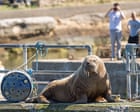
The North Sea does not care about borders, but the things living within it occasionally find themselves caught between them. Imagine standing on a pier in Arbroath, the salt spray stinging your eyes, when a ripple breaks the gray surface. It isn’t a seal. It isn’t a stray piece of driftwood. It is Magnus. He is fifteen hundred pounds of muscle, blubber, and whiskers, a literal titan from the High Arctic who decided, for reasons known only to his own internal compass, that Scotland was the place to be.
He arrived like a displaced tourist who had lost his map but kept his dignity. For weeks, the Scottish coastline became a theater of the absurd and the beautiful. Locals gathered at a distance, watching this massive tusked tenant haul himself onto harbor slipways. He looked out of place against the backdrop of stone cottages and fishing trawlers, a relic of the deep ice resting on a bed of barnacles and concrete. But the thing about houseguests—even the ones that weigh as much as a small car—is that they eventually have to leave.
Magnus has gone. He slipped back into the cold, churning green of the Atlantic and began a journey that reminds us how small our world has become, and how vast his remains.
The Heavy Weight of Being Noticed
When a walrus appears in a place like the Firth of Forth, it isn't just a biological anomaly. It’s a local crisis of affection. We have a desperate, human need to name things, to track them, and to claim them. We called him Magnus. We gave him a personality. We worried about his whiskers and his weight. In doing so, we turned a wild predator into a neighbor.
This is the invisible stake of wildlife conservation in the modern age. It is no longer enough for an animal to survive in the wild; it must survive the scrutiny of our cameras. Every time Magnus closed his eyes for a nap on a Scottish dock, a dozen smartphones were aimed at his snout. He became a celebrity who never signed up for the limelight. The pressure on local authorities was immense. How do you protect a creature that doesn't understand the concept of a boundary? How do you keep people back when they see a "sea monster" and want a selfie?
The tension in Arbroath was palpable. There was a quiet fear that he might get hit by a boat or, worse, become so accustomed to humans that he’d never find his way back to the ice. His presence was a gift, but it was a heavy one. It forced us to confront the reality that our oceans are changing. Walruses are venture capitalists of the sea; they go where the resources are, and as the Arctic ice thins and the currents shift, these lonely scouts are venturing further south than ever before.
A Migration Without a Passport
The North Sea is a treacherous highway. For a walrus, the trek from the Scottish coast to the jagged fjords of Norway isn't just a swim. It’s an odyssey through some of the busiest shipping lanes on the planet. Think of the logistics. Magnus had to navigate the deafening roar of container ships, the invisible webs of fishing nets, and the unpredictable shifts in temperature that signal he is moving closer to home—or further away.
One morning, the slipway was empty. The gray stone was cold. Magnus had departed as quietly as he had arrived.
The reports started trickling in from across the water. A sighting near a Norwegian oil rig. A grainy photo from a coastal village near Bergen. He had crossed the invisible line between nations. To us, it’s a diplomatic shift from Scotland to Norway. To Magnus, it’s just a change in the taste of the salt and the depth of the shelf. He is a master of the long game. Walruses are built for endurance, capable of slowing their heart rates to survive the crushing chill of the depths.
The Mirror in the Water
Watching Magnus move north is a lesson in humility. We often think of the natural world as something that happens "out there," in documentaries or behind zoo glass. But when six hundred kilograms of Arctic life hauls itself onto a local boat ramp, the wall between "us" and "them" vanishes.
Consider the fisherman who has to wait for Magnus to wake up before he can reach his boat. That moment of waiting is a rare surrender to a power older than commerce. In those minutes, the fisherman isn't a worker with a quota; he is a witness. He is seeing a traveler who has seen the edges of the world, someone who carries the scent of the polar night in his thick, scarred skin.
We are obsessed with the "why" of his journey. Is it climate change? Is it a quest for better shellfish? Or is it something more primal—a wandering spirit that exists in certain members of every species? Perhaps Magnus is simply the walrus version of a backpacker, seeing the sights before the responsibilities of the herd pull him back to the ice.
The truth is likely a mixture of all three. Scientific data suggests that as the benthic habitats—the buffet lines of the ocean floor—shift due to warming waters, walruses are forced to become explorers. They are the cartographers of a changing ocean, mapping out new territories because the old ones are disappearing.
The Silent Return
Norway welcomed him with the same mixture of awe and anxiety. They know the story all too well. They remember Freya, the walrus who became a national icon before her story took a tragic turn due to human interference. The stakes in Norway are higher because the memory of what happens when we get too close is still fresh.
There is a specific kind of loneliness in being a pioneer. Magnus is a long way from the massive colonies of Svalbard. He doesn't have the warmth of a thousand other bodies to huddle against during the night. He has only the hull of a Norwegian pier and the distant, rhythmic pulse of the tide.
But he is moving. He is eating. He is surviving.
The journey of Magnus isn't just a news tidbit about a wandering animal. It is a mirror. It reflects our fascination, our intrusive curiosity, and our deep-seated longing for a connection with the wild. We want him to stay so we can look at him, but we need him to leave so he can be whole.
The last sighting of him was near the mouth of a deep fjord. He was swimming with a purpose, his head bobbing rhythmically above the swell. He looked smaller against the massive Norwegian mountains, a speck of life in a landscape of giants. He wasn't a celebrity there. He wasn't a headline. He was just a creature of the sea, heading toward the cold, dark north where the air smells like frozen silence and the land is made of glass.
He left the people of Scotland with a story they will tell for decades. He gave them a reason to look at the horizon with a little more wonder. And as he pushes further into the Norwegian currents, he leaves us with a singular, haunting realization. We don't own the coast. We are just the people standing on the shore, watching the real masters of the deep move on to the next harbor, whether we are ready to say goodbye or not.
The pier is empty now. The water has smoothed over. Magnus is gone, and the sea is heavy with his absence.


