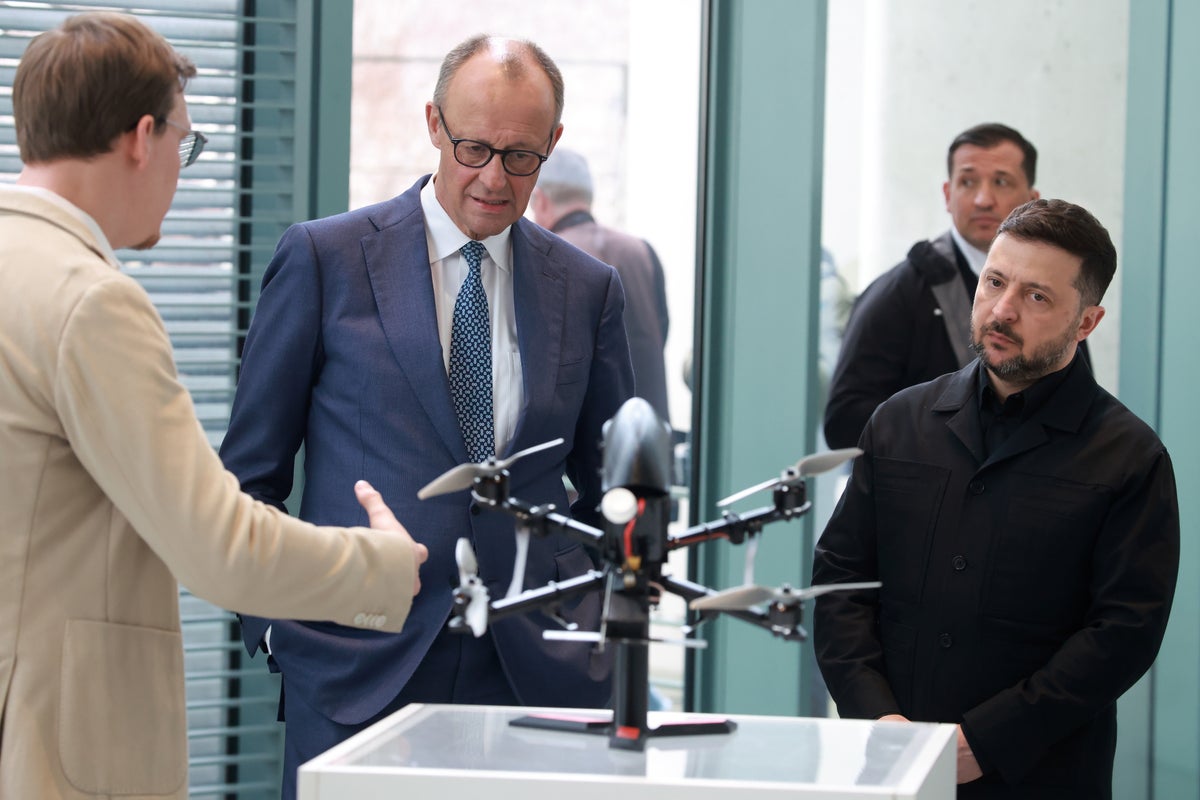
The British government has committed to a massive surge in military support for Ukraine, earmarking £752 million specifically to flood the front lines with 120,000 drones. This isn’t just another shipment of hardware; it is a calculated attempt to industrialize the Ukrainian resistance. By moving beyond high-end, bespoke weaponry and into the realm of mass-produced, expendable flight, the UK is betting that quantity has a quality all its own. This strategy aims to saturate the airspace so completely that Russian armor and infantry find it impossible to move without being spotted or struck.
The centerpiece of this package is the First Person View (FPV) drone. These are small, agile, and remarkably cheap craft, often built with off-the-shelf components. They carry an explosive charge and are piloted via a headset that puts the operator directly in the cockpit. In the mud of the Donbas, these have become the poor man’s guided missile. They cost a few hundred pounds but can take out a main battle tank worth millions.
The Logic of Attrition
War is a matter of math. For months, the narrative surrounding Western aid focused on "silver bullet" platforms like Storm Shadow missiles or Challenger 2 tanks. While effective, these systems are expensive and rare. You cannot afford to lose ten of them in a single afternoon. Drones change that calculation. When you have 120,000 units, a 50% loss rate is not a catastrophe; it is part of the operational plan.
This massive influx allows Ukrainian commanders to treat their aerial assets as ammunition rather than aircraft. If a drone is jammed or shot down, another is already in the air. This constant pressure wears down the enemy’s electronic warfare capabilities and forces them to expend expensive anti-air missiles on targets that are essentially disposable. It creates a tactical dilemma for Russian forces: do they ignore the swarm and risk a direct hit, or do they reveal their positions by trying to shoot down a $500 plastic bird?
Shifting the Supply Chain
The UK’s decision to spearhead this "drone coalition" reflects a shift in how the Ministry of Defence views the future of conflict. We are seeing a move away from the slow, bureaucratic procurement cycles of the past. Instead, the focus is on rapid prototyping and local assembly. A significant portion of this £752 million is intended to help Ukraine scale its own domestic production.
This is about resilience. Shipping finished goods across a border is a bottleneck. Teaching a nation to build its own fleet at scale creates a permanent military advantage. The UK is providing the capital and the technical blueprints to turn small workshops into high-output factories. This decentralization makes the supply chain much harder for Russian long-range strikes to disrupt.
The Electronic Warfare Wall
The biggest hurdle for this swarm is not bullets, but invisible signals. Russia has invested decades into electronic warfare (EW) systems designed to sever the link between a pilot and their drone. If the signal is cut, the drone falls or drifts aimlessly.
A portion of the British funding is dedicated to hardened communication links. Engineers are currently in a dead heat with Russian jammers, constantly updating the frequencies and software that keep these drones airborne. This is a cat-and-mouse game played out in code and radio waves. The UK is sending technicians and data scientists to help Ukrainian pilots stay one step ahead of Russian signal interference.
Autonomous Ambitions
The ultimate goal for these 120,000 drones is to reduce the reliance on a human pilot. When a drone is jammed, it usually loses its "eyes." However, if the drone has enough onboard processing power to recognize a tank or a trench through its camera, it can complete its mission even without a radio link.
We are moving toward terminal guidance AI. This doesn't mean "Terminator" style robots making strategic decisions. It means a drone that, in its final few seconds of flight, can lock onto a target and ignore any jamming attempts. This technology turns a simple hobbyist toy into a lethal, autonomous munition. It is the only way to ensure that a massive investment in hardware actually translates into hits on the ground.
Economic Warfare by Proxy
There is a cold financial reality behind this £752 million package. The UK is effectively devaluing Russia's heavy armor. If 120,000 drones are deployed effectively, the cost-to-kill ratio shifts dramatically in favor of the defender.
- Cost of a Russian T-90 Tank: Approximately £3.5 million.
- Cost of a UK-funded FPV Drone: Approximately £450.
- The Math: One tank costs as much as roughly 7,700 drones.
Even if 99% of those drones miss or are jammed, the remaining 1% would still destroy 77 tanks. From a purely fiscal perspective, the Kremlin cannot win that exchange. The UK is not just sending weapons; it is sending an economic ultimatum.
Training the Next Generation
Hardware is useless without hands to guide it. A significant part of the British effort involves specialized training programs. Operating an FPV drone is not like playing a video game; it requires intense spatial awareness and the ability to fly under extreme stress.
The UK is facilitating training centers where Ukrainian soldiers learn to navigate complex environments, fly through windows, and manage signal degradation. They are training "pilots" who will never leave the ground but will have more impact on the front line than a traditional fighter squadron. This creates a new class of soldier: the electronic infantry.
The Logistics of a Swarm
Managing 120,000 units is a nightmare of batteries, spare propellers, and specialized goggles. You cannot simply drop a crate of drones in a field and expect results. There must be a system for repair and distribution.
British logistics experts are working to streamline the flow of parts. The focus is on modularity. If a motor breaks, it should be swappable in the field in under two minutes. If a camera fails, a new one should snap into place. This is "IKEA-style" warfare, designed for a high-intensity environment where there is no time for sophisticated repairs.
Deep Strike Capabilities
While most of these drones are short-range tactical tools, a segment of the funding covers longer-range systems. These are the craft designed to fly hundreds of miles behind the lines to hit oil refineries, command posts, and ammunition dumps.
By diversifying the types of drones in the package, the UK ensures that Russia has no "safe" rear area. The threat is now 360 degrees. This forces the Russian military to pull air defense systems away from the front lines to protect their own infrastructure, thinning out their defenses and creating openings for Ukrainian ground maneuvers.
Geopolitical Stakes for London
Why is the UK taking such a prominent lead? It is a matter of establishing Britain as the premier defense partner in Europe. By being the first to commit to a drone force of this magnitude, London is setting the pace for the rest of NATO. It signals that despite domestic economic pressures, the UK views the security of the European continent as a non-negotiable priority.
This is also a laboratory. The British military is watching how these drones perform in the most recorded war in history. The data being gathered on the efficacy of low-cost aerial swarms will dictate British defense spending for the next thirty years. Every drone lost in Ukraine provides a lesson that will be integrated into the next generation of UK weaponry.
The Human Element
We must not forget that behind every screen is a person making a life-or-death decision. The psychological toll on Russian troops is immense. Knowing that a silent, explosive-laden bird could drop from the sky at any second creates a level of combat fatigue that is hard to quantify. It breaks the will to fight.
The 120,000 drones represent 120,000 moments of terror for the occupying forces. It is a form of persistent surveillance and threat that no army in history has ever had to face at this scale. The UK's investment is designed to make the occupation of Ukrainian territory physically and mentally unsustainable.
The New Standard of Defense
The era of the "big, slow, and expensive" is ending. The UK’s £752 million commitment is the definitive funeral for the 20th-century model of warfare. We are entering a period where the ability to manufacture and deploy thousands of smart, cheap, and lethal machines is the only metric that matters.
This isn't about a single victory or a specific line on a map. It is about proving that a modern democracy can out-produce and out-innovate a centralized autocracy. The 120,000 drones are a message: the sky is no longer a neutral space, and for those on the ground, there is nowhere left to hide.
The real test begins when the first ten thousand hit the crates. The success of this initiative will be measured not in the headlines of today, but in the burnt-out husks of machinery scattered across the fields of tomorrow.