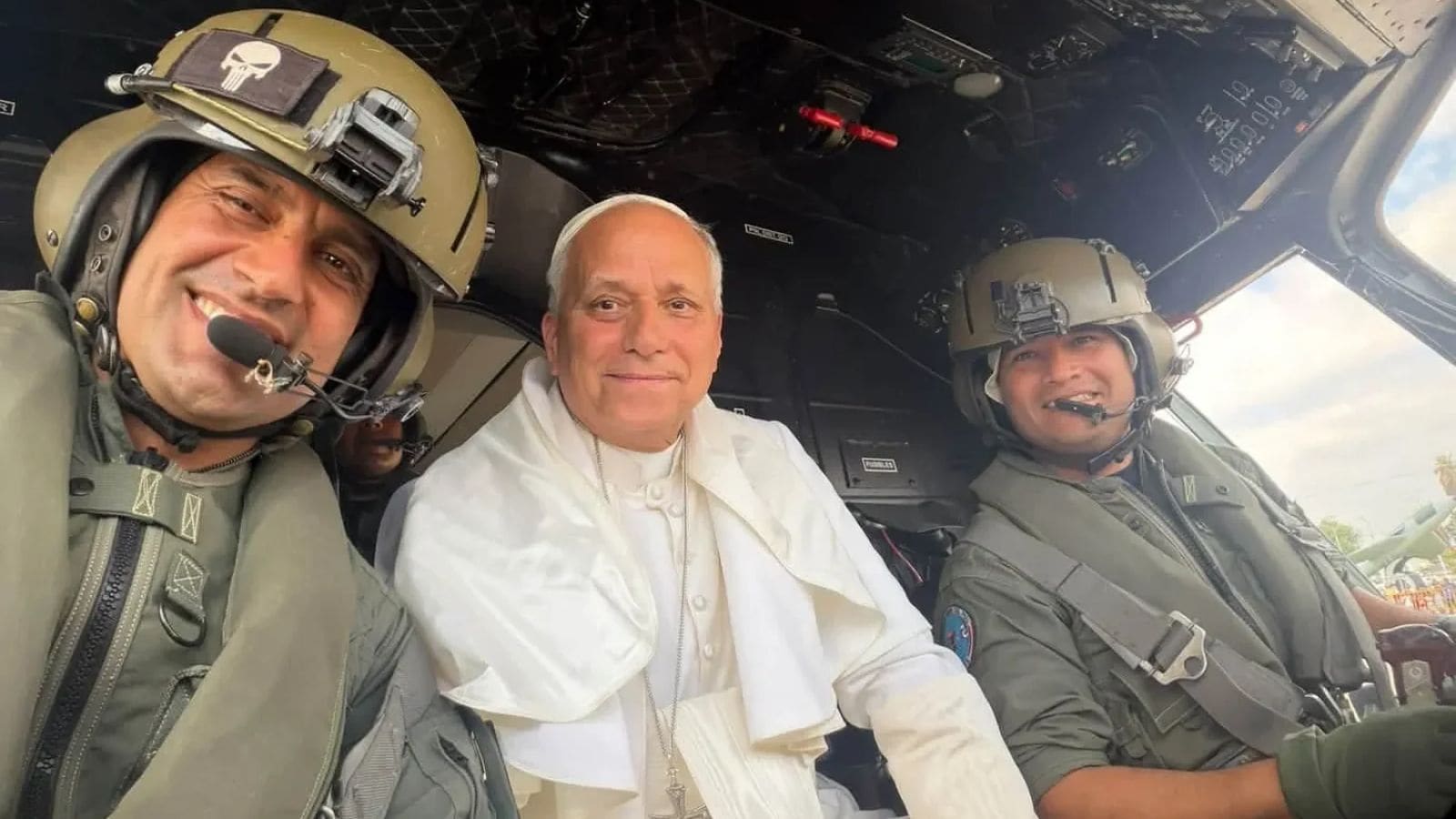
Moving a head of state into high-altitude Andean terrain exposes a fundamental operational trade-off between symbolic proximity and physical security. When Pope Leo XIV arrives in an isolated Andean municipality via rotorcraft—a location he previously accessed as a missionary bishop in a utilitarian Mahindra pickup truck—the shift is not merely cosmetic. It represents a structural overhaul in risk management, executive protection, and geopolitical signaling. Standard media coverage frames this contrast as a simple human-interest anecdote about humility versus office. That framing misses the underlying operational reality. Transitioning from an unarmored commercial utility vehicle to sovereign aviation reflects the rigid mathematical constraints imposed when a global institution assumes direct physical liability for an executive's survival in extreme topography.
The Structural Shift in Executive Mobility
To understand the transition from a light commercial pickup to a heavy-lift or medium-twin helicopter, one must examine the mechanics of institutional risk tolerance. As a regional bishop in Peru, Robert Prevost operated under a localized risk profile. His primary objective was operational reach across unpaved mountain passes where low-cost, high-torque diesel drivetrains offered the only viable mechanical solution. A Mahindra pickup represents peak utility per dollar in rugged terrain: simple leaf-spring suspension, mechanical four-wheel drive, and minimal electronic complexity that local mechanics can repair without proprietary diagnostic tools.
Upon elevation to the papacy, the individual ceases to be a regional administrator and becomes a sovereign asset. In executive protection theory, this transition triggers an immediate shift from acceptable operational risk to zero-defect threat mitigation. The Vatican Gendarmerie and host-nation security apparatuses cannot permit a head of state to traverse narrow, single-lane Andean switchbacks where rockslides, localized protests, or mechanical failure create unmanageable chokepoints.
The Three Pillars of Sovereign Transit
Sovereign mobility in austere environments relies on three non-negotiable operational variables that disqualify standard ground transport:
- Ingress and Egress Velocity: Ground convoys in the Andes operate at average speeds dictated by grade, hairpin turns, and surface degradation. A trip of 60 kilometers can easily consume three hours. Rotorcraft bypasses terrain friction entirely, compressing transit windows from hours to minutes and denying hostile actors the time required to establish ambushes or roadblocks.
- Perimeter Control: Securing a 60-kilometer mountain road requires thousands of personnel deployed across vertical ridges, culverts, and bridges. Securing a landing zone (LZ) requires a localized perimeter of roughly 300 to 500 meters. The resource allocation ratio heavily favors vertical insertion.
- Medical Evacuation Contingency: High-altitude environments introduce acute physiological stressors, including hypoxia and rapid barometric shifts. If a medical emergency occurs on a mountain road, evacuation time mirrors insertion time. Aviation provides an immediate, climate-controlled medevac platform capable of reaching a Level 1 trauma center within a predictable golden-hour window.
Topography as an Economic and Mechanical Filter
The Andes present a hostile operating environment for both internal combustion engines and turbine aircraft, governed by the laws of thermodynamics and fluid dynamics. Examining the exact mechanical contrast between the Mahindra pickup and the helicopter reveals how elevation dictates engineering choices.
In a diesel pickup truck climbing past 3,500 meters above sea level, atmospheric pressure drops significantly. Reduced air density starves the combustion chamber of oxygen, leading to power loss—often exceeding 20 to 30 percent in naturally aspirated engines, though mitigated somewhat by modern turbochargers. The vehicle compensates through gear reduction, trading speed for torque while managing thermal loads on steep inclines. The operational constraint here is infrastructure: the vehicle requires a continuous ribbon of graded earth or rock capable of supporting a two-ton axle load without collapsing into a ravine.
Rotorcraft operating in the same altitude band face an entirely different aerodynamic penalty known as density altitude. As air density decreases, rotor blades generate less lift for a given pitch angle and rotational speed. Simultaneously, turbine engines produce less shaft horsepower due to lower mass airflow. Pilots must carefully calculate gross weight, fuel load, and ambient temperature to ensure the aircraft retains sufficient power margin to hover out of ground effect (HOGE) during landing and takeoff in confined mountain valleys.
- Payload Trade-offs: To safely land in a high-altitude Andean town, a helicopter must shed weight. This often means flying with partial fuel tanks, necessitating forward refueling points or short-hop flight profiles.
- Microclimate Volatility: Mountain valleys generate rapid, unpredictable katabatic and anabatic winds. An LZ that is calm at 0800 hours can experience severe downdrafts by 1100 hours as solar heating warms the valley walls.
- Infrastructure Independence: Despite these aerodynamic penalties, the helicopter eliminates the single greatest point of failure in Andean logistics—the road itself. Washouts, seismic activity, and landslides routinely sever ground links for weeks. Aviation decouples the schedule of a global leader from the geological instability of the terrain.
The Semiotics of the Mahindra Pickup vs. Rotorcraft
In public relations and political communication, the vehicle a leader occupies serves as a primary visual shorthand for governance philosophy. The juxtaposition of the Mahindra pickup and the helicopter creates a distinct semiotic tension that institutional communicators must actively manage.
The Mahindra brand, originating in India and heavily utilized across Latin America, Africa, and South Asia, carries specific industrial associations. It is engineered for agricultural and commercial durability rather than passenger comfort. When a bishop drives a Mahindra through mud and river crossings, the visual signal is unambiguous: institutional solidarity with the periphery. The vehicle indicates that the leader shares the exact physical friction, dust, and transit delays experienced by the local population. There is no glass barrier, no climate-controlled isolation, and no specialized infrastructure separating the pastor from the community.
Conversely, arriving by helicopter introduces an unavoidable vertical hierarchy. The acoustics alone—the rhythmic thump of rotor blades echoing off canyon walls—announce state power long before the aircraft is visible. The physical separation enforced by rotor wash, security cordons, and flight suits transforms a pastoral visit into a state event.
Managing the Optics Gap
Institutions deploy specific countermeasures to prevent this logistical necessity from eroding public trust:
- Historical Anchoring: Communications teams intentionally surface archival imagery of the leader's prior, humble transit methods. Showing the Mahindra pickup establishes a baseline of authentic past sacrifice, framing the current helicopter arrival not as personal indulgence, but as an external requirement imposed by the office.
- Last-Mile De-escalation: Once the aircraft touches down at a perimeter airfield or stadium, security protocols typically transition the principal into an unassuming local vehicle—often a standard sedan or open-sided utility cart—for the final few hundred meters into the town center. This restores visual proximity at the exact moment cameras capture the arrival.
- Duration Compression: By minimizing the time the aircraft spends idling on the ground, organizers reduce the visual dominance of the machine, shifting focus quickly to the human interaction on the plaza.
The Cost Function of Papal Travel
Every papal trip operates on a hidden ledger balancing financial expenditure, diplomatic capital, and security risk. Moving from a solitary pickup truck to a multi-aircraft aviation package alters every variable in this equation.
When a regional bishop travels by pickup, the marginal cost of the trip is measured in liters of diesel, tire wear, and a few hours of driver fatigue. The environmental and financial footprints are negligible. When the Pope visits the exact same coordinates, the logistical tail expands exponentially. A single helicopter never flies alone in sovereign operations. Standard aviation protocols for heads of state require a minimum flight package:
- Primary Transport: The lead aircraft carrying the principal, immediate personal aides, and close-protection officers.
- Backup Airframe: An identical, fully fueled helicopter flying in formation or staged minutes away to allow immediate transfer in the event of a mechanical warning light.
- Advance and Support Lift: Additional airframes carrying advance security teams, medical personnel, communications gear, and accredited press pools.
This aviation package requires coordinated air traffic control, temporary radar coverage, meteorological stations positioned along the flight corridor, and ground crews deployed days in advance to inspect and clear landing zones of foreign object debris (FOD) that could be ingested by turbine intakes.
The Opportunity Cost of Isolation
Beyond direct financial outlay, there is an operational opportunity cost to high-security aviation. Ground travel, despite its inefficiencies, generates unplanned intelligence and organic human contact. A driver stopping at a roadside clinic, conversing with farmers clearing a rockslide, or navigating a town market absorbs unfiltered ground truth about local economic conditions and social sentiment.
Helicopter transit creates an epistemic bubble. The leader moves from one sanitized perimeter directly into another, observing the geography from 1,500 feet above ground level. Problems appear as abstract topographical features rather than lived human realities. For a leader whose authority relies heavily on moral persuasion and grassroots connection, over-reliance on vertical insertion risks severing the feedback loops that informed their leadership prior to elevation.
Institutional Vulnerability and The Illusion of Control
Security planners operate under the assumption that adding layers of technology and altitude inherently reduces risk. In extreme environments like the Andes, this assumption has strict limits. Aviation does not eliminate risk; it merely trades high-probability, low-consequence ground hazards for low-probability, high-consequence aerodynamic hazards.
A flat tire or a blocked road in a Mahindra pickup results in a delayed meeting and an uncomfortable night in a roadside village. A turbine failure, spatial disorientation in sudden mountain fog, or a bird strike in a helicopter offers zero margin for error. High-altitude mountain flying remains one of the most demanding disciplines in aviation, historically claiming the lives of numerous political and military leaders globally who pressed schedules against deteriorating weather ceilings.
Furthermore, the reliance on host-nation military or police aviation introduces dependency risks. The Vatican does not maintain its own long-range expeditionary air force; it relies entirely on the maintenance standards, pilot proficiency, and operational discipline of the host country's armed forces. Auditing and verifying those standards in developing regions requires intense diplomatic finesse and technical oversight by Vatican security advance teams.
Operational Execution for High-Profile Rural Deployments
Organizations, NGOs, or diplomatic missions tasked with moving high-value principals into austere, infrastructure-poor regions cannot rely on ad-hoc planning. The transition from low-profile local operations to high-profile executive visits requires a disciplined operational framework to prevent security requirements from destroying the mission's core purpose.
First, planners must establish a strict risk-to-optics matrix before selecting transport modes. If the terrain permits ground transit within a two-hour window and threat intelligence shows no credible kinetic or kidnapping risk, armored ground vehicles should remain the default choice. Aviation must be reserved strictly for distances or topographical barriers where ground transit exceeds safe physiological or security thresholds.
Second, when rotorcraft insertion is unavoidable, logistics teams must engineer deliberate friction points upon arrival. Establish landing zones at least one to two kilometers outside the destination center, utilizing the final stretch for a slow-moving, visible ground transfer. This neutralizes the intimidating acoustics of the aircraft and allows local populations to engage visually with the visitor without being battered by rotor wash.
Finally, institutions must institutionalize pre-elevation ground truth. Leaders who rise from field operations to executive tiers must actively resist the administrative insulation that accompanies high security. Scheduling unannounced, low-footprint stops along secondary routes—using local, non-luxury vehicles vetted quietly in advance—preserves the direct sensory connection to the field that originally defined their leadership. The helicopter solves the physics of the mountain, but deliberate operational discipline is required to solve the distance it creates between the leader and the ground.


