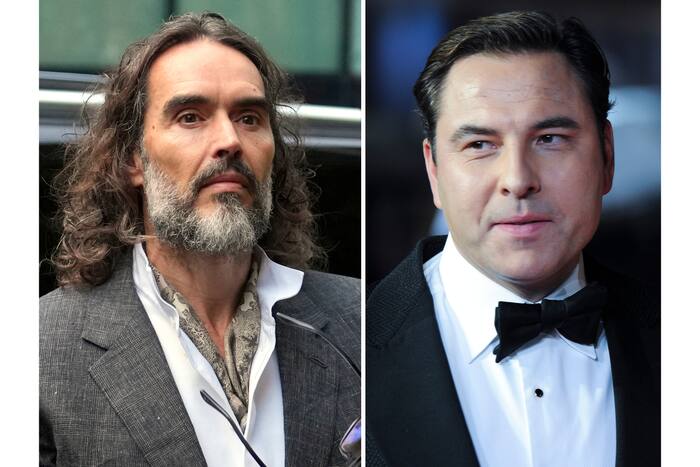
Laughter is an intoxicating shield. For twenty years, across the damp, flickering living rooms of the United Kingdom, two very different men weaponized that shield to become untouchable titans of British culture.
One was a chaotic, Victorian-gothic rock star of stand-up, his hair teased into a static storm, speaking in a breathless torrent of polysyllabic philosophy and raw, unbridled id. The other was a camp, winking master of the Saturday night variety show, who parlayed a sharp-tongued sketch comedy empire into a second, even more lucrative life as the nation’s favorite children’s book author.
Russell Brand and David Walliams did not share a double act, yet they shared a throne. They defined the comedic zeitgeist of early twenty-first-century Britain. If you turned on a television in London, Manchester, or Glasgow between 2003 and 2023, you could not escape them. They were the licensed jesters of the modern court, granted the ancient privilege of saying the unsayable while the establishment applauded.
Now, the applause has curdled into a cold, forensic silence.
To understand what is happening in the corridors of British broadcasting today, you have to look past the headlines and step into the green rooms. Consider a hypothetical scenario, built from the recurring patterns of dozens of real testimonies across the industry. Imagine a twenty-two-year-old runner on a major London television production in 2008. Let us call her Clara. She is holding a clipboard, her sneakers worn thin from fourteen-hour days, thrilled just to be in the orbit of genius. When the star of the show corners her near the catering table, invading her personal space with a lewd joke, she laughs. She has to laugh. In television, the cardinal sin is being a bad sport. If you do not laugh, you are difficult. If you are difficult, your contract is not renewed.
That laugh—nervous, compliant, terrified—is the currency that funded an era of unchecked power.
The Architecture of Impunity
For decades, British comedy operated on a specific, unwritten social contract. Following the stodgy, buttoned-up era of 1970s variety television, the alternative comedy boom of the 1980s and the lad-culture explosion of the 1990s created a new orthodoxy. Shock was virtue. Transgression was art. To question a comedian’s behavior off-stage was to betray a lack of sophistication, as if you simply didn't get the joke.
Russell Brand pushed that boundary until it snapped. Rising from the margins of stand-up to host Big Brother’s Big Mouth and command prime-time radio slots at the BBC and Channel 4, Brand made his hyper-sexuality the central pillar of his brand. Literally. He boasted about his conquests on air, mocked critics as prudes, and turned his personal chaos into public theater. When he and Jonathan Ross left lewd voicemail messages on actor Andrew Sachs’s answering machine in 2008—a scandal known as "Sachsgate"—the public outcry was fierce, yet remarkably short-lived. Brand resigned from the BBC, crossed the Atlantic, married a pop star, and reinvented himself as a spiritual guru and anti-establishment podcaster. The system absorbed the shock and kept spinning.
David Walliams took a different, far more polished route to the same destination. Alongside Matt Lucas, Walliams conquered the BBC with Little Britain, a sketch show that drew colossal ratings by trafficking in grotesque caricatures and boundary-pushing provocations. While Brand played the rebellious outsider, Walliams mastered the art of the insider wink. He became a fixture on Britain’s Got Talent, sitting beside Simon Cowell, offering camp innuendo that blurred the line between affectionate teasing and genuine discomfort. Simultaneously, he built a publishing juggernaut, selling tens of millions of children's books that earned him comparisons to Roald Dahl and a steady stream of royal invitations and charity accolades.
Both men were ratings gold. And in commercial and public-service broadcasting alike, ratings act like a powerful anesthetic. They numb the conscience of executives.
When a single performer generates millions of pounds in advertising revenue, syndication deals, and book sales, the corporate immune system stops fighting infections. Human resources departments become public relations shields. Warnings whispered by junior producers are filed away under "talent management." As one veteran television producer once confided to me over warm white wine at a Soho awards ceremony, "You don't tell the golden goose to stop biting the staff. You just buy the staff thicker trousers."
The Reckoning Arrives
The armor finally cracked not through a single police raid, but through the slow, relentless accumulation of investigative journalism and shifting cultural norms.
In September 2023, a joint investigation by The Sunday Times, The Times, and Channel 4’s Dispatches detonated beneath Russell Brand. Four women came forward with harrowing allegations of rape, sexual assault, and emotional abuse spanning between 2006 and 2013—the exact years of Brand’s meteoric rise in British television and Hollywood. The testimonies painted a picture not of a harmless rogue, but of a predatory system that used BBC cars to shuttle a sixteen-year-old schoolgirl to Brand’s home, and production staff to manage his personal life while ignoring red flags.
Brand vehemently denied all allegations, framing the investigation as a coordinated attack by the mainstream media against his anti-establishment voice. Yet the institutional fallout was immediate. The BBC, Channel 4, and Banijay UK—the production company behind Big Brother—launched internal investigations. YouTube demonetized his channels. Publishers paused his upcoming books. The Metropolitan Police confirmed they had received a number of allegations of sexual offenses in London and elsewhere in the country, launching a formal criminal inquiry that dragged on through 2024 and into 2025, keeping the comedian under the shadow of detectives' interviews under caution.
While Brand’s collapse was explosive, David Walliams’s unraveling was a slow-motion implosion of a carefully curated persona.
The first major fracture appeared in November 2022, when leaked transcripts from the set of Britain’s Got Talent revealed Walliams making derogatory, sexually explicit remarks about contestants during breaks in filming. One elderly contestant was referred to using a vicious profanity; another was targeted with crude sexual commentary. Walliams apologized, stating that the private conversations were never intended to be shared, and stepped down from the judging panel after a decade in the chair.
For a moment, it looked like a survivable PR crisis. Then the deeper questions began to surface.
Critics, parents, and fellow writers began re-examining his past performances and his literary empire. Old footage resurfaced of Walliams pulling down the trousers of young male audience members during live stage tours of Little Britain—a bit that had once drawn roars of laughter from packed arenas, now viewed through the stark prism of consent and power dynamics. Simultaneously, HarperCollins faced growing scrutiny over racial stereotypes and fat-shaming tropes embedded in his early children's titles, leading to quiet edits and the withdrawal of certain stories. By 2025 and 2026, Walliams found himself increasingly sidelined from prime-time television, a figure whose brand of campy, boundary-testing humor no longer fit a broadcasting ecosystem terrified of liability and public backlash.
Why It Took So Long
Readers often ask a deceptively simple question when these scandals break: If everyone knew, why didn't anyone stop it?
The answer lies in the mechanics of silence. It is rarely a single villain locking a door; it is a thousand small compromises made by ordinary people trying to keep their jobs.
Think of the entertainment industry like a massive, high-speed locomotive. The talent sits in the engine room, stoking the fire. Behind them are dozens of carriages filled with camera operators, sound engineers, runners, makeup artists, and junior editors—all working on short-term freelance contracts. In the UK television sector, roughly half the workforce is freelance. There is no tenure. There is no union steward standing beside the monitor. Your next three months of rent depend entirely on the showrunner liking you enough to call you for the next gig.
If you are a freelance floor manager and you see a star behaving inappropriately toward a guest or a junior colleague, you face a brutal math problem. Report it, and you risk being labeled a troublemaker on an informal blacklist that spans Soho from Wardour Street to Charlotte Street. Stay silent, and you pay your mortgage.
To make matters worse, the legal framework in the United Kingdom historically tilted the table in favor of the wealthy. Strict defamation laws meant that newspapers were terrified of publishing allegations without ironclad, multi-source corroboration, even when rumors were open secrets in every media bar in London. Non-disclosure agreements—NDAs—acted as legal gag orders, buying silence with severance payouts while leaving the underlying behavior untouched.
It took the global shockwave of the #MeToo movement, followed by specific British tremors—from the exposure of Jimmy Savile’s monstrous crimes at the BBC to the fallout surrounding broadcaster Huw Edwards and producer Noel Clarke—to finally break the inertia. Executives realized that the cost of covering up misconduct had finally exceeded the cost of confronting it.
The Invisible Scars
We spend a great deal of energy debating the fate of the famous men at the center of these storms. We argue over "cancel culture," due process, and whether comedy is being suffocated by modern sensitivity.
In doing so, we often miss the real casualties.
Consider again our hypothetical runner, Clara, now in her late thirties. Perhaps she left television entirely, taking a lower-paying job in corporate communications just to escape the anxiety of the green room. Or perhaps she stayed, rising to become an executive producer herself, carrying a quiet, simmering guilt for all the times she laughed along to survive. When the news alerts flash on her phone—names she recognizes, places she worked, behaviors she witnessed—it does not feel like celebrity gossip. It feels like a phantom limb aching in the rain.
And what of the audience? There is a specific kind of betrayal felt by the public when a comedian falls from grace. Politicians are expected to disappoint us; bankers are expected to be greedy. Comedians, however, invite us into a shared intimacy. When we laugh at someone’s jokes, we are saying, I see the world the way you do. Discovering that the person who made us laugh during our darkest days was using that very stage to camouflage cruelty leaves a bitter, lingering stain. You cannot watch the old clips the same way. The timing feels off. The wink looks like a leer.
A Different Kind of Stage
The British comedy scene today looks radically different than it did when Brand and Walliams ruled the airwaves.
Walk into a comedy club in Edinburgh or London now, and you will find an industry actively rewriting its rulebook. Major broadcasters, including the BBC, ITV, and Channel 4, have instituted mandatory intimacy coordinators, anonymous whistleblowing hotlines, and strict behavioral riders in talent contracts. The "wild west" ethos of the 2000s—where genius was treated as a license for abuse—is officially dead.
Some lament this shift, arguing that safety kills spontaneity and that great comedy requires danger. They are half right. Great comedy does require danger—the danger of challenging powerful institutions, of mocking pompous politicians, of poking holes in our collective hypocrisies.
It has never required punching down at a twenty-two-year-old runner holding a clipboard.
The microphones are still on in London’s studios, and the red lights still glow above the cameras. A new generation of comics is stepping up to the stand, sharp, fearless, and funny without needing a shield of impunity to protect them. Yet in the quiet moments between takes, when the studio audience holds its breath, the echo of that old, forced laughter still hangs in the rafters—a reminder of what happens when an entire culture decides that being entertained is more important than keeping people safe.


