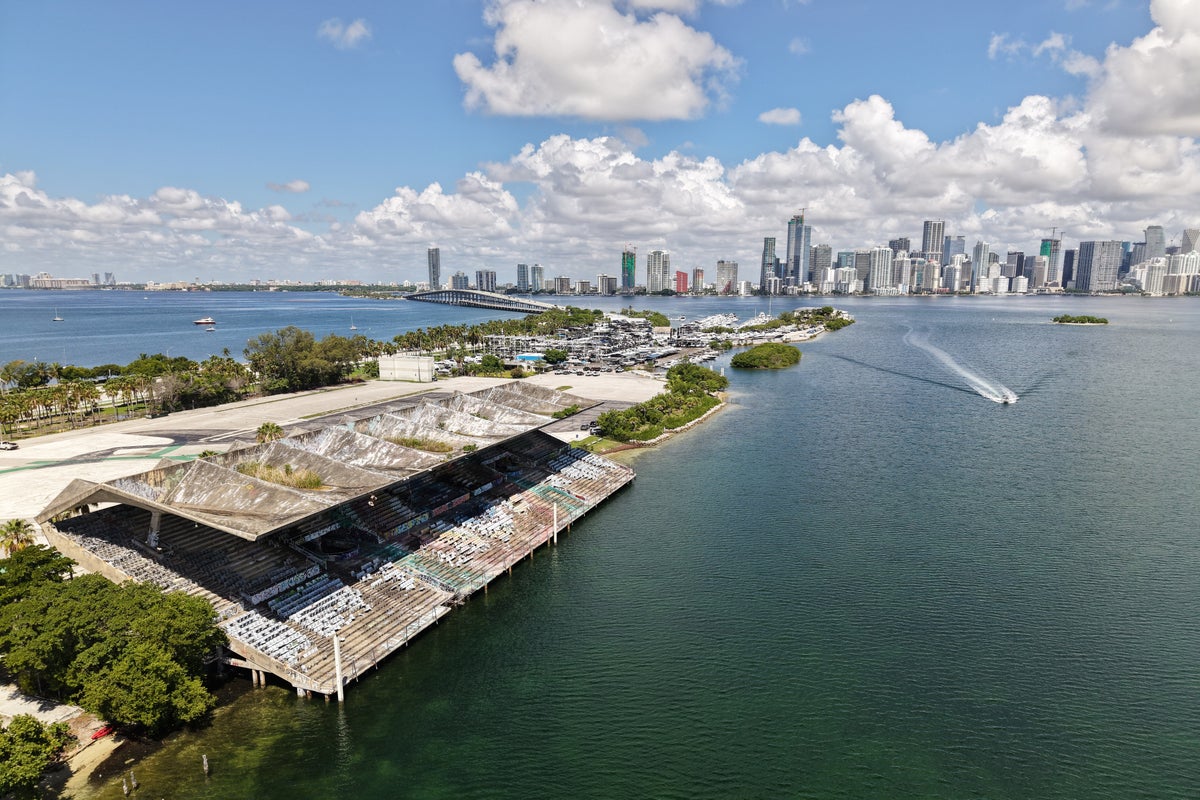
Salt air eats concrete faster than time does. Walk down the abandoned ramps of the Miami Marine Stadium today, and you can smell it: the metallic tang of rust, the heavy rot of damp wood, the ghost of saltwater spray that has been chewing away at the structure for decades.
It sits on Virginia Key like a bleached whale skeleton washed ashore by a hurricane. In other news, take a look at: The Scale in the Shadow of the Castle.
Long before the city council held another tedious zoning meeting, long before lawyers started trading paper across polished mahogany desks, this place was alive. The roof—a massive, folded plate of cantilevered concrete that looks impossibly thin, like a sheet of paper caught mid-drift—still hovers over empty air. It was built in 1963 for two million dollars. An architectural marvel. A concrete palm frond stretching out over Biscayne Bay to catch the Atlantic breeze.
And then, Jimmy Buffett played here. Deadline has also covered this important topic in great detail.
Picture it: 1985. The sun is sinking behind the downtown Miami skyline, painting the water in bruised shades of violet and orange. Thousands of people are floating in boats, canoes, and makeshift rafts right up to the floating stage. Sailboat masts bob like a forest of toothpicks against the dusk. Margaritaville is not yet a global corporate franchise; it is an attitude born right here, fueled by warm beer, salt-stained shirts, and a barefoot guy with a guitar singing about lost shakers of salt.
The stadium was never just seats. It was an amphitheater of the water.
Then came Hurricane Andrew in 1992. The storm tore through South Florida with a violent, teeth-gritting fury, and the city declared the stadium unsafe. They slapped a red tag on the doors, locked the gates, and walked away.
That is how governments kill things. Not with a sudden bomb, but with a slow, bureaucratic shrug.
For more than thirty years, the stadium has stood there as a monument to municipal paralysis. Every few years, politicians dust off a proposal. They talk about public-private partnerships. They murmur words about economic revitalization and luxury waterfront developments. They hold town halls where angry residents wave historic preservation bylaws like medieval shields.
Behind the locked gates, nature moved in. Graffiti artists scaled the perimeter fences, transforming the brilliant white modernist concrete into a towering, sprawling canvas of neon murals. Skateboards clacked against the silent ramps under the cover of midnight. It became an underground cathedral for the kids who grew up in the shadow of high-rise condos they could never afford.
(Note: While the urban exploration of the site is legendary among locals, entering the fenced property is trespassing, and the structural integrity of the cantilevered roof remains a hazard.)
Years after Jimmy Buffett made his famous final appeals and added his voice to the chorus demanding restoration, the legal and logistical machinery continues to grind at a glacial pace. Why? Because nobody knows what to do with a ghost that refuses to stay dead.
To tear it down would cost millions. To rebuild it would cost tens of millions. Every time a developer looks at the footprint, they see dollar signs mapped across the bay. Marinas. Restaurants. High-end retail.
Every time a preservationist looks at it, they see the last remaining piece of mid-century Miami modernism that didn't get bulldozed for glass towers. They see the memory of a city that used to have a soul before it became a playground for offshore wealth.
Consider the mathematics of decay. Concrete cancer is real. When saltwater infiltrates the porous pores of aging rebar, the iron expands as it rusts. It pushes outward from the inside, cracking the stone apart like an eggshell. The stadium is literally bursting at the seams under the weight of its own history.
Yet, the core remains sound. The engineering genius of H.J. Ross and his team back in the sixties created something tougher than the politicians who neglected it.
We are caught in a strange cultural loop. We worship our history right up until the moment the repair bill arrives. Then we suddenly discover amnesia.
When Jimmy Buffett passed away, the tributes poured in from across the globe. People raised glasses of tequila. They played the old cassette tapes. And in Miami, people looked back across the water toward Virginia Key, wondering if the man who sang so eloquently about lost horizons would ever see his favorite outdoor venue brought back to life.
The appeal he backed wasn't just about architecture. It was about access.
Modern cities love to privatize the view. Every new development along Biscayne Bay puts up gates, security guards, and valet parking. It tells the average person that the water belongs to the people who can afford the penthouses overlooking it.
The Miami Marine Stadium was the exact opposite. It was democratic. You didn't need a yacht to enjoy it; you just needed a boat, an inner tube, or a pair of cheap sneakers and a spot on the concrete steps. You paid a few bucks, sat under that magnificent concrete canopy, and watched hydroplane races roar across the bay while the smell of saltwater and fried food hung heavy in the air.
That is what is actually on trial in these endless council debates. Not just concrete and rebar. Not just zoning codes and municipal budgets.
It is the right of ordinary people to claim a piece of the shoreline.
The legal battles drag on. Appeals crawl through courts like crabs across the mud flats at low tide. Estimates rise and fall with the stock market and political whims.
Walk out onto the Rickenbacker Causeway tonight and look across the dark water toward the key. You won't hear the roar of the crowd. You won't hear the opening chords of a tropical ballad drifting across the bay.
You will only hear the gentle lap of the tide against the pilings, washing over the broken dreams of a city that hasn't quite figured out how to remember its own youth, and hasn't quite had the courage to let it go.