History does not always vanish into smoke. Sometimes, it turns to stone, baking under an unforgiving Aegean sun on a scrap of arid earth that cartographers named Gyaros.
For decades, this barren rock in the northern Cyclades was known by a singular, chilling moniker: the island of silence. From the Roman era up through the turbulent political purges of the twentieth century, totalitarian regimes used Gyaros as a human warehouse. More than twenty thousand political prisoners were cast onto its razor-sharp shores, forced to build the very prison blocks that would confine them, breathing dust and despair. To look at Gyaros from a distance was to witness a monument of human cruelty. The crumbling concrete barracks still stand today, skeletal fingers reaching toward an empty sky, echoing with a past too heavy for the wind to sweep away.
Then, the humans left.
The iron gates rusted shut. The guards departed. The politicians moved on. For years, the island sat abandoned, save for the ghost footsteps of its survivors. Yet, while the land above water remained a scarred monument to suffering, something extraordinary began to happen in the dark, cool depths below the surface.
Nature reclaimed the perimeter.
Consider what happens when human interference abruptly ceases. We tend to assume that places broken by our species are permanently ruined, that once the concrete is poured and the wild things are driven out, the damage is absolute. Gyaros proves us wonderfully, beautifully wrong.
Beneath the waves, away from the prying eyes of civilization, a transformation took root. Shards of sunlight began to pierce through water so clear it felt like suspended glass, illuminating dense meadows of Posidonia seagrass swaying in rhythmic cadence with the deep currents. Algal forests, long choked out by unchecked disturbance, started to creep back over the rocky shoals.
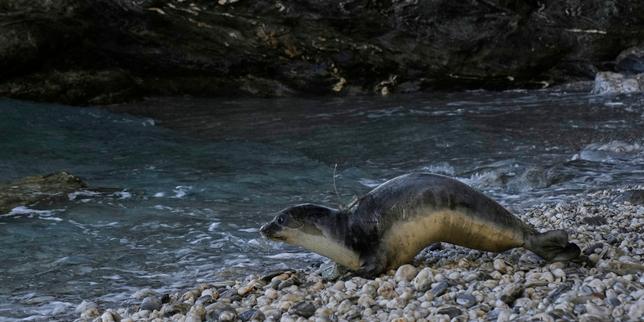
Crucially, the Mediterranean monk seal returned to its ancestral home. These elusive, magnificent creatures—among the rarest marine mammals on earth—found sanctuary in the secluded sea caves carved into the jagged cliffs of Gyaros. Unbothered by boat engines, free from the terror of indiscriminate nets, they began to breed. Today, this ghost island hosts the largest reproductive colony of Mediterranean monk seals left in existence. A place built to isolate and extinguish human life became the accidental cradle for some of the most fragile life in the sea.
But protection on paper is a fragile shield.
Years ago, despite being designated part of the European Natura 2000 network, the waters surrounding Gyaros were far from safe. Illegal fishing boats crept into the coves under the cover of night, dragging bottom nets across fragile reefs that had taken centuries to grow. The local fish stocks were dwindling, mirroring the tired, overexploited state of the wider Mediterranean, where the vast majority of commercial populations face severe strain. The sanctuary was bleeding slowly, hidden behind its intimidating history.
Change arrived not through a corporate decree, but through an uncomfortable, gritty alliance.
Scientists, conservationists from organizations like WWF Greece, local small-scale fishers from neighboring islands, and government officials sat at the same table. They did not agree on everything. Fishers worried about their livelihoods; scientists worried about collapsing ecosystems. But they shared a sobering realization: if Gyaros died, the surrounding sea would soon follow.
They listened to one another. They mapped the migration paths of the fish, traced the feeding habits of the monk seals, and designed a blueprint for survival. Step by step, through years of stubborn persistence, public consultation, and rigorous field research, the legal lines were drawn tighter.
That local experiment crystallized into law with a landmark Presidential Decree. Gyaros was officially locked into place as a fully protected marine reserve, transforming a historical wound into a modern blueprint for ecological recovery.
Walk the shoreline of Gyaros now, and the contrast is staggering.
Above, the stark, empty ruins of the prison camps remind us of our capacity for darkness. Below, fish biomass has surged, groupers glide through thriving reefs, and pups splash in sea caves where political dissidents once stared out into hopeless exile. It is a living, breathing testament to resilience.
The island did not forget its history. It simply smothered it in life.