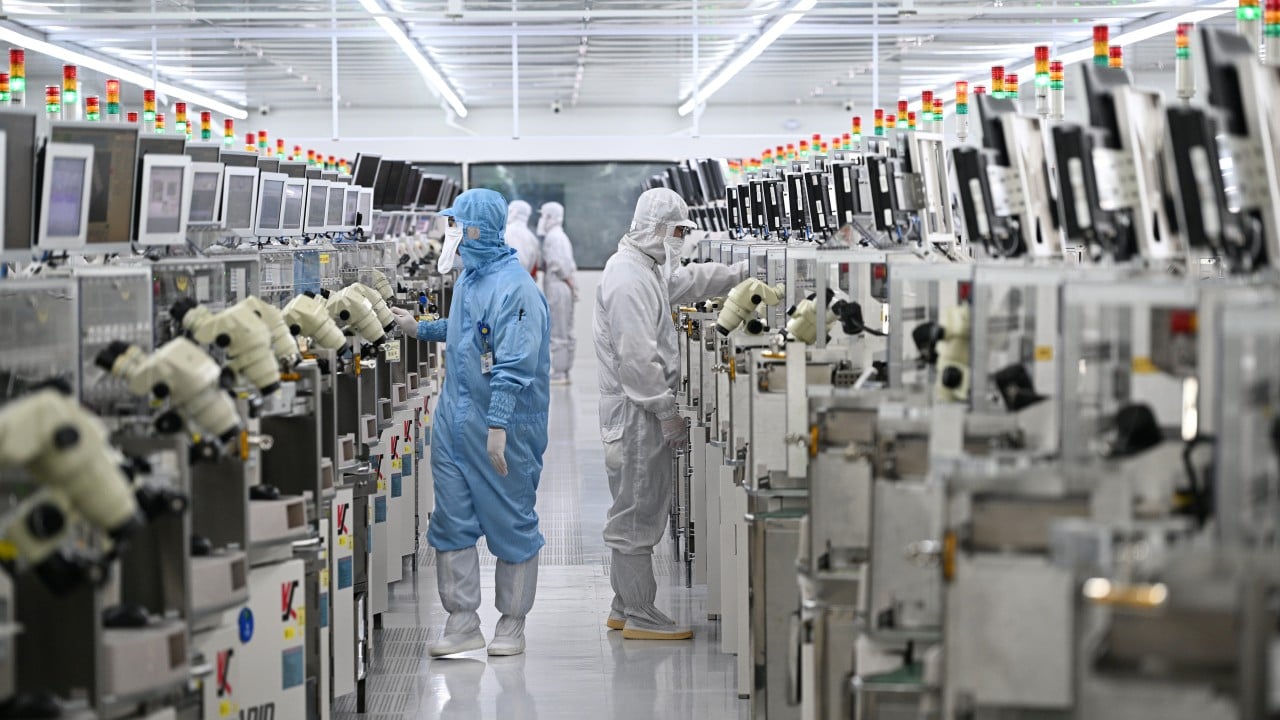
Walk into any high-end laboratory where silicon brains are born, and you will hear a strange kind of silence. It is not the quiet of a church or a library. It is a heavy, pressurized hush, broken only by the low, mechanical drone of air filtration units and the faint, rhythmic ticking of robotic arms placing components onto wafers with microscopic precision.
In this room, no one talks about algorithms. No one debates large language models or neural weights. Here, the entire future of machine intelligence hangs on something much more mundane, much more vulnerable, and infinitely smaller: a speck of black plastic.
For decades, the world has looked at the microchip revolution through the wrong end of the telescope. We obsess over the designers in Silicon Valley, the lithography giants in the Netherlands, and the massive foundries lighting up the night skies of Taiwan. We talk about transistors measured in angstroms and wafers of pure silicon polished to a mirror finish. But silicon, for all its quantum brilliance, is astonishingly fragile. Left exposed to oxygen, moisture, heat, and stray electrical currents, a multi-dollar processor will degrade, short-circuit, or simply burn out in a matter of seconds.
It needs armor.
Enter Sumitomo Bakelite.
Most people have never heard the name. If you mention it at a dinner party, heads will turn toward wine glasses and appetizers. Yet, this Japanese chemical pioneer quietly controls a staggering share of the global market for epoxy molding compounds—the specialized resin packaging that encapsulates semiconductors before they ever see a motherboard. Without their formulas, the AI boom grinds to an immediate, unceremonious halt. You cannot build a modern data center out of bare silicon.
Now, that quiet dominance is shifting eastward under the intense gravity of the artificial intelligence gold rush. Sumitomo Bakelite is aggressively expanding its production capacity for chip packaging materials in China, funneling tens of millions of dollars into its facilities in places like Suzhou and Nantong.
To understand why this matters, you have to look past the corporate press releases and into the messy, physical reality of hardware manufacturing.
Imagine holding a modern graphics processing unit designed to train heavy machine learning models. To the untrained eye, it is a sleek black tile studded with metal pins. But beneath that exterior lies a microscopic city of copper wiring, silicon layers, and thermal pathways operating under brutal physical conditions. As artificial intelligence models grow exponentially larger, the chips driving them demand more electricity, generate more heat, and push thermal limits to the breaking point.
When a processor heats up, it expands. When it cools down, it contracts. This constant mechanical breathing places immense stress on the microscopic wires connecting the chip to the outside world. If the encapsulating plastic is too rigid, the wires snap. If it is too soft, moisture creeps in and rots the circuitry from the inside out.
Finding the exact chemical balance required to protect a high-performance processor drawing hundreds of watts of power is less like manufacturing and more like alchemy. It requires decades of proprietary trial and error, precise molecular engineering, and a supply chain so pure that a single speck of dust can ruin an entire batch.
For years, multinational electronics firms relied on a globalized, frictionless flow of these specialized materials. But geopolitical friction, trade restrictions, and the explosive, localized demand for generative artificial intelligence have rewritten the map. China remains the undisputed manufacturing floor of the world’s electronics ecosystem. Millions of consumer devices, servers, and automotive systems are assembled within its borders.
When the AI boom accelerated, Chinese domestic technology firms found themselves cut off from certain advanced semiconductor imports, forcing an unprecedented rush toward domestic capability. At the same time, global chip designers needed local packaging capacity to keep pace with demand without running the gauntlet of cross-border supply chain bottlenecks.
Sumitomo Bakelite’s expansion in China is a calculated response to this pressure cooker. By pouring capital into local manufacturing lines, the company is bridging two worlds. They are satisfying the surging local appetite for high-end electronic materials while securing their own footing in the most competitive hardware market on the planet.
This is not just a business expansion. It is a structural reinforcement of the entire global digital infrastructure.
Consider what happens when a single weak link snaps in a supply chain this specialized. When automotive manufacturers faced shortages of basic microcontrollers a few years ago, multi-billion-dollar assembly lines sat idle for months over components that cost less than a cup of coffee. Now scale that vulnerability up to the bleeding edge of artificial intelligence. If the specialized epoxy compounds used to package advanced processors run short, the data centers that power our digital economy cannot be built. The supercomputers remain blueprints. The models starve for hardware.
The executives in Tokyo understand this vulnerability better than anyone. They know that in the modern economy, being indispensable is a precarious art. You must be everywhere at once, deep inside the supply chain, where no consumer will ever see your logo, yet every machine depends entirely on your product.
This is the hidden cost of our technological acceleration. We like to think of software as ethereal, floating cloud-like above the physical world. We talk about intelligence as if it were pure thought, weightless and unconstrained.
Yet every single query typed into an AI assistant, every generated image, every automated medical diagnosis requires a physical substrate. It requires copper, silicon, gold, and most importantly, millions of tons of precisely engineered black plastic, baked in industrial ovens thousands of miles away, cooling quietly in the dark.
As Sumitomo Bakelite expands its lines in Suzhou, new equipment arrives on heavy trucks, technicians calibrate robotic dispensers under sterile white lights, and bags of raw polymer resin are stacked floor to ceiling. Outside the gates, the modern world races blindly toward an automated future, entirely unaware of the chemical shield making the journey possible.
The chips get faster. The models get smarter. The ambitions grow wilder. But down at the molecular level, everything still rests on whether a tiny, unassuming block of resin can hold the heat.


