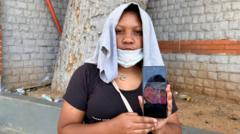
The catastrophic twin earthquakes that struck north-central Venezuela on June 24, 2026, did not create a humanitarian crisis out of thin air. They merely tore away the remaining facade of a state that had already hollowed out its own core over a quarter of a century. While local media outlets capture the immediate, raw fury of citizens accusing the transitional government of apathy and slow reaction times, focusing solely on current bureaucratic paralysis misses the deeper structural rot. The reality unfolding in flattened coastal communities like La Guaira and the fractured barrios of Caracas is the predictable result of long-term state dismantling, institutionalized corruption, and a fatal reliance on makeshift fixes.
The disaster has turned cities into graveyards because the country’s foundational systems were running on empty long before the fault lines slipped. Decades of systemic neglect under the previous regime left hospitals without basic medicine, power grids permanently on the verge of blackout, and building codes completely unforced. Now, under a complex political transition heavily influenced by Washington following the capture of Nicolas Maduro earlier this year, the fragile interim administration is discovering that a change at the top cannot instantly mend a collapsed civilization.
The Anatomy of an Unnatural Disaster
Natural events cause tremors, but political systems dictate the body count. In La Guaira state, where ten-story residential towers pancake-collapsed into neat layers of pulverized concrete, the destruction reveals a total absence of regulatory oversight. For years, construction projects went ahead through a network of bribes rather than structural engineering approvals. The country currently sits near the absolute bottom of the global Corruption Perceptions Index, trailing only war zones like Somalia and South Sudan. When the earth shook, those decades of kickbacks materialized as lethal structural failures.
Official Death Toll Escalation (June 24–28, 2026)
-------------------------------------------------
Wednesday Night:  32
Thursday:         164
Friday:           589
Saturday:         1,430+
The climbing casualty list is directly tied to a state apparatus that has lost the physical capacity to respond. Heavy machinery is scarce because state-owned equipment was long ago stripped for parts or abandoned due to a lack of maintenance. Neighboring districts watched as volunteer civilian rescue squads dug through concrete chunks with their bare hands while official military units stood by, waiting for instructions from an uncoordinated high command in Caracas.
Why a Change in Leadership Solved Nothing
Six months after the dramatic operational shift that removed the old regime, the transitional government led by acting president Delcy Rodriguez is finding out that signing energy deals with global corporations does not automatically fix a broken water pipe. The international community has rushed to promise funding, and entities like the IMF and World Bank have re-established ties with the capital. Yet, the physical reality on the ground remains stubbornly unyielding.
A primary misconception is that the current paralysis stems purely from a lack of government empathy. It does not. The issue is a total evaporation of institutional memory and operational capacity. Bureaucracies require specialized technicians, logistical experts, and functional equipment. When those are replaced over two decades by political loyalists, the state loses its ability to execute basic tasks. When the Interior Ministry finally closed off the choked highway to La Guaira to prioritize emergency vehicles, the enforcement was so erratic that the barricades ended up trapping ambulances in the resulting traffic jam.
The Medical Void
The most damning evidence of this pre-existing rot can be found inside the hospital network. Long before the June 24 disaster, nine out of ten Venezuelan public hospitals required patients to bring their own basic medical supplies—including bandages, scalpels, and sterile gloves—just to undergo routine surgeries. Only about 40 percent of the nation's operating rooms were even functional.
The Reality of Medical Care: A citizen arriving at an emergency room with crush injuries from a collapsed roof is met not by an equipped trauma team, but by a doctor handing them a handwritten list of items their family must purchase at a private pharmacy before treatment can begin.
The medical system did not break because of the earthquake. The earthquake simply forced thousands of critically injured people into a system that was already dead. While international aid agencies emphasize that recovery will take months, the immediate bottleneck is not a lack of foreign goodwill, but the physical absence of clean running water and reliable electricity inside the wards to keep basic equipment running.
The Illumination Myth
The transitional government recently touted new agreements to overhaul the domestic electrical grid, which has suffered from systemic blackouts for years. But these high-level corporate strategies offer cold comfort to a population currently living in the dark. The country’s energy sector faces a massive, structural generation deficit. Even in the best-protected areas of Caracas, power drops out multiple times a week, forcing small businesses and medical clinics to depend entirely on loud, fuel-thirsty portable generators.
In the disaster zones, this lack of power means rescue efforts halt the moment the sun goes down. There are no massive battery-powered lighting arrays or emergency grid backups to illuminate the rubble. The darkness is absolute, punctuated only by the flashlights of desperate residents looking for relatives.
The Long Road to Bare Minimums
Fixing this crisis requires looking past the immediate outrage of the population. The anger is justified, but pointing fingers at a single official ignores the scale of the reconstruction required. To achieve even basic stability, several interlocking structural challenges must be addressed systematically.
- Depoliticize Technical Institutions: Engineering, water management, and grid maintenance must be handed back to career experts rather than security forces or political operatives.
- Rebuild the Local Supply Chain: Foreign aid must bypass central state warehouses, which are notorious bottlenecks, and go directly to localized distribution nodes managed by independent civil organizations.
- Enforce Strict Infrastructure Audits: Any incoming private capital for the oil, mining, or utility sectors must be legally tied to parallel investments in regional public infrastructure.
The international community frames the Venezuelan situation as a sudden emergency brought on by a tragic natural event. But those who have spent decades tracking the region understand that the country is experiencing a prolonged, structural breakdown where natural events merely accelerate the inevitable timeline of institutional decay. The rubble lining the coast is not just stone and mortar; it is the physical manifestation of a state that stopped serving its people a generation ago.
Venezuela's pre-existing vulnerabilities explained provides an expert assessment from international delivery specialists on how this natural disaster collided with an already collapsed public infrastructure system.