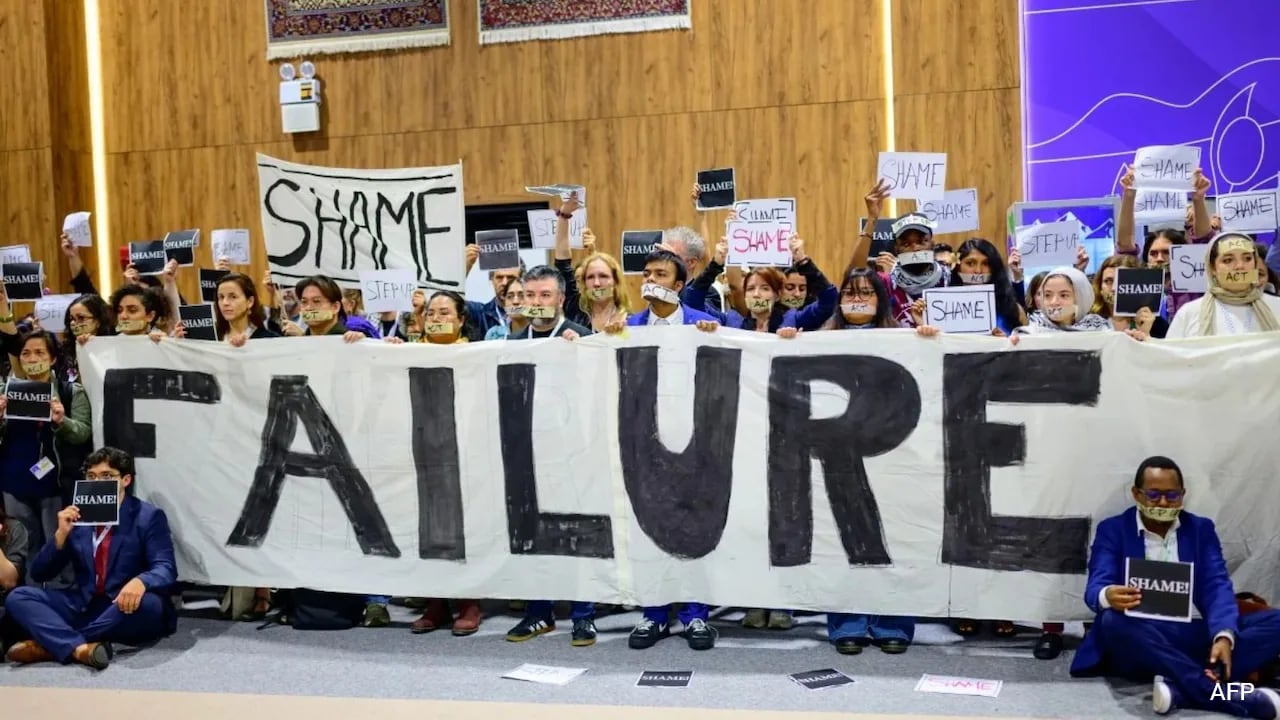
Since 1995, the United Nations has convened nearly 200 nations every year to negotiate the survival of a livable planet. Yet several of the most high-profile UN climate talks ended in bitter deadlock, watered-down compromises, or outright diplomatic collapse—most notably COP6 in The Hague (2000), COP15 in Copenhagen (2009), and COP25 in Madrid (2019). These summits failed not because negotiators lacked scientific data, but because a structural trap built into the United Nations Framework Convention on Climate Change (UNFCCC) requires unanimous consensus among petrostates, industrial superpowers, and vulnerable island nations whose immediate economic survival depends on opposite outcomes.
If you have ever watched a UN Conference of the Parties (COP) stretch thirty-six hours past its scheduled Friday adjournment into a bleak Sunday afternoon, you already know the smell of diplomatic exhaustion. Fluorescent conference center lights hum over plastic water bottles, stale pastries, and bleary-eyed delegates huddled in corridors. Journalists camp outside closed plenary doors waiting for a bracketed text—diplomatic shorthand for unresolved disputes—to finally drop its square brackets. Read more on a related issue: this related article.
Most official press releases call these marathons historic breakthroughs. Veterans on the beat know better. When nearly two hundred countries with wildly divergent economies must agree on every single comma, gridlock is not an accident. It is the baseline operating system.
The Structural Trap Behind UN Climate Gridlock
To understand why specific summits imploded, you first have to look at the rulebook adopted in the early 1990s. When the UNFCCC was drafted in 1992, delegates failed to agree on voting rules. Because no consensus was ever reached on how to vote, Rule 42 of the Draft Rules of Procedure remained un-adopted, defaulting every substantive decision to consensus. Further reporting by The New York Times explores comparable perspectives on this issue.
Consensus does not mean unanimity in a strict legal sense, because a chair can gavel through a decision if no single country formally objects on the floor. In practice, however, it hands a functional veto to every delegation in the room. A single fossil-fuel-dependent nation or a major industrial emitter can stall an entire global accord simply by threatening to raise its flag and block the gavel.
Layered on top of this procedural bottleneck is a deep, unresolved fault line established by the 1992 treaty itself. That fault line is known as Common But Differentiated Responsibilities and Respective Capabilities (CBDR-RC). Originally designed to divide the world into developed nations (Annex I) that caused historical emissions and developing nations (Non-Annex I) that needed room to grow, the binary split worked in 1992. By the late 2000s, it had become an anchor dragging down every negotiation. China had surpassed the United States as the world's largest annual emitter, yet remained legally classified alongside impoverished nations with negligible carbon footprints. Wealthy nations refused to sign binding cuts unless emerging giants took on obligations; developing nations refused to sacrifice poverty reduction to clean up a mess the West created over two centuries of coal-fired industrialization.
COP6 in The Hague and the Carbon Sink Standstill
November 2000. The Kyoto Protocol had been signed three years earlier, promising legally binding emission cuts for industrialized nations, yet nobody had agreed on the actual rules for enforcing it. Delegates arrived in The Hague to finalize the operational mechanics. Instead, they walked straight into a transatlantic brick wall.
The core dispute centered on carbon sinks—specifically, whether wealthy nations like the United States, Canada, and Japan could count existing forests and agricultural land as credits against their obligation to cut tailpipe and smokestack emissions. The Clinton administration argued that domestic forests absorbed massive amounts of carbon dioxide and should offset roughly half of the required U.S. reductions. European ministers, led by French Environment Minister Dominique Voynet and British Deputy Prime Minister John Prescott, viewed the proposal as creative accounting that would let Washington avoid real industrial transformation.
Negotiations dragged into an all-night marathon. At 4:00 AM on the final Saturday, Prescott and Voynet hammered out a tentative compromise with U.S. chief negotiator Frank Loy. Exhausted, Voynet returned to brief the European Union delegation, where green ministers from Germany and Denmark rejected the concession as too weak. By the time Voynet returned to the table, the deal had evaporated.
COP6 did not end with a signed treaty. It was formally suspended—an extraordinary diplomatic admission of failure—forcing negotiators to reconvene in Bonn six months later. By then, George W. Bush had taken office in Washington and repudiated the Kyoto Protocol altogether, gutting the treaty's global reach before it even entered into force.
The Copenhagen Meltdown of 2009
No climate summit carried heavier expectations than COP15 in Copenhagen. Over 115 world leaders descended on the Danish capital in December 2009, turning the Bella Center into a security fortress choked by freezing temperatures and tens of thousands of protesters outside. This was supposed to be the moment the world replaced the expiring Kyoto framework with a sweeping, legally binding global treaty.
It turned into one of the most chaotic diplomatic failures in modern multilateral history.
The breakdown began months before anyone landed in Denmark, rooted in a clash over legal architecture. European leaders wanted a top-down, legally binding treaty with strict national caps and international verification. The United States, constrained by a Senate that would never ratify a binding climate treaty, pushed for a bottom-up "pledge and review" system. Meanwhile, China and India resisted any international monitoring of their domestic emissions, viewing foreign inspection teams as an infringement on national sovereignty.
Inside the Bella Center, Danish hosts committed a fatal procedural blunder. Rumors leaked of a secret "Danish Text" drafted behind closed doors by the hosts, the U.S., and the UK—a document that appeared to sideline the Kyoto Protocol and shift heavier burdens onto developing nations. Developing countries erupted in fury, accusing the hosts of disenfranchising the Global South. Trust vanished overnight.
By the final Friday, the formal UN process had completely seized up. U.S. President Barack Obama arrived to find negotiations paralyzed. In a scene that has become diplomatic legend, Obama, Secretary of State Hillary Clinton, and German Chancellor Angela Merkel walked uninvited into a closed-door meeting where Chinese Premier Wen Jiabao was huddled with the leaders of India, Brazil, and South Africa.
Inside that small room, the leaders drafted a three-page political statement called the Copenhagen Accord. It contained no legally binding targets. It abandoned the goal of limiting warming to 1.5 degrees Celsius in favor of a looser 2-degree aspiration, and it merely promised to "mobilize" $100 billion a year in climate finance by 2020 without specifying who would pay what.
When Obama and the group emerged and presented the text to the full UN plenary at 3:00 AM, the room exploded. Delegates from Venezuela, Bolivia, Sudan, and Tuvalu took the floor to denounce the backroom deal as a coup against the United Nations. Lumumba Di-Aping, the Sudanese chair of the G77 bloc, compared the deal to asking Africa to sign a suicide pact. Because a handful of nations refused to give consensus, the UN could not even adopt the Copenhagen Accord. Plenary delegates had to settle for a humiliating procedural workaround—voting merely to "take note" of the document's existence.
COP25 in Madrid and the Carbon Market Collapse
Ten years after Copenhagen, the 2015 Paris Agreement was supposed to have solved the architecture problem by letting every country set its own voluntary targets. Yet in December 2019, COP25 in Madrid proved that voluntary pledges could still grind to a halt over the fine print.
Originally slated for Chile before massive social protests forced a last-minute relocation to Spain, COP25 ran forty-four hours overtime, making it the longest climate conference in UN history. Its primary mandate was straightforward: finish the Paris Rulebook by finalizing Article 6, the section governing international carbon markets and emissions trading.
Instead, delegates deadlocked over double counting and zombie credits.
Brazil, backed by Australia and India, insisted on carrying over hundreds of millions of old carbon credits generated under the defunct Kyoto Protocol's Clean Development Mechanism. Independent analysts and climate scientists pointed out that these legacy credits represented past projects—many of dubious environmental value—that would flood the new Paris market and allow major polluters to buy cheap offsets rather than cutting actual emissions.
At the same time, Australia argued for accounting rules that would let both the buyer and the seller of a carbon offset count the same emission reduction toward their national targets—a practice known as double counting. If one ton of avoided carbon is claimed by two countries, global emissions quietly rise while spreadsheets look clean.
Costa Rica, the European Union, and a coalition of small island states drew a hard line, arguing that no deal was better than a bad deal that rigged the carbon math. By Sunday afternoon, exhausted negotiators threw in the towel, punting Article 6 to the following year's summit in Glasgow. Meanwhile, the final political declaration stripped out urgent language calling on major emitters to immediately strengthen their 2020 climate pledges, prompting UN Secretary-General António Guterres to publicly express his disappointment.
Why Modern Summits Still Stall Even When They Claim Success
If you look closely at recent summits like COP26 in Glasgow (2021), COP28 in Dubai (2023), and COP29 in Baku (2024), you will notice a pattern. Organizers rarely allow a summit to end in an official, headline-grabbing collapse like The Hague or Copenhagen anymore. Instead, deadlock has evolved into a quieter, more insidious phenomenon: the lowest-common-denominator text.
Consider what happened in the final hours of COP26 in Glasgow. For two weeks, negotiators had crafted a landmark pledge to "phase out" unabated coal power—the single largest source of global carbon dioxide emissions. Minutes before the final gavel, Indian Environment Minister Bhupender Yadav, backed by China, took the microphone and demanded a single word change. "Phase out" was altered on the floor to "phase down." Alok Sharma, the British president of the summit, fought back tears as he apologized to the plenary for how the process had unfolded, acknowledging that blocking the edit would have collapsed the entire Glasgow Climate Pact.
A similar dynamic played out at COP29 in Baku in November 2024. The summit's primary mission was establishing a new global climate finance target to replace the expired $100 billion pledge. Developing nations, backed by independent economists, calculated that at least $1.3 trillion per year was needed to help vulnerable countries transition away from fossil fuels and survive extreme weather.
After two weeks of bitter recriminations—during which negotiators from the Alliance of Small Island States and the Least Developed Countries briefly walked out of the negotiating rooms in protest—wealthy nations pushed through a commitment of $300 billion per year by 2035. Even that figure was padded with vague language allowing funds to come from "a wide variety of sources," meaning private loans and multilateral development bank financing rather than direct grants. Developing nations called the sum an insult, yet feared walking away with zero guaranteed funding.
The Counter-Argument for Slow Multilateralism
Critics frequently argue that the COP process has become an expensive, carbon-intensive circus overrun by fossil fuel lobbyists—over 2,400 of whom were granted badges at COP28 in Dubai, outnumbering almost every national delegation. Some policy analysts suggest scrapping the universal UN format in favor of smaller "climate clubs" where a dozen major emitters negotiate binding trade and carbon tariffs among themselves.
That argument misses a crucial geopolitical reality. Smaller clubs of wealthy emitters tend to ignore climate adaptation, loss and damage funding, and technology transfers for the developing world. Without the universal UN forum, nations like Tuvalu, Bangladesh, or Malawi have virtually zero leverage over the superpowers whose emissions are submerging their coastlines.
Furthermore, despite the theatrical gridlock, the UNFCCC architecture has quietly bent the global emissions curve. Before the Paris Agreement was negotiated in 2015, the world was tracking toward a catastrophic 4 degrees Celsius of warming by 2100. Today, under existing national policies and pledges, projected warming sits closer to 2.6 to 2.8 degrees Celsius. That is still far above safe limits, and it leaves millions exposed to severe climate disruption, but it proves that international peer pressure does alter domestic industrial policy over time.
What Actually Breaks a UN Climate Stalemate
History shows that UN climate talks rarely break deadlock inside the plenary hall itself. Movement happens only when external economic or geopolitical shocks shift domestic calculations before delegates ever board their flights.
In 2014, the road to the Paris Agreement was paved not by UN bureaucrats, but by a bilateral handshake in Beijing between Barack Obama and Chinese President Xi Jinping. By announcing joint, synchronized targets months ahead of COP21, the world's two largest polluters removed the mutual veto that had destroyed Copenhagen five years earlier.
Today, the real battleground has shifted from diplomatic phrasing to industrial economics. Rapidly falling costs for solar photovoltaics, wind turbines, and grid-scale battery storage are beginning to do what thirty years of bracketed UN text could not: make fossil fuels financially uncompetitive in power markets from Texas to Tamil Nadu. Meanwhile, mechanisms like the European Union's Carbon Border Adjustment Mechanism (CBAM)—which imposes tariffs on imported steel, cement, and aluminum based on their carbon footprint—are forcing exporting nations to price carbon whether they like UN treaties or not.
Diplomats in fluorescent-lit convention centers will continue fighting over adjectives until the final gavel falls at 4:00 AM. The treaties they produce will remain messy, compromised, and perpetually behind the physics of a warming atmosphere. Yet the real verdict on whether those deadlocks matter is no longer being written in UN corridors—it is being decided in power grids, supply chains, and capital markets where clean energy is finally outpricing the status quo.


