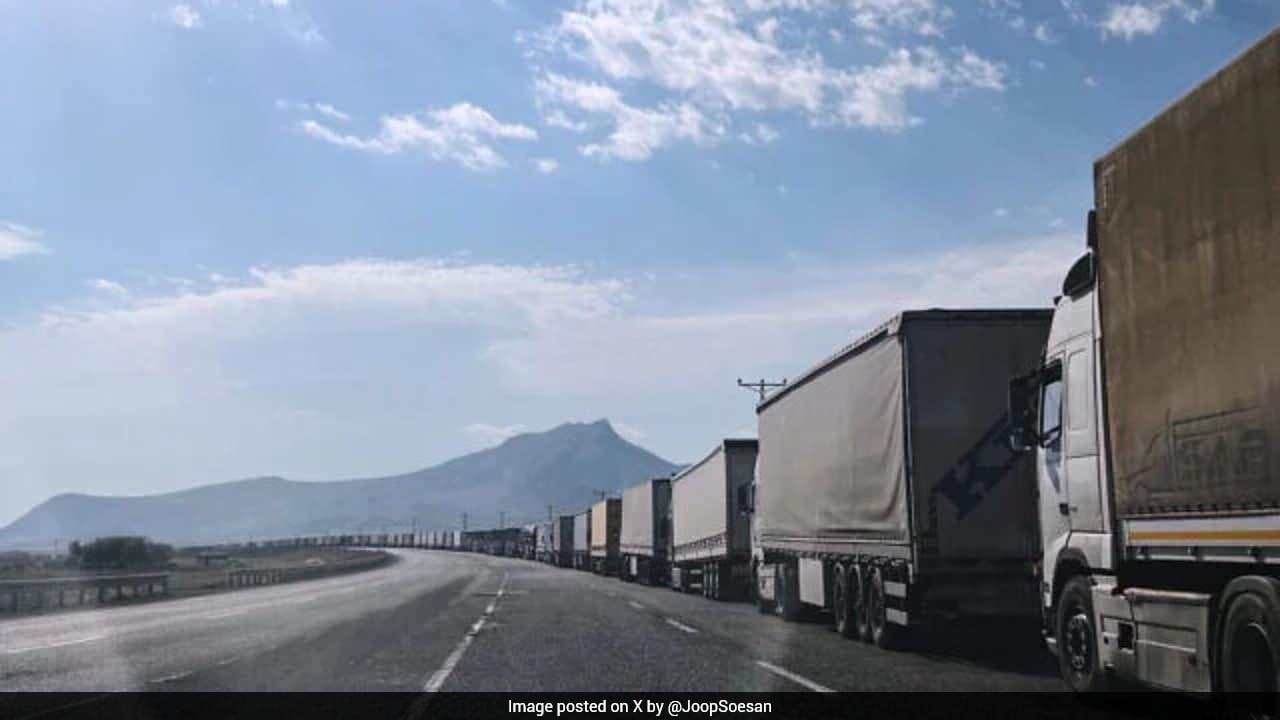
Hundreds of heavy cargo haulers stretch for miles along the rugged asphalt leading to the Gurbulak and Bazargan border gates between Turkey and Iran. Drivers spend days, sometimes weeks, idling in the exhaust-choked mountain air. This monumental traffic jam is not merely a logistical failure of customs administration. It is the visible, grinding friction point of a massive geopolitical squeeze. As American naval operations choke off Iran's maritime commercial lifelines in the Persian Gulf, international trade has been forcefully rerouted onto fragile overland asphalt. The result is a high-stakes economic bottleneck that reveals the raw mechanics of modern financial warfare.
Understanding how a military strategy executed thousands of miles away materializes as a multi-mile truck queue in eastern Anatolia requires looking at the anatomy of secondary pressure. When maritime ports face strict naval interdiction, sovereign supply chains do not simply vanish. They compress. They seek the path of least resistance through neighboring states. For Tehran, the mountain crossings into Turkey have transformed from routine commercial corridors into critical respiratory tracts. Every container of industrial machinery, chemical component, and consumer staple creeping across this frontier represents an attempt to bypass Washington's financial wall.
The United States Treasury and the Pentagon have watched this overland migration closely. In response, Washington has expanded its campaign beyond blue-water blockades, setting its sights squarely on land corridors and regional transit hubs. Through initiatives like Task Force Iron Gate, American officials have leaned heavily on neighboring governments to tighten inspections, throttle dual-use shipments, and choke off the financial plumbing that keeps cross-border commerce moving. Yet this strategy triggers immediate friction with regional capitals. Ankara and Baghdad find themselves caught between compliance with Western financial directives and the economic reality of their own border communities, which depend entirely on the steady pulse of cross-border trade.
On the ground, the human and economic toll of this geopolitical chess match falls squarely on independent operators. Truck drivers carrying rubber, raw textiles, and manufacturing parts report waiting times extending past five days on the Turkish side, while return queues stretching into Iranian territory can last up to three weeks. Basic sanitation infrastructure along these staging routes is practically nonexistent, turning high-altitude mountain passes into makeshift encampments of frustration. Inflation inside Iran, compounded by currency depreciation and structural contraction, means that the rial earnings of these journeys buy fractions of what they did a year prior.
At the macro level, the Iranian economy absorbs structural damage that international monitors measure in billions. Yet the regime in Tehran has demonstrated a high tolerance for ordinary hardship, prioritizing state survival over civilian economic relief. While Washington calculates that squeezing land transit will force strategic concessions, local merchants and regional authorities point out a glaring counter-argument. Total isolation is practically impossible across porous mountainous terrain. When formal routes bottleneck, informal and illicit channels frequently expand, enriching smuggling networks while starving legitimate municipal economies.
Ankara walks a tightrope of diplomatic pragmatism. While Turkish banking and regulatory institutions have gradually fallen into line with evolving Western compliance standards—evidenced by tighter scrutiny of foreign corporate entities and the scaling back of certain legacy financial operations—complete economic decoupling from a major neighbor remains politically and logistically volatile. Turkish transport ministers face fierce pushback from domestic logistics associations whose profit margins depend on bilateral trade volume.
Meanwhile, the asphalt infrastructure itself tells the story of an escalating conflict. Road authorities in eastern Turkey have quietly initiated lane expansions and customs upgrades, planning for a future where trade blockades are not temporary emergencies but permanent fixtures of regional commerce. These concrete investments suggest that governments are bracing for a prolonged era of fractured supply chains.
The standoff at the frontier demonstrates the limits of economic statecraft in an interconnected world. Washington can issue directives, deploy interdiction task forces, and pressure regional capitals to seal the leaks, but the geography of the Middle East resists neat administrative boundaries. As long as a desperate market exists on one side of the mountain and willing intermediaries operate on the other, the trucks will keep lining up, turning every kilometer of highway into a contested zone of global power.