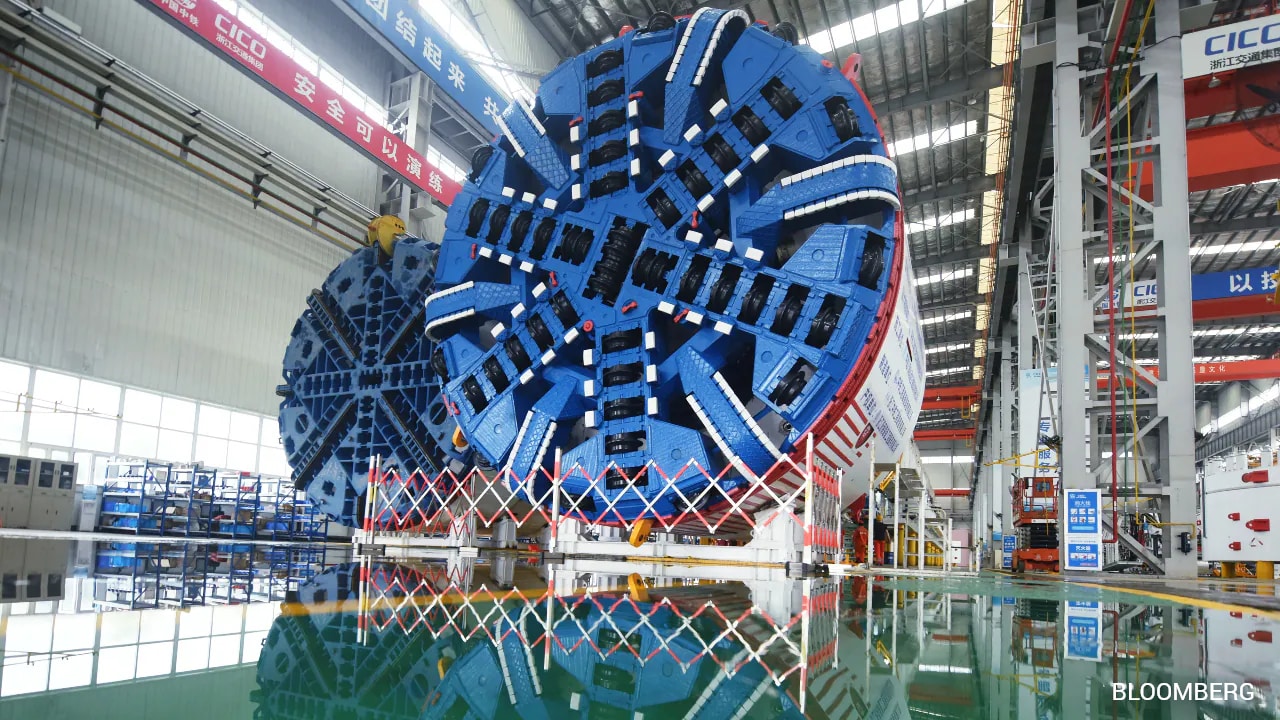
India's multi-trillion-dollar infrastructure expansion faces an immediate, physical chokepoint. Deep beneath cities like Mumbai, Delhi, and Bengaluru, the massive tunnel boring machines (TBMs) carving out metro lines, undersea roadways, and Himalayan rail links are largely manufactured in China—and Beijing's tightening export controls on heavy machinery and specialized components threaten to stall projects across the subcontinent. Even when Indian contractors purchase machines from European heritage brands like Germany's Herrenknecht or America's Robbins, the critical sub-assemblies, cutterheads, and main bearings frequently originate from Chinese factories or rely on Chinese supply chains. Without uninterrupted access to these 5,000-ton subterranean factories, India's ambitious timelines risk stretching by years while costs spiral.
It is an uncomfortable paradox for New Delhi. Over the past several years, the Indian government has erected strict regulatory walls to push Chinese firms out of strategic sectors, tightening visa rules for Chinese technicians and barring state-linked Chinese companies from bidding directly on public infrastructure tenders. Yet when a civil engineering firm needs to bore a 12-meter-wide tunnel through unstable basalt or waterlogged clay, the global market offers remarkably few alternatives.
The Anatomy of a 5,000-Ton Dependency
To understand why a single machine can hold a billion-dollar transit corridor hostage, you have to stop thinking of a TBM as a piece of construction equipment. It is a bespoke, moving factory.
A large-diameter TBM stretches longer than a football field and weighs anywhere from 1,500 to over 5,000 metric tons. Unlike an excavator or a crane, you cannot buy one off a lot. Engineers design each unit specifically for the exact geology it will chew through—factoring in water pressure, rock hardness, fault lines, and soil composition. Inside its steel shield, operators run a continuous assembly line: rotating disc cutters fracture the rock face, screw conveyors extract the muck, hydraulic jacks push the entire apparatus forward, and robotic erectors bolt precast concrete segments into place to form the tunnel walls behind it.
Two decades ago, European and Japanese manufacturers dominated this engineering niche. That changed when China embarked on the largest domestic tunneling spree in human history, building thousands of kilometers of high-speed rail, urban metros, and water diversion tunnels. Backed by state subsidies and guaranteed domestic demand, Chinese state-owned enterprises—most notably China Railway Engineering Equipment Group (CREG) and China Railway Construction Heavy Industry (CRCHI)—absorbed foreign designs, scaled up manufacturing, and eventually captured roughly two-thirds of the global TBM market.
They did not just win on price, though Chinese machines routinely undercut European competitors by 20 to 30 percent. They won on delivery speed. Where a European manufacturer might quote 18 to 24 months to design, forge, and assemble a custom machine, Chinese conglomerates can often deliver in under a year. For Indian contractors operating under tight government deadlines and steep penalty clauses, that speed was irresistible.
The Geopolitical Squeeze Beneath the Surface
The vulnerability is no longer theoretical. Following border clashes in the Himalayas in 2020, New Delhi overhauled its procurement rules, requiring bidders from countries sharing a land border with India to obtain special security clearances. Simultaneously, visa approvals for Chinese engineers and technical specialists slowed to a crawl.
On paper, this looked like a decisive move toward self-reliance. On the ground, at active tunnel shafts in Mumbai and Chennai, it triggered quiet panic.
Buying a TBM is only the beginning of the relationship with the manufacturer. During assembly at the bottom of a launch shaft, commissioning, and complex geological transitions, the manufacturer's proprietary software and specialist engineers are essential. When a main bearing overheats 40 meters beneath a densely populated neighborhood, a contractor cannot simply call a local mechanic. They need the original equipment manufacturer's engineers on-site to diagnose the telemetry and oversee repairs.
Visa delays left expensive machines sitting idle in shafts while contractors scrambled to arrange remote troubleshooting over video calls—a precarious workaround when dealing with high-pressure subterranean equipment. Worse still, Beijing has increasingly demonstrated its willingness to weaponize supply chains. Export restrictions on dual-use technologies, specialized metallurgy, and heavy industrial equipment mean that customs clearances in Chinese ports can suddenly stall without formal explanation. A delayed shipment of replacement disc cutters or hydraulic seals can halt a tunneling drive for months, burning through millions of dollars in idle labor and equipment leases.
The Hidden Chinese Footprint in Western Brands
A common misconception among policymakers is that Indian contractors can simply pivot back to German, Japanese, or American suppliers. In practice, the global supply chain for heavy tunneling equipment is deeply intertwined with China.
To stay price-competitive over the last fifteen years, Western TBM manufacturers shifted substantial portions of their fabrication and component sourcing to Chinese facilities. A machine carrying a prestigious European nameplate might have its primary steel shield fabricated in Guangzhou, its backup gantries welded in Tianjin, and its critical electrical components sourced from Shenzhen. Even if an Indian firm signs a contract with a European headquarters, the physical hardware frequently ships out of a Chinese port—exposing the project to the exact same geopolitical friction and export scrutiny.
Why India Cannot Quickly Build Its Own
Whenever supply chain vulnerabilities surface in New Delhi, the instinctive policy response is to invoke domestic manufacturing initiatives. But replicating a heavy TBM ecosystem from scratch is vastly more difficult than assembling smartphones or fabricating steel bridges.
The bottleneck lies in metallurgy and precision machining. Consider the main bearing—the massive, multi-ton ring that allows the TBM's cutterhead to rotate under thousands of tons of thrust while keeping out pressurized groundwater and abrasive rock dust. Only a handful of facilities worldwide possess the specialized forging presses, heat-treatment furnaces, and microscopic grinding capabilities required to produce a bearing that will not fail mid-tunnel. If a main bearing fails underground, you cannot pull the machine out; contractors often have to dig a rescue shaft from the surface down to the stalled machine at astronomical cost.
Similarly, the cutterhead tools—rolling disc cutters made from ultra-hardened steel alloys—must withstand extreme friction and impact against abrasive quartzite and basalt. While Indian heavy engineering giants like Larsen & Toubro (L&T) have built impressive capabilities in refurbishing used TBMs and assembling smaller units, the domestic ecosystem still relies heavily on imported core components. Building a fully indigenous supply chain for large-diameter machines would require billions in capital expenditure and at least a decade of operational trial and error.
The True Financial Cost of a Stalled Bore
When a TBM stops moving, the financial bleed is immediate and severe. Infrastructure financing in India relies heavily on tight project schedules; delays do not just push back ribbon-cutting ceremonies, they destroy project economics.
Consider a hypothetical metro rail package in a major Indian city budgeted at $500 million. The contractor structures its debt repayments around milestone payments triggered by each kilometer of completed tunnel. If export delays on a replacement hydraulic pump or a visa hold-up for a commissioning engineer stalls the machine for four months, the contractor still pays daily wages for hundreds of workers, maintains dewatering pumps running 24 hours a day to prevent shaft flooding, and absorbs mounting interest on working capital loans.
Over a multi-year infrastructure pipeline worth hundreds of billions of dollars—spanning the National Infrastructure Pipeline, urban metro expansions across two dozen cities, and strategic border tunnels in Ladakh and Arunachal Pradesh—these friction costs compound rapidly. Taxpayers ultimately absorb the blow through revised project estimates, arbitration claims, and delayed public transit relief.
Navigating the Chokepoint Without Paralyzing Growth
Indian engineering firms and infrastructure ministries are not entirely without options, though every workaround carries distinct trade-offs.
The most immediate pragmatic measure is aggressive TBM refurbishment. Because machines are built to withstand immense structural stress, their steel shields and primary frames often outlive a single project. Indian contractors have become increasingly adept at extracting used machines at the end of a metro line, stripping them down in local yards, replacing worn seals and bearings, and modifying the cutterhead diameter for a new geological profile. Refurbishment cuts reliance on whole-machine imports from China, though it still leaves contractors exposed to spare-part bottlenecks.
A second approach involves selective visa carve-outs and bonded supply agreements. Infrastructure ministries have quietly lobbied security agencies to create fast-track visa channels for essential technical personnel tied to critical public transit projects, recognizing that blocking a Chinese technician from fixing a machine already paid for by an Indian state agency hurts India far more than Beijing. Simultaneously, forward-looking contractors are writing strict clauses into procurement contracts requiring non-Chinese origin for critical wear parts and mandating stockpiles of high-failure components on Indian soil before boring begins.
Finally, policymakers must separate strategic border infrastructure from urban transit. Keeping Chinese equipment and personnel away from sensitive Himalayan road and rail tunnels near the Line of Actual Control is a non-negotiable national security imperative, regardless of the higher cost and longer timelines required to procure purely Western or Japanese machines. Applying that same blanket restriction to a municipal water tunnel in Pune or a metro line in Patna, however, imposes a self-inflicted economic penalty that slows urban development without delivering proportional security gains.
Infrastructure development is ultimately a game of physical realities, not policy slogans. You cannot negotiate with solid rock, and you cannot bore through a mountain with procurement guidelines. Until India cultivates the deep metallurgical and precision-manufacturing base required to build 5,000-ton machines on its own soil, its underground ambitions will remain tethered to the factories—and geopolitical whims—of its northern neighbor.