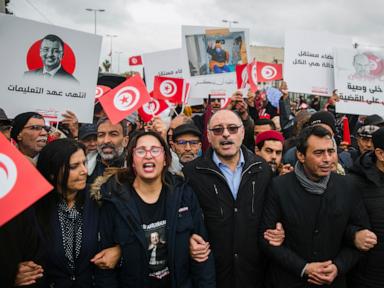
Tunisia's highest judicial authority, the Court of Cassation, finalized a crushing blow to political pluralism by upholding lengthy prison sentences of up to 45 years for dozens of prominent opposition leaders, human rights defenders, and attorneys. This definitive ruling effectively closes the legal avenues for individuals swept up in the sweeping "conspiracy against state security" trials under President Kais Saied. The dismantling of the opposition via the courts marks a profound turning point for a nation that once stood as the sole remaining democratic beacon of the 2011 Arab uprisings.
To understand how a nation can transition from a vibrant constitutional democracy to an arena of mass political trials, one must look closely at the mechanical dismantling of institutional checks and balances. Since suspending parliament and assuming executive control in July 2021, Saied has systematically reshaped the legal architecture of the Tunisian state. The executive branch did not merely bypass the legislature; it reconfigured the judiciary through executive decrees, retiring judges en masse and replacing them with appointees more aligned with the palace's vision of state preservation.
The mechanics of the conspiracy case reveal a troubling blueprint for modern executive overreach. Initiated under vague statutes regarding internal and external state security, the prosecution targeted figures whose primary offense was organizing political coalitions against presidential decree. Defense lawyers repeatedly noted procedural anomalies throughout the multi-year ordeal, including restricted access to case files, sudden trial accelerations, and a total disregard for the evidentiary standards required in standard criminal jurisprudence. Defendants like Ahmed Nejib Chebbi, Chaima Issa, and Jaouhar Ben Mbarek found themselves trapped within a judicial pipeline where pretrial detention stretched past legal limits before transforming into definitive multi-decade prison terms.
International observers have documented these deviations closely. Human rights organizations and legal monitors pointed out that the Court of Cassation's rejection of the final appeals came after a defense notification period lasting merely three days, a timeline rendering meaningful legal preparation practically impossible. Such velocity in a high-stakes mass trial involving 34 upheld convictions signals an executive preference for administrative closure over substantive justice.
The defense strategies deployed during the final hearings underscore the profound limitations placed on legal representation in contemporary North African politics. Attorneys argued that the core charges—forming criminal conspiracies and attempting to alter the nature of the state—rested entirely on routine political communications, diplomatic meetings, and coalition-building exercises that are standard practice in any multi-party system. In a functioning democracy, these activities represent the bread and butter of opposition politics. Under the current dispensation in Tunis, they are treated as high treason.
President Saied has consistently framed these prosecutions through the lens of national sovereignty and anti-corruption. In public addresses, the administration characterizes domestic critics not as legitimate political opponents, but as external agents and domestic saboteurs attempting to engineer food shortages, manipulate social unrest, and dismantle the republic from within. This populist rhetoric effectively frames every political disagreement as an existential security threat, justifying extraordinary measures that would otherwise be unconstitutional.
The political fallout from the Cassation Court ruling is already shifting the locus of opposition resistance. Families of the detained activists and surviving political coalitions have signaled that the fight has officially moved from the courtroom to the broader civic sphere. With legal recourse exhausted inside domestic tribunals, human rights advocates are looking toward international bodies and regional bodies to maintain pressure on the Tunisian government. Yet, the efficacy of external pressure remains deeply questionable given the administration's willingness to absorb diplomatic criticism in exchange for domestic consolidation.
Consider a hypothetical scenario where an administration wishes to neutralize political opposition without resorting to outright military dictatorship. The playbook does not require closing parliament entirely or canceling all ceremonies of governance. Instead, it involves weaponizing the penal code, transforming standard administrative infractions or conspiracy statutes into catch-all nets for dissidents, and ensuring that the judiciary operates as an extension of the executive office. Tunisia's trajectory over the past five years provides a textbook case study in this subtle, legalistic erosion of democratic norms.
The human cost of this judicial campaign extends far beyond the prison walls of Mornaguia or other correctional facilities. Many of the convicted figures are aging politicians and career lawyers whose health has deteriorated significantly during prolonged periods of detention. Successive heat waves and inadequate medical care inside overcrowded cells have turned what was intended to be legal detention into a severe physical ordeal. Families describe an atmosphere of exhaustion mixed with defiant persistence, noting that the physical imprisonment of individual leaders has paradoxically forced younger, decentralized networks of dissent to find new ways of organizing.
As Tunisia settles into this new political reality, the structural changes to its governance model appear increasingly entrenched. The judiciary, once celebrated for its independence during the early post-2011 transition, has been subdued. The political class that authored the 2014 constitution is either in exile, underground, or serving historic prison terms. What remains is a centralized state apparatus built around the singular vision of an executive determined to insulate itself from any form of organized electoral or civic challenge, leaving the future of Tunisian pluralism hanging by a thread
Watch the detailed coverage on Tunisia's judicial developments through Tunisia Court Upholds Prison Sentences.
http://googleusercontent.com/youtube_content/1