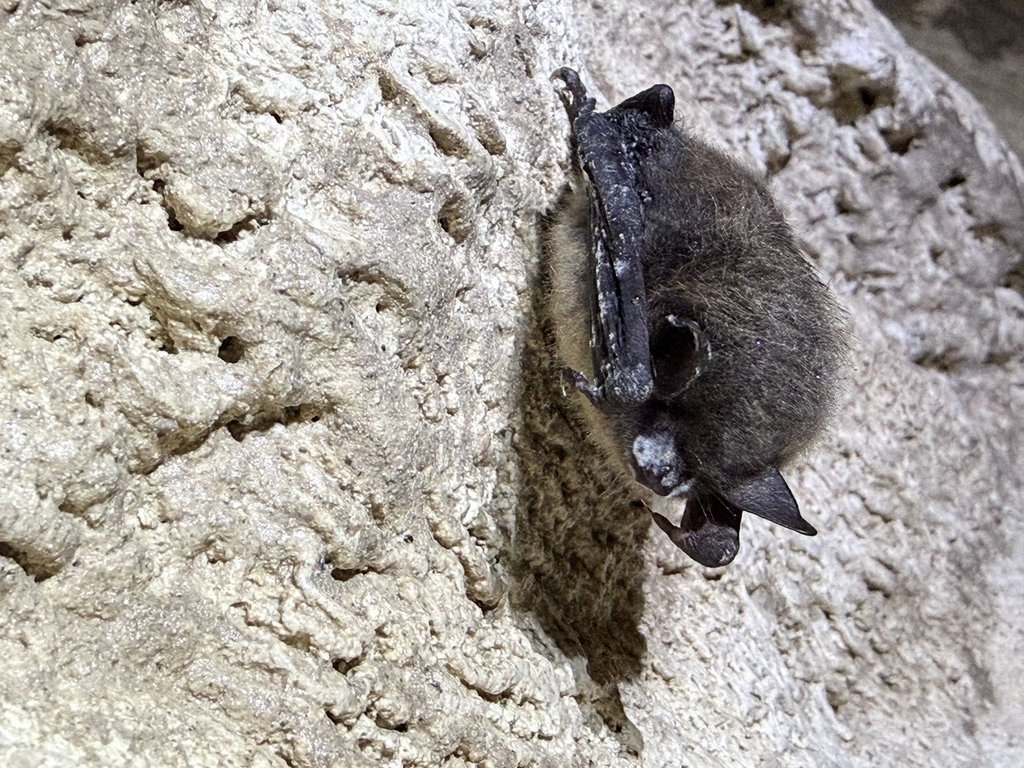
An invisible biological apocalypse has officially breached the gates of the Canadian Rockies, and the frontline defense relies on freeze-dried vials of bacteria sprayed into the dark. Parks Canada wildlife teams and provincial biologists are currently scrambling to halt white-nose syndrome, a catastrophic fungal disease that is tearing through Alberta bats after a relentless twenty-year march across the continent. The infection, which causes hibernating mammals to burn through their winter fat reserves and starve, was recently confirmed in Jasper National Park and the high-profile Cadomin Cave. This development puts the region's flying nocturnal mammals on the brink of localized extinction.
For years, wildlife managers held out hope that the vast distances and freezing, high-altitude geology of western Canada would act as a natural firewall. That firewall has collapsed. The arrival of the invasive fungus Pseudogymnoascus destructans in the mountain parks marks a turning point from passive monitoring to desperate, experimental triage.
While public announcements frame the deployment of bacterial probiotics as a proactive solution, a deeper investigation reveals a grim reality. Biologists are operating blind across vast swaths of the wilderness, fighting an apex environmental killer with a treatment that is not a cure, while facing systemic underfunding and an incomplete understanding of western bat ecology.
The Carnage at the Cave Mouth
In March, an ecological monitoring team hiked to the hidden mouth of a limestone cave in Jasper National Park. What they found shattered decades of bureaucratic optimism. Nearly a dozen dead little brown myotis bats lay frozen at the entrance. Weeks later, the body count climbed to sixty-nine. In the preceding two years, researchers had found an average of three dead bats at the same site.
The shift was sudden. It was brutal.
When wildlife biologists entered the cave to examine the survivors, they turned on ultraviolet lamps. Under the specialized light, the wings of the roosting bats glowed with an eerie, intense orange fluorescence. The color indicates deep tissue penetration by the fungus. The physical toll of white-nose syndrome is grotesque, manifesting as a fuzzy white growth on the muzzle, ears, and wing membranes.
The fungus thrives in cold, humid subterranean environments, precisely where bats enter torpor to survive the brutal Canadian winter. Torpor drops a bat's body temperature and metabolic rate to near freezing, conserving energy when there are no insects to eat. The fungus disrupts this delicate state. It irritates the skin, forcing the bats to awaken repeatedly during the dead of winter.
Each awakening drains precious energy. A single arousal can consume up to a month's worth of stored body fat in a matter of hours. Starving and dehydrated, the disoriented creatures fly out into the sub-zero winter air in a desperate, futile search for food. They freeze to death, or they drop from the limestone walls to the cave floor, too weak to move.
The Fall of the Rocky Mountain Firewall
The path to this crisis began in 2006, when the fungus was inadvertently introduced to a commercial cave in New York state, likely carried on the gear of an international caver arriving from Europe. In Europe, native bat species coexisted with the fungus for millennia and developed evolutionary defenses. North American bats had zero immunity.
The disease spread outward from New York like an oil slick, wiping out ninety to ninety-eight percent of affected colonies within a few seasons. Biologists watched the devastation move through Ontario, Quebec, and down into the American South.
By 2022, the fungus arrived in the badlands along Alberta’s Red Deer River, near Dinosaur Provincial Park. By 2024, the state of subclinical infection transitioned into full-blown clinical white-nose syndrome. In February, the provincial government confirmed the disease had invaded Cadomin Cave, one of the largest and historically most vital bat hibernation sites in western Canada.
The geographic jump into Jasper shows that the disease is moving faster through mountain corridors than models predicted. Human activity remains a primary suspect for these massive geographic leaps. Microscopic fungal spores cling to boots, ropes, and clothing. A caver entering an infected site in eastern Canada or the United States can easily transport the pathogen to an uninfected western cave if decontamination protocols are ignored.
The provincial government has implemented year-round closures for Cadomin and Wapiabi caves, alongside seasonal restrictions for other sites. Enforcement, however, is a different matter. The wilderness of the eastern slopes of the Rockies contains hundreds of unmapped fissures, sinkholes, and old mine shafts. It is impossible to police them all.
The Blind Spots of Western Bat Ecology
The strategies used to combat white-nose syndrome in eastern North America cannot simply be duplicated in the West. This represents a massive hurdle for wildlife agencies.
In the East, millions of bats overwinter in massive, easily accessible abandoned mines and sprawling cave systems. Counting them and monitoring their decline is relatively straightforward. In Alberta and British Columbia, the behavior of the animals is vastly different.
Western bats are highly dispersed. Outside of a few famous sites like Cadomin, scientists do not know where the vast majority of Alberta's bats hibernate. They use tiny rock crevices, deep cracks in mountain cliffs, root systems, and isolated scree slopes. They do not gather by the hundreds of thousands in single, centralized locations.
This behavior provides a small measure of natural social distancing, which may slow the transmission of the fungus from bat to bat. However, it also makes conservation efforts incredibly difficult. Biologists cannot treat or save a colony if they cannot find it.
The lack of basic baseline data means that when population crashes occur, they will happen silently. Whole sub-populations could vanish from mountain valleys before researchers even realize they are infected.
The Gamble on Experimental Probiotics
With no large-scale cure or vaccine in existence, Parks Canada and the Wildlife Conservation Society Canada are pinning their hopes on an experimental microbial cocktail. The treatment uses a freeze-dried blend of four naturally occurring bacterial strains. These bacteria produce compounds that actively inhibit the growth of the destructive fungus.
Teams mix the powder with water and use agricultural sprayers to coat the entrances of known maternity roosts, bat boxes, and building attics where bats congregate in the spring and summer. The goal is simple. As bats crawl through the treated areas, the beneficial bacteria transfer to their skin, wings, and faces, integrating into their natural wing microbiome. When winter arrives, this biological shield follows them into the hibernation caves, suppressing the fungus during the months when the animals are most vulnerable.
Early data from trials in British Columbia and southern Alberta indicate that treated bats successfully retain the probiotic and can even pass it to other individuals through social grooming. But nobody is calling this a silver bullet.
The probiotic is a mitigator, not an eradication tool. It reduces the severity of the infection, giving the bat a marginal, slightly higher chance of surviving until spring. If a bat survives hibernation with a low fungal load, its immune system fires back up once it emerges into the warm spring air. It can then heal its damaged wings.
Yet, spraying bat boxes and a handful of accessible caves is a drop in the bucket. The scale of the wilderness makes comprehensive application impossible. The labor-intensive nature of the work requires biologists to hike into remote backcountry sites with heavy gear, climbing into narrow spaces to spray roosts by hand. It is an expensive, localized defense against a systemic, provincial threat.
Economic and Ecological Fallout
The impending collapse of the Alberta bat population is not merely a tragedy for wildlife enthusiasts. It represents a severe economic threat to the province's agricultural sector.
Bats are the primary nocturnal predators of insects. A single little brown myotis can consume its own body weight in insects every single night. They eat moths, beetles, and mosquitoes, acting as a massive, free pest-control system for farmers growing canola, wheat, and barley along the eastern slopes and plains.
Data from the United States shows that the loss of bats leads to an immediate increase in crop damage and a sharp rise in the chemical pesticides used by industrial farmers. The financial impact can quickly scale into millions of dollars. The loss of these predators also impacts forest health, allowing defoliating insect populations to swell unchecked in the timberlands of the foothills.
Recovery from a white-nose syndrome crash is agonizingly slow. Unlike mice or insects, which reproduce rapidly, bats have an incredibly low reproductive rate. A female little brown myotis typically gives birth to just one single pup per year. Even if a small percentage of the population possesses a genetic resistance to the fungus, rebuilding a stable population from a ninety percent decline will take generations.
The Failure of Decontamination Protocols
Despite strict guidelines published by the Alberta Speleological Society and provincial authorities, compliance within the recreational caving community remains inconsistent. The fungus produces highly resilient spores that can survive for years in soil without a host.
Many hobbyists and outdoor enthusiasts use the same gear across provincial lines. While hardcore, organized cavers generally adhere to rigorous chemical washing protocols using specific disinfectants, casual explorers, geocachers, and hikers frequently enter open fissures without taking any precautions.
The problem is exacerbated by online forums and social media, where the locations of sensitive, unmanaged caves are shared publicly. This draws foot traffic to sites that should remain isolated. Once the fungus enters a cave system, it becomes a permanent resident of the underground ecosystem. It cannot be washed away or fumigated without destroying the delicate subterranean lifeforms that depend on that specific habitat.
The current strategy relies heavily on public education, a tool that has proven insufficient to stop the spread of invasive species worldwide. Without mandatory, enforced closures of high-risk zones and harsh penalties for trespassing in bat habitats, human vectors will continue to outpace conservation efforts.
What Happens Now
The fight to save Alberta's bats has reached its most critical phase. The transition of the disease into Jasper National Park and Cadomin Cave proves that the period of geographical isolation is officially over. The future of these species depends entirely on whether the experimental probiotic treatments can be scaled fast enough to preserve a resilient remnant population.
Government funding for wildlife disease monitoring remains tight, often lagging behind immediate economic priorities. If the public and provincial authorities treat this as an isolated biological curiosity rather than a major ecological emergency, the skies over the Alberta foothills will grow permanently quieter, and the true cost will be paid by the ecosystems and agricultural fields left undefended below.