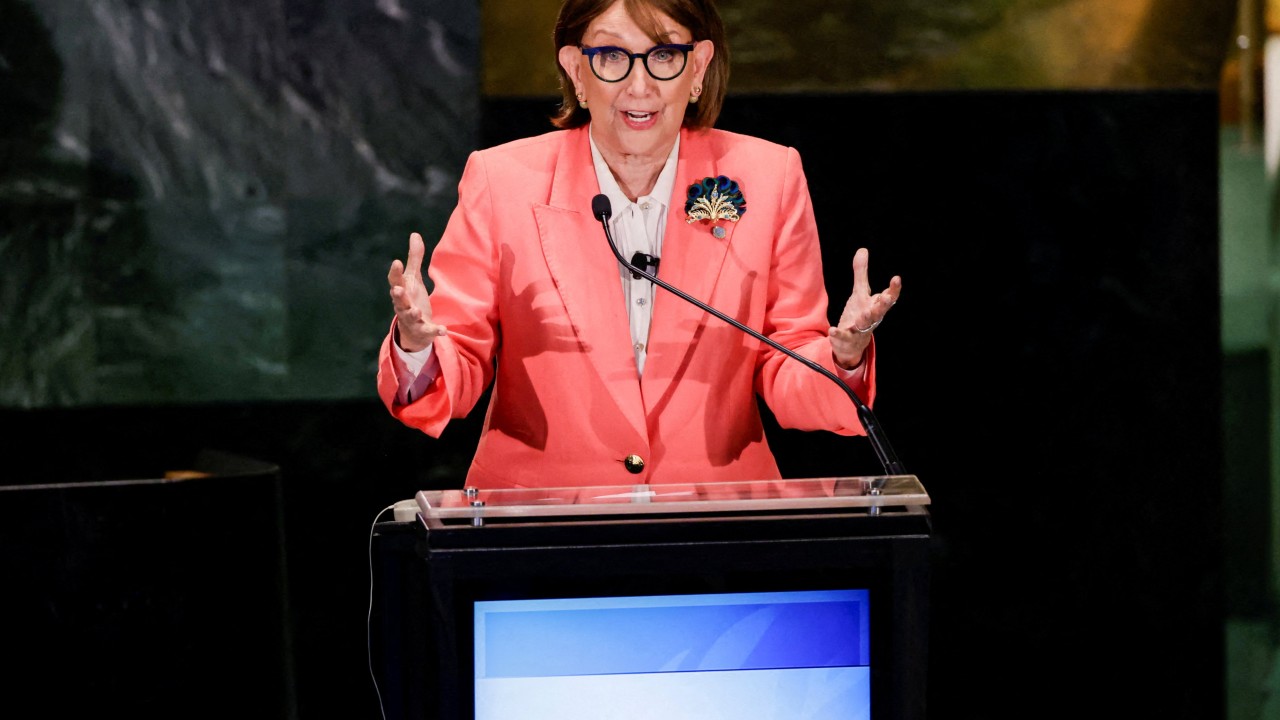
The grand marble hallways of Turtle Bay are humming with a familiar, high-stakes anxiety. António Guterres is stepping down at the end of December, leaving behind an office battered by geopolitical paralysis, institutional bloat, and escalating global fractures. Behind closed doors, the fifteen members of the United Nations Security Council have just cast their first informal straw ballots to find his successor.
Costa Rican diplomat Rebeca Grynspan has pulled ahead as the early frontrunner, securing ten "encourage" votes. Right behind her is Guyana's Ambassador Carolyn Rodrigues-Birkett with nine, while International Atomic Energy Agency chief Rafael Grossi holds a surprise third place with seven.
Yet straw poll math is notoriously deceptive. Beneath the initial tallies lies a complex diplomatic chess match where regional ambitions, historic glass ceilings, and the unyielding veto power of the P5 collide.
The Anatomy of a Straw Poll
To understand why Grynspan's early lead does not guarantee victory, one must look at how the Security Council conducts its initial evaluations. Members use a simple color-blind ballot system containing three options: encourage, discourage, or no opinion.
An encouraging vote simply means a state is willing to let the candidate stay in the running. It is a soft endorsement, entirely non-binding.
The real danger lurks in the discourage column. Grynspan picked up one discourage vote in this opening round, while Rodrigues-Birkett drew two. In these early rounds, the ballots do not reveal whether that opposition came from an elected member or one of the five permanent veto-wielding powers—China, France, Russia, the United Kingdom, and the United States.
A single red card from a permanent member will eventually kill any candidacy dead in its tracks. Until the Security Council shifts to colored ballots in later rounds, nobody knows who carries a silent veto in their pocket.
Breaking the Eight-Decade Mold
For eighty years, the top administrative post of the United Nations has been held exclusively by men. Pressure has intensified to shatter that precedent. A General Assembly resolution passed late last year formally urged member states to nominate female candidates, framing representation not as an ideological preference, but as an institutional necessity.
Both Washington and Beijing have publicly voiced support for selecting a woman to helm the organization this time around. That convergence of superpower interest explains why female candidates like Grynspan and Rodrigues-Birkett are outperforming seasoned heavyweights early on.
Grynspan brings significant administrative pedigree. As the current head of the United Nations Conference on Trade and Development (UNCTAD) and a former Vice President of Costa Rica, she operates comfortably within the multilateral machinery. Her background also carries profound historical weight; if successful, she would become the first woman and the first person of Jewish descent to lead the global body.
Yet Rodrigues-Birkett's strong second-place finish signals that the Caribbean and Latin American blocs are far from unified, and developing nations are demanding serious consideration for leadership roles that traditionally default to European or Western-aligned insiders.
The Counter-Weight of Institutional Fatigue
Beyond identity politics and regional rotation, the next Secretary-General inherits an administrative behemoth facing a crisis of relevance. Critics point to overlapping mandates, bloated bureaucracies, and sluggish field responses as structural failures that weaken the organization's mandate.
During recent closed-door dialogues and public town halls, member states repeatedly pressed candidates on operational austerity. The demand is clear. The next chief must prune administrative bloat at headquarters in New York and redirect funds toward frontline humanitarian and peacekeeping missions.
Rafael Grossi's third-place standing highlights this appetite for hard-nosed operational management. As head of the nuclear watchdog IAEA, Grossi has navigated hyper-sensitive geopolitical flashpoints with visible public assertion. For capitals exhausted by quiet backroom diplomacy, an assertive executive holds distinct appeal.
However, Grossi faces headwinds from regional dynamics and the reality that nuclear oversight is a specialized portfolio distinct from the sprawling, generalized crisis management required of the Secretary-General.
What Lies Ahead in the Selection Timeline
The race is only entering its first quarter. Additional straw polls will roll out through the late summer under shifting Security Council presidencies, gradually introducing color-coded ballots that expose where permanent member vetoes lie.
Candidates like former Chilean President Michelle Bachelet and former Senegalese President Macky Sall are still in the mix, waiting for shifting alliances to open up pathways or force compromises.
The Security Council must eventually agree on a single nominee and pass that recommendation to the 193-member General Assembly. Until then, the quiet lobbying in diplomatic lounges will dictate whether Grynspan's early momentum solidifies into a historic appointment or dissolves under the weight of a hidden veto.

/GettyImages-157526585-93425538070d4422ad42d22af28c0758.jpg)