When crowds wearing crisp university blazers appeared outside police headquarters in Jakarta to praise law enforcement and condemn anti-government demonstrators, observers immediately spotted the telltale signs of a staged counter-rally. The jackets did not match actual campus insignia, participants stumbled when asked basic questions about their supposed faculties, and the banners looked freshly printed from a single commercial shop. This phenomenon, known locally as massa bayaran or paid crowds, represents a deliberate, well-funded strategy to manufacture public consensus, neutralize organic student dissent, and muddy the informational waters during moments of political friction in Indonesia.
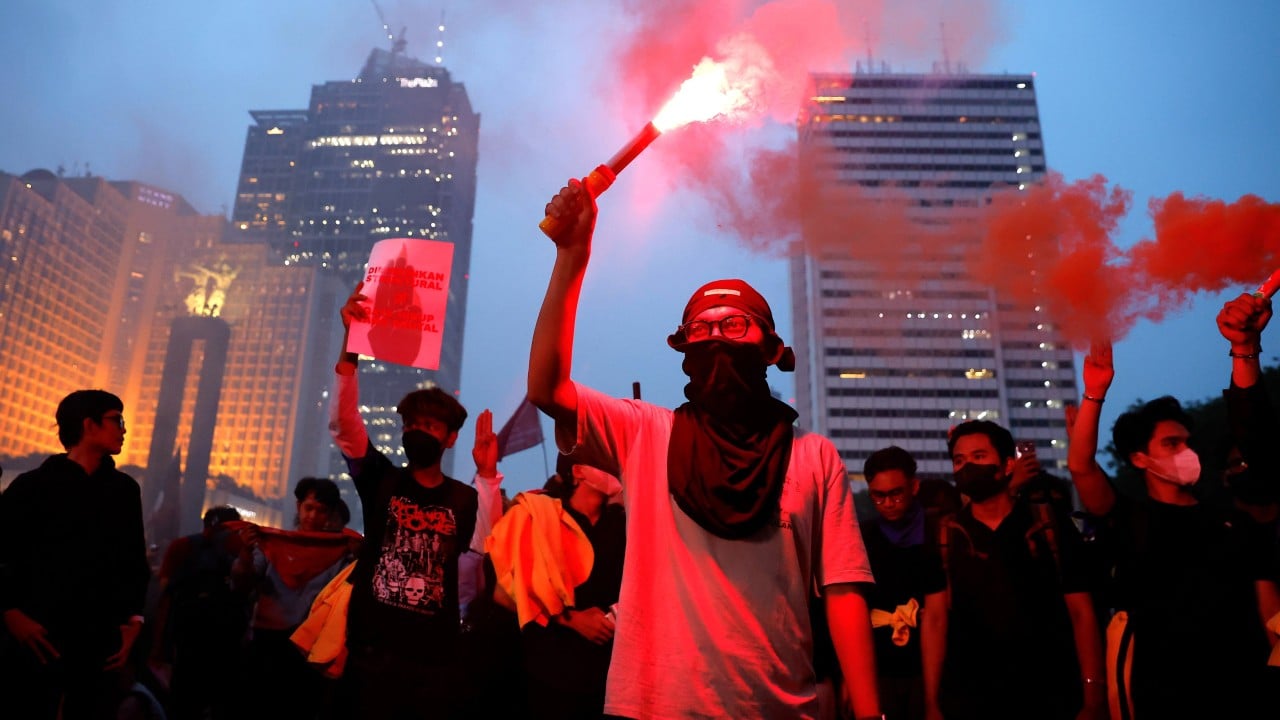
Street protests carry immense symbolic weight in Southeast Asia's largest democracy. In 1998, genuine student mobilization brought down the three-decade authoritarian rule of Suharto. That historical memory gives university students a unique moral authority in Indonesian public life. When students take to the streets today—whether over controversial revisions to the Criminal Code, labor laws, or electoral rules—their presence signals a crisis of legitimacy for those in power.
To counter that moral authority, political operators and state-aligned actors do not always rely on water cannons or tear gas. Brute force creates martyrs and generates bad press. Instead, they deploy a softer, more insidious tactic: astroturfing on the pavement. By putting fake students in front of television cameras to cheer for the police or denounce opposition groups, organizers create the illusion of a divided youth movement.
The Anatomy of a Staged Rally
Organizing a fake student demonstration requires logistical precision rather than ideological conviction. Veteran political fixers in Jakarta operate through informal networks of labor brokers, local youth organizations, and neighborhood strongmen. When a client needs a crowd—whether to support a embattled police chief, back a controversial infrastructure project, or counter an organic protest—the recruitment machine kicks into gear within hours.
The recruits rarely come from elite universities. Instead, brokers tap into pools of unemployed young men, informal sector workers, and members of mass organizations known as ormas.
Consider a hypothetical example of how a typical mobilization unfolds. A coordinator receives a lump sum to deliver two hundred bodies to a specific intersection by ten in the morning. The coordinator subcontracts four field leaders, each tasked with bringing fifty people. Each participant is promised a modest daily stipend—often equivalent to ten or fifteen US dollars—along with a boxed lunch, bottled water, and transportation via rented minibuses.
To sell the illusion to broadcast news cameras, props are essential. Almamater jackets, the colored blazers that identify students from specific Indonesian universities, are rented or purchased in bulk from garment markets. Because genuine university coats feature intricate embroidered crests that are expensive to replicate quickly, staged groups often wear generic solid-colored blazers—bright yellow, deep blue, or maroon—that mimic the visual language of campus activism from a distance.
On the ground, the choreography is predictable. Participants hold professionally printed vinyl banners featuring identical typography and state-friendly slogans. A designated speaker, usually a seasoned orator rather than an actual undergraduate, reads a prepared statement through a megaphone while cameramen capture tight shots of the crowd. Within forty-five minutes, the speech ends, the banners are rolled up, the cash is distributed behind a nearby alleyway, and the protesters disperse before investigative reporters can conduct extended interviews.
Why Counter-Rallies Target Student Legitimacy
The primary objective of deploying fake students at a police rally is not to persuade the opposing demonstrators. It is to confuse the broader public watching on evening news broadcasts and scrolling through social media feeds.
In modern information warfare, volume and ambiguity matter more than coherent arguments. When genuine student alliances—such as the All-Indonesia Students' Executive Board—organize against perceived democratic backsliding or police heavy-handedness, their message is clear and unified. A counter-rally muddies that clarity.
Manufacturing Moral Equivalence
By placing two groups wearing university-style jackets on opposite sides of a police barricade, organizers construct a false narrative of internal student conflict. Television news segments, constrained by time and journalistic norms of showing both sides, often air ten seconds of anti-government protesters followed by ten seconds of pro-police demonstrators. To a casual viewer in another province, the takeaway is simple: the students cannot even agree among themselves.
Validating State Narratives
Police and government officials frequently frame organic protests as disruptive, chaotic, or hijacked by external provocateurs. A staged pro-police rally provides immediate visual validation for that framing. When fake students hand roses to riot police or hold signs thanking officers for maintaining public order, those images dominate state-aligned media outlets and pro-government social media accounts. The narrative shifts from state repression to civic gratitude.
The Economics of Street Mobilization
Understanding this phenomenon requires looking at Indonesia's informal political economy. Street mobilization is not an anomaly in Indonesian democracy; it is an established service industry that spikes during election cycles, legislative battles, and high-profile corruption scandals.
For political entrepreneurs, maintaining access to rapid-response crowds is a valuable asset. It demonstrates influence to wealthy patrons and senior officials. The money flowing into these operations rarely leaves an official paper trail. Payments are made in physical cash, routed through intermediaries who take a cut at every tier of the recruitment pyramid.
| Role in Mobilization | Primary Responsibility | Typical Compensation Structure |
|---|---|---|
| Political Patron / Client | Defines the message and provides the overall budget | Lump-sum cash transfer to lead broker |
| Lead Coordinator | Prints banners, rents sound systems, sources jackets | Retains administrative margin from total budget |
| Field Brokers | Recruits warm bodies and arranges minibus transport | Per-head commission for delivered participants |
| Paid Participants | Wears provided attire, holds signs, stands for cameras | Flat daily cash stipend plus meal and transport |
This transactional ecosystem thrives on economic precarity. In major urban centers where underemployment remains high among young adults, spending two hours standing in the sun wearing a borrowed blazer is simply gig work. Most participants hold no malice toward genuine student activists, nor do they harbor deep ideological loyalty to the police. They are fulfilling a temporary labor contract.
Digital Amplification and the Buzzer Ecosystem
A physical counter-rally of a few hundred people has limited reach on its own. Its true power emerges when it merges with Indonesia's industrial-scale social media manipulation networks, commonly referred to as buzzers.
Before the protesters even board their minibuses to leave the venue, photographers embedded within the staged rally upload high-resolution images and short video clips to coordinated WhatsApp groups. Within minutes, hundreds of semi-automated accounts and paid social media influencers push those visuals onto X, TikTok, and Instagram using synchronized hashtags.
The digital campaign serves two functions:
- Search Engine Poisoning: When citizens search for news about a police protest, the top visual results become flooded with images of smiling, supportive crowds rather than confrontations or grievances.
- Algorithmic Suppression: Coordinated reporting and counter-hashtags drown out organic student livestreams, preventing critical coverage from trending nationally.
This hybrid model—combining low-cost physical theater with high-velocity digital amplification—makes it extraordinarily difficult for ordinary citizens to distinguish grassroots sentiment from top-down astroturfing.
The Blowback When the Illusion Breaks
Despite its frequency, the fake student tactic carries significant reputational risks when executed poorly. Indonesian netizens and independent journalists have grown remarkably adept at forensic crowd analysis.
When footage of a suspect rally goes viral, online investigators immediately zoom in on the details. They cross-reference the blazer colors against official university registries. They check the stitching on the logos. They track down the printing shops stamped on the corners of the vinyl banners. And most effectively, they amplify awkward on-camera interviews where supposed university students fail to name their own campus rectors or stumble over the meaning of the slogans written on their own signs.
When these exposures gain traction, the tactic backfires spectacularly. Instead of softening criticism of the police or government, the revelation of a staged rally confirms the public's worst suspicions about institutional dishonesty. It shifts the news cycle from the original policy dispute to a scandal over state-sponsored deception.
Yet the practice persists because the short-term tactical benefits often outweigh the medium-term reputational costs. In the fast-moving churn of Indonesian news cycles, dominating the first twenty-four hours of visual coverage can successfully blunt the momentum of an emerging protest movement. By the time fact-checkers dismantle the illusion three days later, the legislative vote has passed or the public's attention has moved elsewhere.
Genuine Student Movements Adapt
Faced with continuous efforts to dilute their brand, authentic student organizations have had to change how they organize and verify their presence on the streets.
Student executive boards from major institutions—such as the University of Indonesia, Gadjah Mada University, and the Bandung Institute of Technology—now routinely issue formal public disclaimers whenever suspicious rallies use their colors or implied endorsement. They publish official statements clarifying that their members were not on the streets on a given date, effectively stripping the counter-rallies of their borrowed prestige.
Organizers of genuine demonstrations also enforce stricter internal verification during marches. Marshals check student identification cards at assembly points to prevent infiltrators from joining their ranks, either to spark violence that justifies a police crackdown or to stage embarrassing media moments from within the crowd.
The Deeper Cost to Democratic Trust
The proliferation of fake students and paid counter-protesters exacts a quiet, corrosive toll on Indonesian civic life. When every public gathering is suspected of being a paid performance, genuine grievances become easier to dismiss.
Cynicism becomes the default posture of the electorate. Citizens begin to view street politics not as a vital mechanism for democratic accountability, but as a shadow play orchestrated by rival elites fighting over budgets and power. That cynicism ultimately benefits entrenched institutions, because an apathetic public rarely mobilizes to demand systemic reform.
As long as political fixers can rent a crowd for the price of a boxed lunch and a borrowed blazer, the theater of manufactured dissent will remain a permanent fixture outside Indonesia's halls of power.