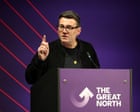
The Green Party is locked in a fierce internal struggle over whether to aggressively challenge Greater Manchester Mayor Andy Burnham in the upcoming Makerfield by-election on June 18. This conflict is not merely about a local seat; it represents a fundamental disagreement on strategy that could reshape the British left.
While some national figures urge caution to prevent a Reform UK victory, local activists are eager to exploit Labour's plummeting poll ratings following disastrous local election results. This deep divide highlights the tension between pragmatism and ideological purity within the Green movement.
The Illusion of Unity
On the surface, the Green Party presents a front of democratic procedure. The official line states that local members are running the selection process, drawing confidence from their recent breakthrough in the Gorton and Denton by-election. Beneath this rhetoric lies a deep disagreement over how to deploy national resources.
Former leader Caroline Lucas has publicly urged the party to de-escalate. Her argument relies on tactical cooperation. She believes Burnham's support for proportional representation makes him a valuable ally for long-term electoral reform. For Lucas and the pragmatists, the primary threat is Nigel Farage’s Reform UK, which dominated the recent Wigan council elections across the Makerfield boundaries.
Makerfield Council Election Aggregate (May 2026)
┌──────────────────────────────────────────┐
│ Reform UK: 50%                           │
├───────────────────┬──────────────────────┤
│ Labour: 27%       │ Others/Greens: 23%   │
└───────────────────┴──────────────────────┘
A new wave of left-wing activists rejects this approach. They argue that stepping aside for a prominent Labour figure yields nothing but self-marginalization. These members point to the local election data as proof that Labour’s traditional "Red Wall" support has collapsed, meaning the Greens must offer a genuine alternative rather than acting as a safety net for the establishment.
The Shadow of Gorton and Denton
The debate is driven by the party's historic victory in Gorton and Denton just months ago. In that contest, the Greens overturned a massive 13,000-vote Labour majority by flooding the constituency with thousands of national volunteers and a highly organized leafleting operation.
Activists want to repeat that success. They see Makerfield not as a defensive battleground to protect Burnham, but as an opportunity to cement their status as a major political force in the North West.
National leaders, including party head Zack Polanski, face a difficult calculation. Makerfield is demographically distinct from Gorton and Denton. It is a predominantly working-class, high-homeownership area south of Wigan that voted 65% to leave the European Union in 2016. The Greens finished a distant fifth here in the 2024 general election.
Survation’s initial pre-poll modeling shows that with Burnham as the candidate, Labour holds a narrow lead over Reform UK, 45% to 42%. The Green vote share is projected at a modest 4%.
Survation Pre-Poll Projection (Burnham as Candidate)
┌──────────────────────────────────────────┐
│ Labour (Burnham): 45%                    │
├──────────────────────────────────────────┤
│ Reform UK: 42%                           │
├───────────────┬──────────────────────────┤
│ Greens: 4%    │ Others: 9%               │
└───────────────┴──────────────────────────┘
A full-scale national Green campaign targeting left-leaning voters could inadvertently hand the seat to Reform UK.
The Radical Wing Rejects Compromise
The internal division exposes a growing rift between the party’s traditional leadership and its younger, more radical base. To these new members, Burnham remains part of a compromised political class. They argue that his recent shifts on fiscal policy prove he cannot be trusted to deliver real change.
"There is a world of difference between turning up to the hustings with a bit of leafleting and what we saw in Gorton and Denton," notes a senior Green source. "Throwing everything at it is a choice."
Local party members feel entitled to make that choice independently. The highly decentralized structure of the Green Party means the national executive cannot easily block a local campaign. If the local branch chooses to run a high-energy candidate, the national leadership will have to decide whether to support them with funds or withhold resources to protect Burnham's chances.
The National Implications
The stakes extend far beyond the borders of Makerfield. This by-election was triggered by the sudden resignation of Josh Simons, explicitly intended to clear a path for Burnham to return to Westminster and mount a leadership challenge against Keir Starmer.
If the Greens run a aggressive campaign that splits the progressive vote, they risk electing a Reform UK MP in a seat held by Labour since 1983. This outcome would end Burnham’s national ambitions and deal a devastating blow to the broader center-left. Conversely, if the Greens hold back, they risk alienating their own members and missing a chance to build momentum.
The Green Party must decide whether its primary goal is to act as a tactical pressure group influencing the Labour Party, or to replace it entirely in post-industrial Britain. A candidate announcement is expected soon, and the scale of the campaign that follows will reveal which faction has won control of the party's future strategy.