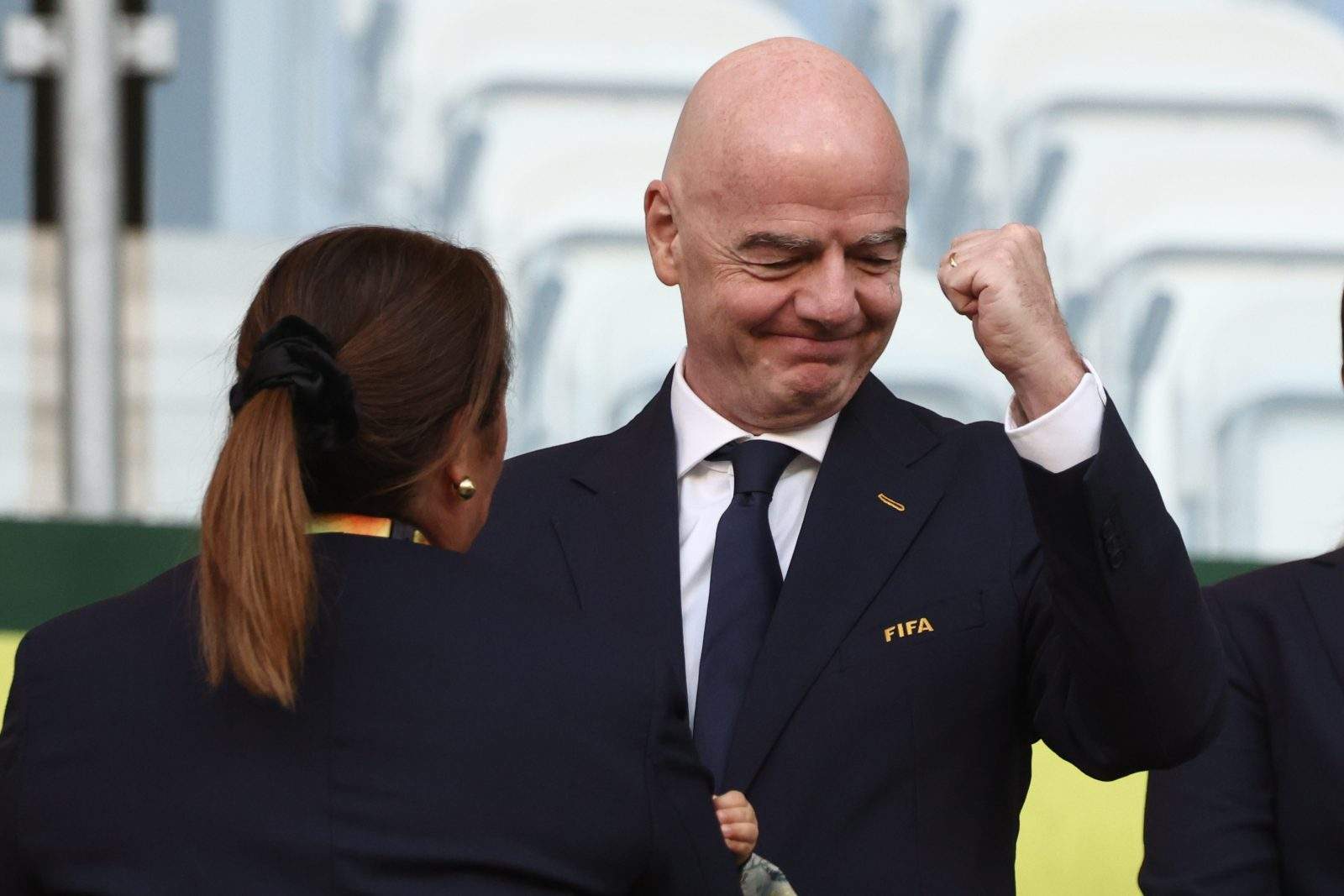
Gianni Infantino is not wrong when he claims the "vast, vast majority" of global soccer backs him ahead of FIFA’s presidential election. He is simply leaving out how that consensus was engineered. In Zurich, unanimous support is rarely an organic groundswell of ideological passion. It is the predictable output of a voting architecture where tiny island nations carry the exact same ballot weight as five-time World Cup champions, and where billions of dollars in development grants flow directly from the president's office to the local federations casting those votes.
If you have covered international sports governance long enough, you learn to ignore the podium speeches and follow the ledger. The headline quote about overwhelming support comes from an incumbent who already ran unopposed in 2019 and 2023, and who has spent a decade perfecting the art of turning FIFA’s massive World Cup broadcast revenues into unassailable political capital. Understanding why almost nobody dares run against Infantino requires looking past the trophy presentations and examining the cold mechanics of one-nation, one-vote politics.
The Arithmetic of Global Consensus
To understand FIFA elections, you have to discard every assumption you hold about how influence works on the pitch. Brazil, Germany, Argentina, and France generate the lion's share of global soccer’s commercial value, television ratings, and sporting prestige. Inside the FIFA Congress, however, their combined voting power is effortlessly neutralized by four micro-states with a collective population smaller than a mid-sized European suburb.
Every one of FIFA’s 211 member associations holds a single, equal vote. That rule is the bedrock of modern sports diplomacy, originally designed to prevent wealthy colonial powers from dictating the sport's rules to the rest of the world. In practice, it creates a marketplace where the cheapest and most reliable votes belong to associations that depend entirely on Zurich to keep their lights on.
Consider a hypothetical example of how this math plays out in an election cycle. Suppose a candidate wants to secure a simple majority of 106 votes. They could spend years negotiating complex regulatory concessions with the heavyweight federations of UEFA and CONMEBOL, risking public backlash from fans and sponsors at every turn. Or, they could quietly guarantee increased annual operational funding to 110 smaller federations across Africa, Asia, Oceania, and the Caribbean—associations whose domestic leagues generate negligible commercial revenue and whose survival hinges on FIFA’s central treasury.
Infantino did not invent this dynamic. His predecessor, Sepp Blatter, mastered it over seventeen years before the 2015 corruption scandals brought his era to a crashing halt. What Infantino did was formalize, expand, and supercharge the system while stripping away the rogue intermediaries who used to skim off the top.
How FIFA Forward Locked Down the Ballot Box
When Infantino took office in February 2016, FIFA was radioactive. Sponsors were fleeing, the U.S. Department of Justice was indicting executive committee members, and the organization's reserves were bleeding legal fees. Infantino’s solution was as simple as it was effective: open the vault and distribute the cash directly to the voters.
Under the FIFA Forward development program, launched shortly after his arrival and expanded twice since, direct funding to member associations exploded. During the Blatter era, federations received roughly $250,000 a year in baseline financial assistance. Under Infantino, that figure climbed steadily into the millions per four-year cycle. By the 2023–2026 cycle, FIFA committed over $2.25 billion to the program—nearly seven times what was distributed before 2016.
The money comes with stricter auditing requirements than in the old days, which allows Zurich to boast about transparency and good governance. Yet the political effect remains identical. For a federation president in a developing nation, losing favor with Zurich does not mean losing a polite debate over formatting rules. It means risking the funding that pays for youth national team travel, artificial turf installations, and administrative salaries.
When an incumbent controls a multi-billion-dollar disbursement pipeline, challenging him is an act of financial self-harm for any regional confederation. That is why public endorsements roll in months before a single ballot is printed. Confederation presidents in CONCACAF, CAF, AFC, and OFC routinely pledge block support early in the cycle, signaling to any potential rival that the math is already dead on arrival.
The 48-Team World Cup as a Political Dividend
Money is only half the equation. The other half is access to the sport’s crown jewel.
Expanding the men’s World Cup from 32 to 48 teams—a signature campaign promise Infantino pushed through almost immediately after taking office—was widely criticized by European clubs and player unions worried about fixture congestion and diluted quality. From a political standpoint, however, it was a masterstroke.
Adding 16 slots meant handing out permanent, life-changing lottery tickets to regional confederations that had spent decades begging for crumbs:
- Africa (CAF) jumped from five guaranteed spots to nine, plus an intercontinental playoff berth.
- Asia (AFC) moved from four-and-a-half spots to eight, with a ninth possible via playoffs.
- North and Central America (CONCACAF) expanded to six automatic berths, even outside of cycles when it hosts the tournament.
- Oceania (OFC) finally received a guaranteed direct spot rather than being forced into sudden-death intercontinental qualifiers.
For dozens of national federation presidents, a single World Cup qualification transforms their domestic standing overnight. It unlocks government subsidies, local corporate sponsorships, and an immediate $9 million to $10.5 million participation payout from FIFA alone. By widening the door to the tournament, Infantino gave roughly half the planet’s football executives a realistic path to career-defining glory. You do not vote out the man who just doubled your odds of reaching the World Cup.
The Club World Cup Expansion Play
The same logic drives FIFA’s aggressive push to establish an expanded, 32-team Club World Cup. Historically, European powerhouse clubs held leverage over FIFA because they employed the players who made the national-team World Cup profitable. By creating a lucrative new club competition with massive prize pools—and spreading participation slots across South America, Africa, Asia, and North America—Infantino is building a direct financial relationship with club owners worldwide. It weakens the collective bargaining monopoly of European soccer while giving non-European clubs a payday they could never earn in their domestic markets.
Why European Dissent Never Becomes an Actual Threat
Every election cycle brings predictable rumblings of discontent from Northern and Western Europe. Federations in England, Germany, Norway, Denmark, and the Netherlands frequently voice concern over human rights due diligence, tournament hosting bids, governance standards, or the sheer speed of calendar expansion. During the 2022 World Cup in Qatar, several European associations openly clashed with Zurich over armband bans and migrant worker compensation funds.
Yet when the nomination deadline arrives, Europe almost never produces a candidate. Why?
First, UEFA itself is deeply fractured. The 55 member associations of European soccer do not vote as a monolith. While Scandinavian and Western European nations lean toward strict regulatory oversight, dozens of smaller Eastern and Central European federations rely heavily on FIFA Forward grants and share much closer ideological alignment with Zurich’s developmental priorities.
Second, European leaders understand the arithmetic. UEFA holds 55 votes out of 211—roughly 26 percent of the Congress. Even if every single European nation united behind a reformist challenger, that candidate would still need to peel away more than 50 votes from Africa, Asia, or the Americas against an incumbent holding all the institutional levers. Running a guaranteed losing campaign only alienates the winner, risking unfavorable committee assignments and reduced influence over future World Cup hosting decisions.
The Structural Flaw of Unopposed Elections
Infantino’s boast about having the "vast, vast majority" behind him highlights a troubling reality in global sports governance. Uncontested elections are a symptom of institutional capture, not healthy democracy.
Under FIFA’s own statutes, a candidate needs the written backing of at least five member associations to get on the ballot. On paper, that is a remarkably low bar. In practice, getting five federations to put their names on a challenger's nomination form requires them to publicly break ranks with their regional confederations and risk years of bureaucratic freeze-out from Zurich.
When nobody runs, nobody has to debate. There is no opposition platform forcing the incumbent to defend controversial decisions—such as the fast-tracked awarding of the 2030 and 2034 World Cups through a bundled, single-slate approval process that effectively eliminated competitive bidding. There is no formal scrutiny of FIFA’s skyrocketing operating expenses, the expansion of executive compensation, or the long-term sustainability of cramming even more matches onto an already saturated international calendar.
Instead, the FIFA Congress turns into a ceremonial coronation. Delegates fly into a luxury host city, listen to upbeat financial presentations projecting record revenues—FIFA crossed $7.5 billion in the 2019–2022 cycle and projected over $11 billion for 2023–2026—and applaud unanimously.
What Happens When the Bill Comes Due
The system works smoothly as long as the revenue curve points relentlessly upward. Right now, broadcast rights, commercial partnerships, and hospitality packages for expanded tournaments keep the treasury overflowing. Every constituency gets a slice of the pie, and silence is bought at market rate.
The vulnerability in this model sits entirely on the backs of the athletes and the domestic leagues that employ them. Players' unions, led by FIFPRO, alongside major European leagues, have already initiated legal challenges against FIFA over the unilateral imposition of international match calendars. They argue that adding expanded tournaments without genuine collective bargaining violates labor protections and threatens the physical limits of elite players.
If injuries spike among marquee stars, or if broadcast fatigue sets in as tournaments stretch across more weeks and more teams, the commercial value of the product could plateau. A plateau in revenue would immediately test the loyalty of those 211 member associations. When the checks stop growing, the unanimity in the room tends to evaporate just as quickly as it was assembled.
Until that financial ceiling arrives, however, Infantino’s assessment of his support remains entirely accurate. He does not need to campaign on vision or reform because he owns the distribution network, and in Zurich, the man who signs the checks never loses the room.