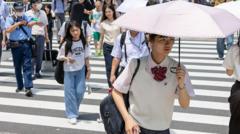
Japan has crossed a dangerous meteorological threshold. Temperatures surpassing 40 degrees Celsius—a phenomenon meteorological authorities now classify under the dire designation of "cruelly hot days"—are no longer freak statistical anomalies. They are becoming an annual reality. In cities like Sano, Kumagaya, and across greater Tokyo, mercury spikes above 40°C have transformed routine summer heat warnings into acute public health emergencies. Hospital emergency rooms are overflowing with heatstroke victims, while state regulators scramble to keep a fragile national power grid from collapsing under record-breaking cooling demands.
This surge in extreme heat exposes deep structural vulnerabilities across Japan’s energy infrastructure, urban planning, and demographic reality. It is a compounding crisis where climate pressure meets an aging society and a precarious energy policy.
The Physical Toll of Extreme Heat
Human physiology has hard limits. When ambient temperatures breach 40°C alongside high relative humidity, the body loses its primary mechanism for self-cooling: the evaporation of sweat.
Medical facilities across Kanto and Kansai face severe operational strain each time temperatures top this mark. The vast majority of emergency hospital admissions for severe heat-induced illness involve adults over the age of 65. In a country where nearly 30 percent of the population fits into this age demographic, extreme heat becomes a major mortality driver rather than a temporary discomfort.
Many elderly residents live in older, non-insulated wood-frame houses built for passive ventilation rather than modern air retention. Compounding the physical danger is a widespread cultural reluctance among older generations to run air conditioning units continuously, often driven by worries over soaring utility bills or a deeply ingrained preference for natural breeze.
When indoor temperatures climb quietly past 35°C overnight, heat exhaustion transitions rapidly into fatal heatstroke.
An Energy Grid Pushed to the Edge
The most urgent systemic threat sits on the supply side of the electrical grid. Air conditioning units across Tokyo, Osaka, and Nagoya consume immense volumes of electricity simultaneously during peak afternoon heat.
Japan’s energy infrastructure operates under tight safety margins. Following the post-2011 shutdown and slow recertification of the national nuclear fleet, the country relies heavily on imported liquefied natural gas and coal to handle baseline and peak loads. Thermal power plants running at maximum capacity during prolonged heatwaves face thermal stress themselves, leading to sudden, unplanned outages.
The Peak Demand Dilemma
Power transmission companies monitor reserve capacity margins with extreme caution. A healthy grid requires a reserve margin of at least 3 percent to handle unexpected surges or generator failures. During recent 40°C spikes, Tokyo’s regional reserve margin dropped dangerously close to 1 percent.
Government officials routinely issue urgent energy conservation requests, asking citizens to turn off unnecessary lights and moderate power consumption while keeping air conditioners running to preserve health. This paradox illustrates the narrow ledge energy managers walk. Turning off air conditioning saves the grid but fills the wards. Running every unit flat out threatens rolling blackouts, which would kill power to cooling centers and medical equipment alike.
The Financial Strain on Households
Energy prices in Japan have risen sharply due to volatile global fuel markets and a weakened yen. The financial burden of keeping a home cooled to safe levels is becoming prohibitive for fixed-income retirees.
- Baseline Electricity Tariffs: Up significantly over recent years due to fuel adjustment surcharges.
- Peak Usage Multipliers: High summer usage pushes households into top-tier utility brackets.
- Subsidies: While the central government periodically reintroduces temporary utility subsidies to cushion the blow, these measures operate as short-term Band-Aids rather than permanent structural relief.
Urban Architecture and Thermal Retention
Japan’s massive metropolitan centers act as massive heat sponges. High-density urban architecture, vast stretches of asphalt, and a lack of sufficient green space create intense urban heat islands.
During the day, concrete and pavement absorb intense solar radiation. At night, instead of cooling down, these surfaces radiate trapped thermal energy back into the surrounding air, keeping night temperatures above 25°C—a phenomenon known as "tropical nights."
Daytime Solar Absorption -> Deep Thermal Storage in Concrete -> Nighttime Radiation -> Sustained High Ambient Heat
This cycle deprives the human body of nighttime thermal relief, worsening heat stress over several consecutive days.
Standard urban redesign approaches move too slowly to counteract rapid temperature escalation. Installing cool roofs, expanding urban tree canopies, and utilizing permeable pavement require decades of sustained capital investment. Tokyo and Osaka are attempting targeted interventions, such as applying heat-shielding pavements on major marathon routes and pedestrian pathways, but these localized efforts cover only a tiny fraction of the total urban footprint.
Structural Bottlenecks in the Public Health Response
Local government responses rely heavily on issuing Heat Illness Risk Alerts through public broadcasts, smartphone apps, and street displays. While warning systems are technically efficient, their practical impact is limited.
Information alone does not cool a room.
Many municipalities have designated public buildings, such as libraries and community centers, as official cooling shelters. Yet, mobility limitations often prevent the most vulnerable citizens from reaching these facilities during peak daylight hours. Walking even 500 meters in 40°C heat to reach a cooling center presents a severe health risk for an frail senior citizen.
Furthermore, emergency transport services face compounding delays. As ambulance dispatch volumes soar during extreme thermal events, response times lengthen significantly. Hospitals frequently reach capacity for heat-related admissions, forcing emergency crews to contact multiple facilities to secure a bed for patients in critical condition.
The Policy Deadlock Over Long-Term Adaptation
Fixing Japan's summer heat crisis requires reconciling conflicting national priorities: decarbonization targets, energy security, and social welfare protection.
Restarting idle nuclear reactors offers a low-carbon, stable baseload power supply capable of meeting massive summer cooling spikes without driving up greenhouse gas emissions. However, political resistance, strict post-Fukushima safety regulations, and legal challenges continue to slow the pace of reactor recommissioning.
Solar energy generates high output during clear, sweltering days, helping offset peak daytime demand. Yet solar production drops off sharply in the late afternoon, precisely when residential air conditioning usage peaks as people return home from work while outdoor temperatures remain extremely high. Without large-scale utility battery storage—which remains expensive and technically challenging to deploy at national scale—renewable power alone cannot eliminate the risk of grid failure.
The country stands at a crossroads. Patchwork measures like temporary energy subsidies and public awareness campaigns are insufficient against sustained, record-breaking temperatures. Upgrading building codes to mandate high-efficiency insulation, overhauling grid infrastructure, and establishing neighborhood-level care networks for isolated seniors require immediate funding and political courage.
When temperatures break 40°C, the margin for administrative error vanishes.


