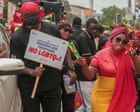
The Ghanaian parliament just passed one of the most draconian pieces of anti-LGBTQ+ legislation in modern African history, triggering panic across Accra and deep anxiety in international financial markets. Officially titled the Human Sexual Rights and Family Values Bill, the legislation criminalizes not just same-sex acts, but the very act of identifying as lesbian, gay, bisexual, transgender, or queer. It goes much further than mere social policy. By imposing prison sentences of up to three years for identity and up to ten years for advocacy, funding, or allyship, the bill threatens to dismantle domestic civil society, derail billions of dollars in foreign aid, and fundamentally alter the geopolitical alignment of one of West Africa's most stable democracies.
While superficial commentary focuses solely on the immediate fear within the local queer community, the structural reality of this crisis cuts far deeper. The legislation represents a deliberate, calculated political maneuver that has been years in the making. It bridges the gap between populist domestic politics and an increasingly organized pan-African conservative movement.
The Mechanical Trap of the New Legislation
To understand the panic on the streets of Accra, one must look at the specific mechanics of the text approved by lawmakers. Ghana already had a colonial-era prohibition on "unnatural carnal knowledge" inherited from British rule. However, that law was rarely enforced in private spheres and required physical proof of an act.
The new bill completely shifts the legal framework from regulating private conduct to policing public identity and social association. Under the provisions passed by parliament, simply declaring oneself an ally of the LGBTQ+ community carries a potential five-year prison term. Landlords who rent apartments to suspected queer individuals, digital platform owners who host supportive discussions, and journalists who report neutrally on sexual minorities face severe criminal liability.
This creates an environment of state-sanctioned surveillance. Neighbors are effectively incentivized to report neighbors to avoid being accused of shielding prohibited activity. Local advocacy groups warn that the law will destroy decades of public health infrastructure, particularly HIV/AIDS prevention and treatment programs funded by international donors. Doctors are now caught in a legal paradox. Providing healthcare to a transgender patient or offering specialized counseling can be interpreted under the broad language of the bill as promoting or facilitating illegal activity.
The Geopolitical and Economic Collision
The economic fallout of this legislative push is not a theoretical concern. It is an impending math problem for the Ghanaian treasury.
When an earlier iteration of this bill gained momentum, the Ghanaian Ministry of Finance explicitly warned that the country risked losing roughly $3.8 billion in World Bank funding over a five-year window. For an economy that has spent recent years grappling with severe debt restructuring, high inflation, and currency volatility, a sudden restriction on international capital is perilous.
Western diplomatic missions have hinted at potential conditionalities on trade agreements and direct budgetary support. However, the sponsors of the bill are betting on a different geopolitical counterweight.
The timing of the bill's passage aligns with Ghana hosting the African inter-parliamentary conference on family values and sovereignty. This regional alignment mirrors the legislative trajectory of Uganda, which passed its own severe anti-homosexuality laws following similar regional summits. A growing bloc of conservative lawmakers across the continent is framing the criminalization of LGBTQ+ individuals as an act of anti-colonial resistance against Western ideological imposition.
This creates a highly effective rhetorical shield. Local politicians can dismiss Western economic threats as bullying, using international condemnation to whip up nationalist sentiment ahead of electoral cycles.
Political Scapegoating and Regional Convergence
The domestic political utility of the bill explains why it commands such broad, bipartisan support within the Ghanaian parliament. Both major political parties have embraced the legislation, recognizing that opposing it is a quick path to electoral defeat in a deeply religious society where powerful Christian and Islamic institutions wield immense influence.
By centering the national discourse on moral preservation and cultural defense, politicians successfully deflect public anger away from persistent economic grievances. High unemployment, crumbling infrastructure, and the rising cost of living are replaced in the headlines by a state-manufactured moral emergency.
The strategy relies on rewriting history. Proponents of the bill frequently claim that non-binary gender identities and same-sex attractions are entirely foreign imports. Yet, West African historical and linguistic records tell a more complicated story. Local anthropological studies note that indigenous languages, including various dialects of Akan, have long possessed specific terminology to describe individuals who did not fit traditional binary gender roles or heterosexual expectations. Ironically, the actual foreign import is the structural legal machinery of state criminalization, which remains a direct legacy of European colonial rule.
The Legal and Corporate Aftermath
The battle now moves to the executive branch and the highest levels of the judiciary. A previous attempt to pass the legislation stalled when the executive office deferred signing it, pointing to pending challenges in the Supreme Court. In late 2024, the Supreme Court dismissed those early challenges, ruling them premature because the bill had not yet been formally enacted into law.
With parliament overriding previous roadblocks and a political transition that puts intense pressure on the current presidency to align with the legislative majority, the path to a formal veto has narrowed significantly. If signed into law, the constitutional battle will reignite immediately. Legal scholars are preparing to challenge the act on the grounds that it violates fundamental guarantees of dignity, privacy, and freedom of association explicitly protected under the Ghanaian Constitution.
For multinational corporations, international non-governmental organizations, and foreign investors operating within the country, the reality on the ground is shifting rapidly. Companies that maintain global diversity, equity, and inclusion policies will soon find their internal corporate guidelines in direct violation of Ghanaian statutory law. Human resources departments will face the impossible task of ensuring employee safety while complying with a legal framework that criminalizes the existence of certain staff members.
The panic observed in Accra is not just a reaction to a bad piece of news. It is the rational response of a community and an entire civil ecosystem realizing that the legal ground beneath them has been thoroughly systematically dismantled. The true test for Ghana will be whether its institutional checks and balances can survive the immense political momentum of state-enforced uniformity.