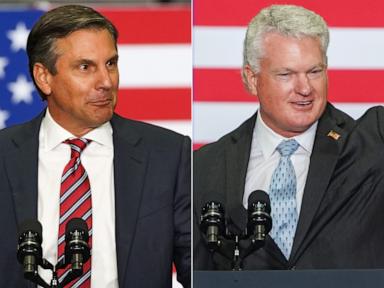
Georgia Republicans failed to secure an outright winner in Tuesday's primary, forcing a June 16 runoff between Representative Mike Collins and former college football coach Derek Dooley. This prolonged internal warfare delays a general election challenge against Democratic incumbent Senator Jon Ossoff, who sits on a massive $31 million war chest. By splitting the vote and pushing the nomination battle into a grueling summer extension, the Georgia GOP has exposed its deepest factional rifts, burning through critical resources while Ossoff remains completely unopposed.
The result is a worst-case scenario for national Republicans who viewed Georgia as their premier pickup opportunity of the cycle. Instead of launching a unified assault on a vulnerable Democratic incumbent in a state Donald Trump won two years ago, the party faces a month of expensive, scorched-earth intraparty fighting.
The Proxy War Between Trumpism and the Kemp Machine
The upcoming runoff is not merely a contest between two men. It is an ideological proxy war for the soul of the state’s conservative base.
Mike Collins represents the unyielding, online-focused wing of the modern GOP. A two-term congressman and trucking business owner, Collins has built his brand on aggressive social media rhetoric and hardline immigration policy. He authored the Laken Riley Act, the immigration enforcement bill that became a central pillar of national conservative messaging. His approach relies on turning out the ruby-red rural core of the state.
Derek Dooley represents the institutional counterweight. The son of legendary University of Georgia football coach Vince Dooley, he enters politics as a newcomer backed entirely by the formidable political apparatus of Governor Brian Kemp. When Kemp declined national party requests to challenge Ossoff himself, he handpicked Dooley to run a campaign designed to appeal to the vital moderate and independent voters in the expanding Atlanta suburbs.
The geographic breakdown of Tuesday’s vote highlights this deep regional split.
| Candidate | Core Strength | Strategy | Institutional Backing |
|---|---|---|---|
| Mike Collins | Rural Georgia, Exurban Belts | Maximum Base Mobilization | House Freedom Caucus Allies |
| Derek Dooley | Metro Atlanta Suburbs | Suburban Moderate Appeal | Governor Brian Kemp, Hardworking Americans Inc. |
Dooley performed strongly in the affluent suburban precincts of Cobb, Gwinnett, and Fulton counties—areas where Republicans have bled support during the last decade. Collins dominated the rural stretches and small towns, proving that his firebrand style retains a powerful hold over the grassroots base.
The Cost of Trump’s Silence
A major catalyst for this deadlock is Donald Trump’s calculation to remain neutral. While both candidates spent the winter and spring jockeying for his endorsement, Trump withheld his formal blessing. Without a definitive signal from the top of the ticket, primary voters fractured.
This neutrality allowed traditional fault lines to re-open. In previous cycles, a Trump endorsement could instantly clear a primary field or elevate a lagging candidate. In this race, the vacuum allowed Kemp’s leadership political action committee, Hardworking Americans Inc., to pour nearly $2 million into television advertisements and field operations to keep Dooley viable.
The strategy worked well enough to eliminate Representative Buddy Carter, a sixth-term congressman from Savannah who ran as an orthodox conservative but lacked a distinct geographic or ideological hook to break through the noise. Carter’s exit leaves his 24 percent block of voters up for grabs, setting off a frantic scramble for endorsements and alliances over the next four weeks.
Ossoff’s Substantial Structural Advantage
While Collins and Dooley prepare to spend the next month trading personal attacks, Jon Ossoff is executing a disciplined, uncontested general election campaign.
History shows that Georgia runoffs are immensely expensive and emotionally exhausting affairs. The state requires a candidate to eclipse 50 percent of the vote to win outright in the primary, a rule that historically favored institutional candidates but now frequently leads to prolonged radicalization as candidates race to the extremes to secure low-turnout runoff voters.
Ossoff’s campaign team is already utilizing the Republican gridlock to frame the general election narrative. Following the returns on Tuesday night, the Democratic operation released a sharp statement labeling both Collins and Dooley as structurally flawed candidates tied to national polarization.
The financial disparity will widen further. Ossoff raised over $14 million in the first quarter of the year alone. Every dollar the eventual Republican nominee raises between now and June 16 must be spent immediately on local television markets, digital targeting, and staff to survive the runoff. Ossoff can preserve his cash, invest in statewide voter registration infrastructure, and run positive biographical ads to define himself before his opponent even takes the field.
The High Stakes of the Summer Extension
The danger for the GOP extends beyond simple arithmetic. The primary campaign has already turned bitter. Carter spent the closing weeks of his campaign highlighting a House ethics investigation into whether Collins’s office mishandled taxpayer funds regarding a former staff member. Collins dismissed the attacks as the desperate ploys of a sinking campaign, but the blueprint for attacking his character is now public.
Dooley faces his own vulnerabilities. His rivals have repeatedly attacked his decades-long absence from the state during his coaching career and his spotty voting record, noting he failed to cast ballots in critical recent general elections. In a high-stakes general election, these details will form the core of the opposition research deployed by national Democratic groups.
The nominee must stitch together an incredibly fragile coalition to defeat Ossoff in November. They will need the absolute enthusiasm of the rural populist base that powers Collins, alongside the quiet compliance of the suburban college-educated moderates who listen to Kemp.
Historically, bruised primary losers do not always rush to help the person who defeated them. If the next four weeks devolve into personal animosity, the path to unifying the party before August becomes treacherous. Georgia is no longer a reliably red state where any nominee can coast to victory on party label alone. It is a razor-thin battleground where structural discipline, timing, and resources dictate the final outcome. Right now, those factors reside squarely on the Democratic side of the ledger.